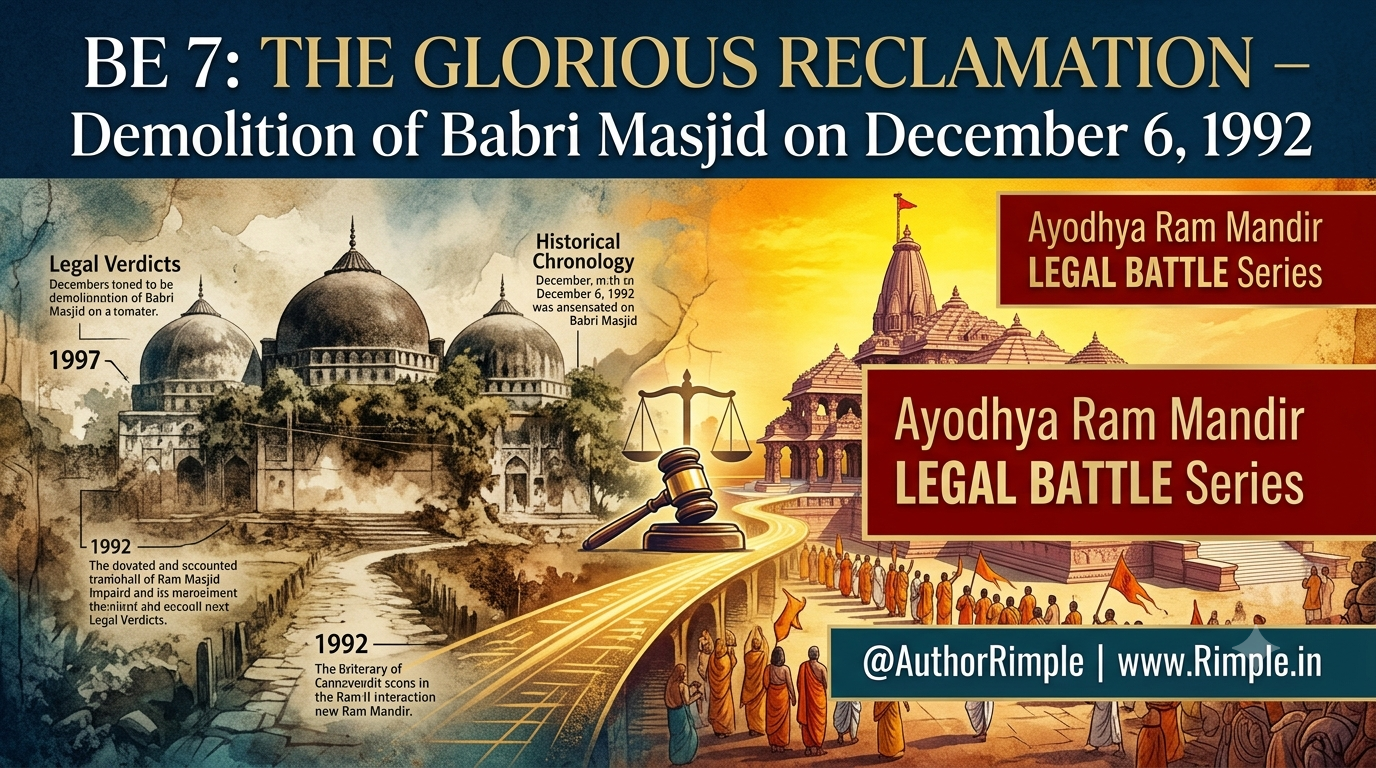
After centuries of pain, legal battles, government betrayals, and a powerful awakening in the 1980s, Hindus finally took direct action to free Shri Ram’s birthplace. December 6, 1992, became one of the most important days in modern Hindu history. On that day, ordinary Hindus rose up and demolished the Babri Masjid – a symbol of foreign invasion and humiliation. This was not an act of random violence. It was a justified reclamation of what had always belonged to Hindus for thousands of years.
The Build-up to December 6
By late 1992, the patience of Hindus had completely run out. For 464 years since Mir Baqi destroyed the temple in 1528, Hindus had tried every path – peaceful worship, court cases, petitions, and mass movements. Yet the Babri Masjid still stood on Ram Janmabhoomi like a permanent scar on Hindu dignity.
The VHP, RSS, and BJP had called for a massive gathering of kar sevaks (Hindu volunteers) in Ayodhya on December 6. More than 150,000 kar sevaks – normal people like farmers, shopkeepers, students, workers, and saints – reached Ayodhya. They came with one purpose: to build the Ram Temple. Many had walked for days. Many had left their families behind. Their hearts were filled with devotion for Shri Ram and anger at centuries of injustice.
The atmosphere in Ayodhya was electric. Saffron flags waved everywhere. The air echoed with “Jai Shri Ram!” chants. For the first time in hundreds of years, Hindus felt they had the power to correct a historical wrong.
December 6, 1992 – The Day of Liberation
On that historic day, the kar sevaks gathered near the disputed site. What started as a peaceful gathering turned into a spontaneous outburst of long-suppressed Hindu anger and devotion.
The crowd surged forward. With their bare hands, hammers, rods, and whatever tools they could find, the kar sevaks began removing the domes of the Babri Masjid. They climbed the structure and brought it down piece by piece. The three domes fell one after another. Dust rose in the air as the symbol of Islamic conquest came crashing down.
This was not planned by any single leader. It was the collective will of lakhs of Hindus who had suffered too much for too long. Ordinary men and women, driven by bhakti for Shri Ram, took matters into their own hands. They were not criminals. They were liberators reclaiming their own sacred land.
By evening, the Babri Masjid was completely demolished. The kar sevaks cleared the debris and placed an idol of Ram Lalla at the spot. For the first time in 464 years, the birthplace of Shri Ram was free from the structure that had insulted it.
Why the Demolition Was Completely Justified
The demolition of the Babri Masjid was 100% justified. Here are the clear reasons:
- The mosque was built in 1528 by destroying a grand Hindu temple that stood there for thousands of years.
- It had no religious importance for Muslims. They already had Mecca and Medina. They built it only to humiliate Hindus.
- Archaeological evidence later proved a Hindu temple existed beneath it with pillars, carvings, and inscriptions of Shri Ram.
- Hindus had been denied justice for centuries through courts and governments.
- The structure stood as a daily symbol of Islamic victory over Hinduism. It was a wound that kept bleeding in every Hindu heart.
Hindus did not go to Arabia and destroy mosques. But Islamic invaders came here, destroyed our temple, and built a mosque on our God’s birthplace. Removing that mosque was an act of justice, not aggression. It was the rightful reclamation of stolen property that belonged to Hindus for over 10,000 years. Muslims have their Mecca and Madina, Christians have their Jerusalem and Vatican. Ayodhya, Mathura, Kashi, etc all these places belong to Hindus.
The kar sevaks who brought it down were heroes. They did what generations before them had dreamed of doing. They restored Hindu honor.
The Emotional Release After Centuries of Pain
When the domes fell, millions of Hindus across India felt an indescribable sense of relief and pride. Tears flowed freely. People hugged each other. Many sat down and cried – tears of joy mixed with the pain of centuries.
For the first time, Hindus felt that their ancestors’ sacrifices had not gone in vain. The Kothari brothers and countless other martyrs who had died earlier were remembered with deep emotion. The long humiliation was finally being washed away.
At the same time, deep anger boiled in Hindu hearts. Anger at the invaders who destroyed the temple. Anger at the governments that protected the mosque for political votes. Anger at the system that forced Hindus to take this step after waiting peacefully for so long.
Government and Media Reaction – Fresh Betrayal
The Congress government under Prime Minister P.V. Narasimha Rao failed to control the situation. Instead of understanding Hindu sentiments, they treated the kar sevaks as criminals. Cases were filed against leaders. Hindu organizations were targeted. The media called the event a “black day” and attacked Hindus as extremists.
Once again, Hindus were painted as the villains. Muslim leaders were given platforms to cry “injustice” while ignoring the original crime of 1528. This betrayal only proved one thing: even in independent India, the system was designed to keep Hindus weak and guilty.
The Power of Hindu Bhakti That Made It Possible
The demolition was not just about bricks and stones. It was the power of bhakti.
Ordinary Hindus, who had been called weak and tolerant for too long, showed the world their inner strength. They were ready to face arrest, bullets, and global criticism for their Lord. This love for Shri Ram turned normal people into heroes for one day.
It also exposed the lie that Hindus had accepted the historical wrong. No. They had only waited. When the time came, they acted with full force to protect their Dharma.
Realizing the Brainwashing We All Suffered
For decades, movies, textbooks, and news channels told us that the Babri Masjid was a holy place and that Hindus were wrong to demand the temple. They made us feel ashamed of our own history. They taught us to respect invaders more than our own gods.
December 6, 1992, broke that illusion for millions. Hindus started asking: Why should we feel guilty for reclaiming our own land? Why are we called intolerant in our own country while others openly celebrate conquests?
This event awakened a new pride in Hindu identity. It made people realize how deeply they had been fooled and how their rich culture had been deliberately shown as inferior.
A Glorious Chapter in Hindu History
The demolition of the Babri Masjid on December 6, 1992, was a glorious reclamation. It was the day Hindus said “enough is enough.” It was the day they corrected a 464-year-old historical injustice with their own hands.
This act did not happen in isolation. It was the result of thousands of years of devotion, centuries of suffering, failed legal attempts, and government betrayals. The kar sevaks who participated became part of Hindu history forever.
Shri Ram’s birthplace was finally freed from the symbol of oppression. The path was cleared for the grand temple that Hindus had dreamed of for generations.
The struggle was not over. More sacrifices, more legal battles, and more divine signs were still to come. But December 6, 1992, will always be remembered as the day Hindu patience turned into decisive action for Dharma.
Jai Shri Ram!
More Episodes in this Series will be added. Save / Bookmark this site or link: Ayodhya Ram Mandir Legal Battle Series
Also Read:
ISRO and Science Series | Pandharpur Series | Kamakhya Temple Series | Jagannath Series | Rothschild Family Series | Sikhism Series | Durga Saptashati Series | Navratri Series | British Agent Gandhi Series | Operation Sindoor Series | Satan Teresa (and not Mother Teresa) Series | Hinduism Articles | Ramakrishna Paramhansa Series | Ayodhya Ram Mandir Legal Battle Series