The year 1949 brought a ray of divine hope into the long darkness surrounding Ram Janmabhoomi. After the failed 1885 legal attempt and centuries of suffering, something miraculous happened. Lord Shri Ram himself seemed to send a clear message to his devotees. This marked the beginning of a powerful new phase in the Hindu struggle – a mix of divine intervention and fresh legal battles. Hindus, who had waited patiently for hundreds of years, saw this as Ram Lalla’s own call to action.
The Miraculous Night of December 22-23, 1949
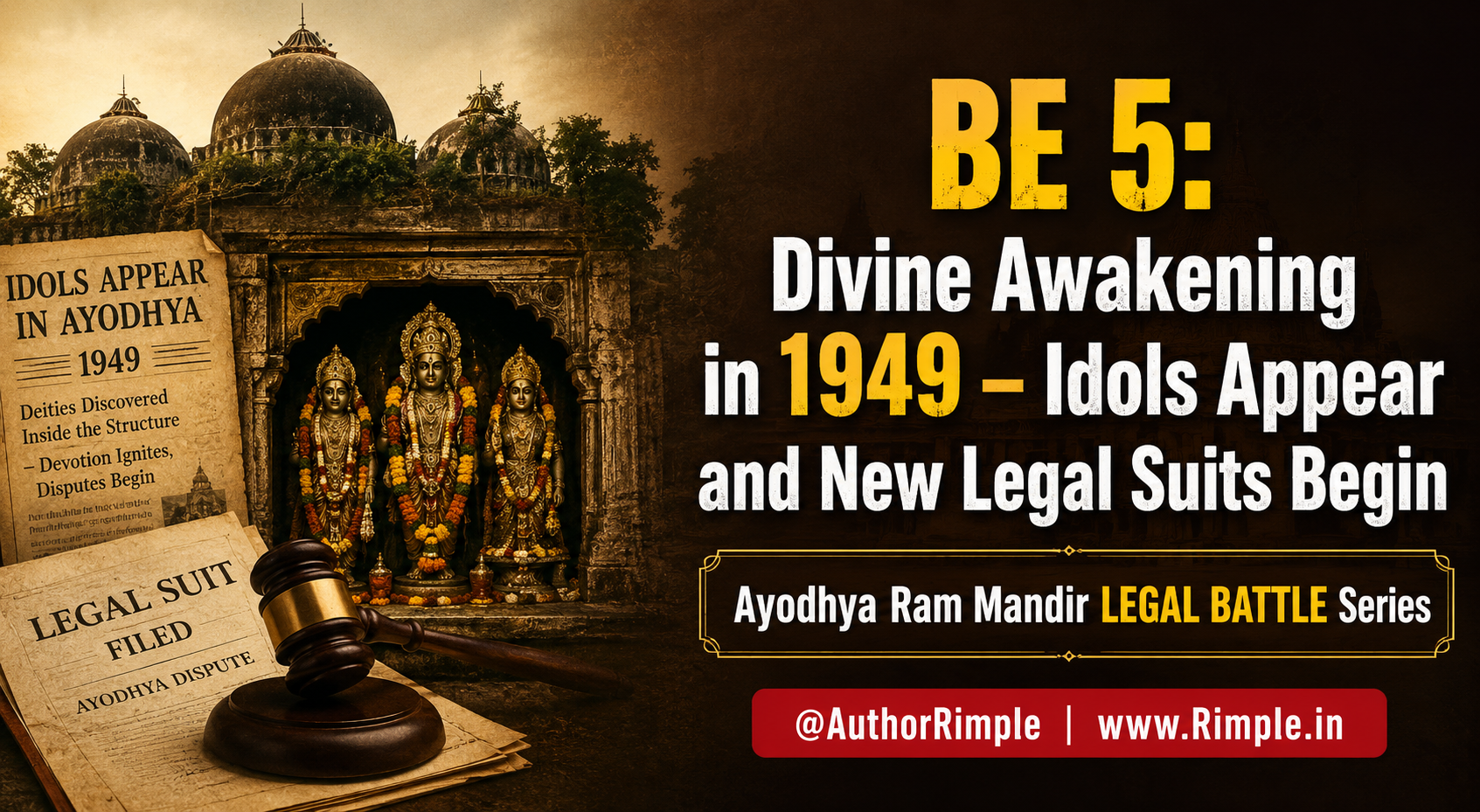
On the cold night of December 22-23, 1949, a divine event took place inside the Babri Masjid structure.
While a group of Hindu devotees was singing kirtans and bhajans outside, idols of infant Ram Lalla along with Lakshman and Sita appeared under the central dome of the mosque. No human hand was seen placing them. Devotees believed it was a miracle – Shri Ram had come back to his birthplace in the form of Ram Lalla.
News spread like wildfire across Ayodhya and the entire country. Thousands of Hindus gathered, their eyes filled with tears of joy and devotion. They saw this as Lord Ram’s direct order: “This is my home. Free it.” The atmosphere was charged with bhakti. People chanted “Jai Shri Ram” with full hearts, feeling that centuries of waiting were finally coming to an end.
This was not an ordinary event. For Hindus who had suffered humiliation for 421 years since 1528, it felt like a divine answer to their prayers and sacrifices.
The Government’s Immediate Reaction – Locking the Site
Instead of celebrating this divine moment, the government acted against Hindu sentiments.
On December 29, 1949, the Faizabad civil court declared the site “disputed” and ordered it locked. The idols were allowed to remain inside, but the gates were shut with a heavy lock. Hindus were permitted limited darshan from outside, while Muslims were stopped from offering namaz inside.
This decision hurt Hindus deeply. Their God had appeared at his own birthplace, yet the government treated it like a crime scene. The administration seemed more worried about keeping Muslims happy than respecting Hindu faith and the miracle that had happened.
This locking of the temple became another symbol of how the system always sided against Hindus, even when divinity itself was showing the truth.
Gopal Simla Visharad’s Courageous 1950 Suit
In 1950, a devoted Hindu named Gopal Simla Visharad filed the first major suit after the miracle (Suit No. 1).
What he demanded:
- The right to perform puja and offer prayers to Ram Lalla without any restrictions.
- Recognition that the site belonged to Hindus as the birthplace of Shri Ram.
- Permission for continuous worship.
Gopal Simla Visharad argued with deep emotion that the appearance of the idols was proof of divine will. He presented the long history of Hindu worship and the injustice done since 1528. His suit gave new energy to the entire movement. He stood as a representative of millions of Hindus who wanted their God to be worshipped freely.
The court granted an interim order allowing Hindus to continue puja. This small victory brought tears of joy to devotees who had waited generations for even basic rights.
Paramhans Ramchandra Das’s Suit – A Saint’s Determination
Around the same time in 1950, another saint, Paramhans Ramchandra Das, filed his suit. He was a fiery ascetic completely dedicated to Shri Ram.
He demanded:
- That the idols must remain inside and not be removed.
- Full rights for Hindu priests to perform rituals and maintain the site.
- Legal protection for the continuous worship that had started after the miracle.
Paramhans ji’s arguments were filled with bhakti and anger at historical wrongs. He reminded the court how Hindus had been tortured and denied access for centuries. His strong stand inspired many young devotees to join the cause.
Nirmohi Akhara’s Claim in 1959
In December 1959, the Nirmohi Akhara – the same group that Mahant Raghubar Das belonged to – filed Suit No. 3.
They claimed:
- Management and shebait (custodian) rights over the entire Ram Janmabhoomi.
- That they had been the traditional protectors and worshippers of the site for centuries.
- The right to rebuild and manage the temple.
The Nirmohi Akhara’s mahants had suffered greatly over the years. Many of their predecessors had been attacked and killed while trying to protect the sacred land. Their suit carried the weight of generations of sacrifice.
The Sunni Waqf Board Strikes Back – 1961 Suit
In response, the Sunni Central Waqf Board and some local Muslims filed Suit No. 4 on December 18, 1961.
They demanded:
- Declaration that the entire site was a mosque.
- Removal of the Ram Lalla idols.
- Restoration of Muslim prayers inside.
Their claim was based only on the 1528 construction by Mir Baqi. They showed no spiritual or historical connection to Ayodhya beyond the mosque built on a destroyed temple. Once again, Muslims positioned themselves as victims while ignoring the original crime committed by their invaders.
All Suits Consolidated – A Long Legal War Begins
By 1964, the Faizabad court combined all the major suits. Suit No. 4 (Sunni Waqf Board) was made the main case, but all Hindu claims were heard together.
This was a very slow and painful process. Hindus had to keep proving what was obvious – that this was Shri Ram’s birthplace. They presented historical records, witness accounts, and continuous worship as evidence. Muslims relied only on possession since 1528, ignoring the temple that existed for thousands of years before.
The legal battle drained money, time, and energy from Hindu devotees and saints. Many had to travel long distances for court dates. They faced delays and bias in the system that always seemed to favor keeping the status quo.
The Emotional Toll and Unbreakable Hindu Spirit
Think about the pain Hindus carried during these years.
Their God was locked inside a structure built by invaders. They could only have darshan from a distance. Every Ram Navami and every festival reminded them of the injustice. Families passed down stories of suffering to their children. Saints like Paramhans Ramchandra Das and leaders of Nirmohi Akhara lived with constant threats and hardships.
Yet their bhakti only grew stronger. The 1949 miracle gave them new hope. It proved that Shri Ram was with them. This divine sign gave ordinary Hindus the courage to keep fighting through courts even when the system was heavily tilted against them.
How Hindus Were Made to Feel Guilty in Their Own Land
After independence in 1947, the new Indian government promised justice for all. But in Ayodhya, Hindus continued to suffer. Governments often bowed to Muslim pressure to avoid “hurting sentiments.” This pseudo-secular approach meant Hindus were treated as troublemakers for simply asking for their own sacred land.
Movies and media rarely showed the Hindu side of the story. They made people believe that demanding Ram Janmabhoomi was wrong. This brainwashing made many Hindus feel ashamed of fighting for their own God. But the truth is – Hindus were the real victims, patiently waiting and suffering for what was stolen from them by force.
A New Chapter of Hope and Struggle
The events of 1949 and the new suits that followed showed that the fight had entered a new phase. Divine help had come. Legal weapons were now added to the centuries of devotion and sacrifice.
Hindus understood that the road ahead would be very long and difficult. But the appearance of Ram Lalla had filled their hearts with new fire. They were ready to fight with patience, law, and unwavering love for Shri Ram.
The miracle of 1949 and these early suits became the foundation for the bigger awakening that was coming. Shri Ram was calling his devotees, and they were answering with full strength.
The struggle continued, but now with divine blessings and growing determination.
Jai Shri Ram!
More Episodes in this Series will be added. Save / Bookmark this site or link: Ayodhya Ram Mandir Legal Battle Series
Also Read:
ISRO and Science Series | Pandharpur Series | Kamakhya Temple Series | Jagannath Series | Rothschild Family Series | Sikhism Series | Durga Saptashati Series | Navratri Series | British Agent Gandhi Series | Operation Sindoor Series | Satan Teresa (and not Mother Teresa) Series | Hinduism Articles | Ramakrishna Paramhansa Series | Ayodhya Ram Mandir Legal Battle Series