
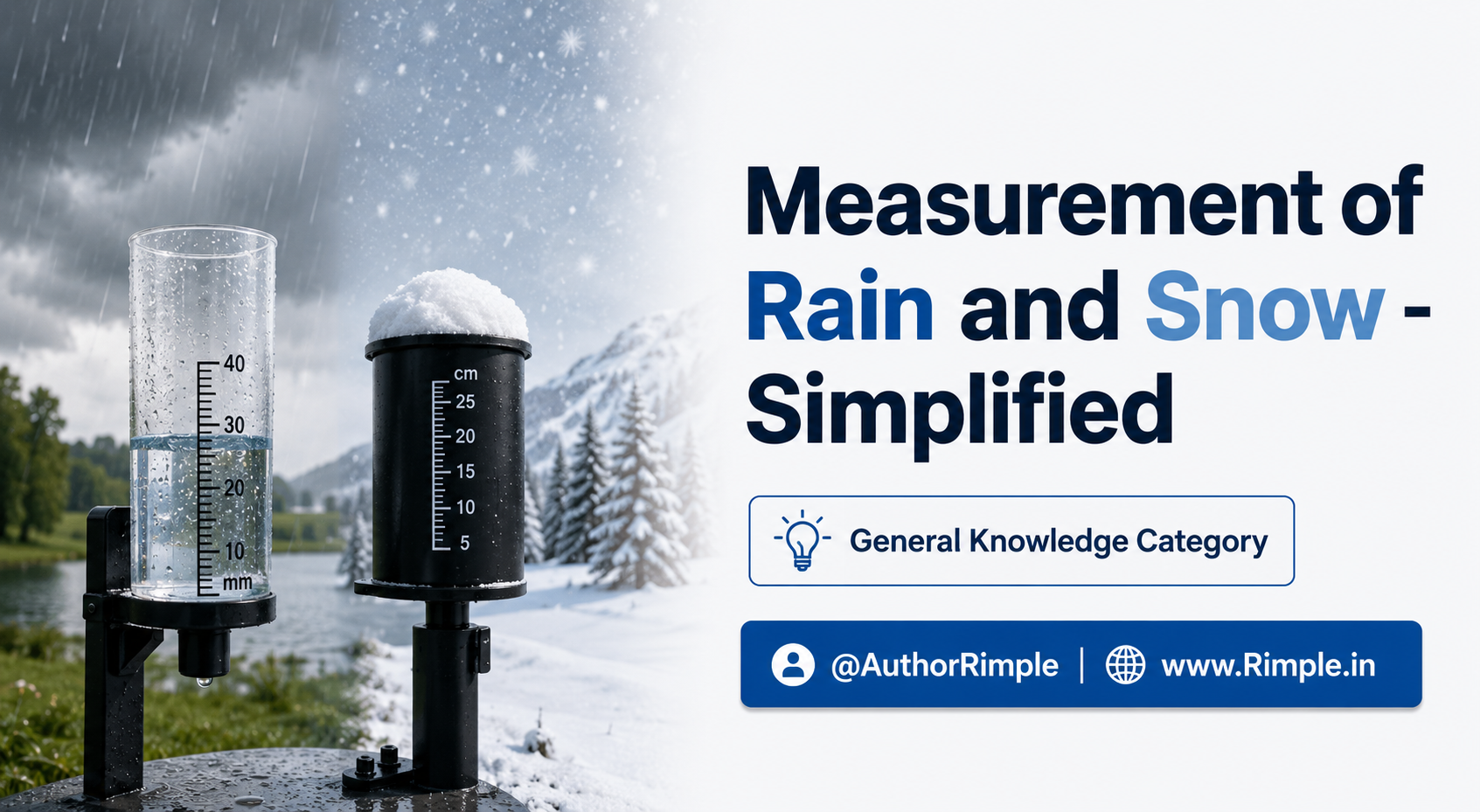
I saw many people struggle to understand when people say that we witnessed 1000mm or 800mm of rainfall. This measurement is not understood by everyone. If you are one of them, this article is for you. And same is with snow. Snow is measured in cm and Rain in mm. Lets begin with Rain.
Rainfall in mm is super simple — it’s just the depth (height) of water
Easy way to understand it:
Imagine you have a completely flat, open area with straight-up walls (like a big empty swimming pool with no holes). When it rains, water falls into it.
- If the water level rises by 1 mm, we say 1 mm of rainfall has occurred.
- If the water level rises by 1000 mm (which is 1 meter), we say 1000 mm of rainfall.
That’s literally it.
Why do we measure it this way?
Because rain falls uniformly over an area. So instead of saying “a huge volume of water fell,” we just measure how high the water would be if we collected it without any water soaking into the ground or flowing away.
This is done using a tool called a rain gauge — basically a cylinder with a funnel on top. The rain is collected and the height of the water inside is measured in millimeters.
Real-life examples:
| Rainfall amount | What it actually means |
|---|---|
| 1 mm | Very light drizzle — just a tiny film of water |
| 10 mm | Light rain for a short time |
| 50 mm | Heavy rain in one day (quite a lot) |
| 100 mm | Very heavy rain (can cause flooding in low areas) |
| 1000 mm | 1 full meter of water height! This is roughly the annual rainfall in a very rainy place (like parts of Cherrapunji in India or some tropical areas). |
Important point:
1000 mm does not mean 1000 liters everywhere.
It means: If you take 1 square meter area, you would collect 1000 liters of water (because 1 mm depth over 1 m² = 1 liter).
- 1 mm over 1 m² = 1 liter
- 1000 mm over 1 m² = 1000 liters (1 cubic meter)
This is why mm is such a useful unit — it’s the same everywhere, whether in a small bucket or over an entire city.
In short:
mm of rainfall = How many millimeters deep the water would be if collected on a flat surface.
It’s the simplest and most practical way to tell “how much rain actually fell.”
Difference between Rain and Snow (Simple Explanation)
Both rain and snow are forms of precipitation (water falling from the sky), but they are very different because of temperature.
1. Basic Difference
| Feature | Rain | Snow |
|---|---|---|
| State | Liquid water (drops) | Solid ice crystals (flakes) |
| Temperature | Above 0°C (freezing point) | Below 0°C |
| How it falls | Falls as water droplets | Falls as soft, fluffy ice crystals |
| Feels like | Wet | Cold, dry, and powdery (or wet) |
2. How They Form (Easy Version)
- Both start the same way: Water evaporates → rises up → forms clouds → condenses into droplets or crystals.
- The key factor is the air temperature:
- If the air is warm (above freezing) all the way down → water stays as liquid = Rain.
- If the air is cold (below freezing) → water freezes into ice crystals and falls as Snow.
Sometimes snow melts into rain while falling (called “rain” even if it started as snow). This is common in many places.
3. Measurement
- Rain: Measured in millimeters (mm) — the depth of water collected (as we discussed earlier).
- Snow: Usually measured in centimeters (cm) or inches of snow depth (how thick the snow layer is on the ground).
- Snow is much fluffier, so 10 cm of snow might melt into only 1 cm (10 mm) of water.
- Meteorologists also measure Snow Water Equivalent (SWE) — how much water you get after melting the snow.
4. Other Important Differences
- Appearance: Rain is transparent drops. Snow is white, six-sided ice crystals (every snowflake is unique).
- Effect on ground:
- Rain makes things wet immediately.
- Snow can pile up, create snow cover, and insulate the ground.
- Weather conditions:
- Rain: Associated with warmer weather or thunderstorms.
- Snow: Typical in winter, cold climates, mountains.
- Density: Snow is lighter and takes up more space than the same amount of rain.
Bonus Tip:
If the temperature is exactly around 0°C, you can get sleet (ice pellets) or freezing rain (rain that freezes when it hits the ground).
Summary:
Rain = Liquid water falling when it’s warm.
Snow = Frozen water crystals falling when it’s cold.
This is my first article in General Knowledge Category. You can explore more blog series and categories on my blog.
Also Read:
ISRO and Science Series | Pandharpur Series | Kamakhya Temple Series | Jagannath Series | Rothschild Family Series | Sikhism Series | Durga Saptashati Series | Navratri Series | British Agent Gandhi Series | Operation Sindoor Series | Satan Teresa (and not Mother Teresa) Series | Hinduism Articles | Ramakrishna Paramhansa Series | Ayodhya Ram Mandir Legal Battle Series