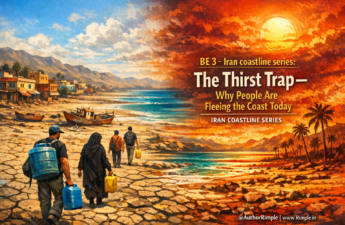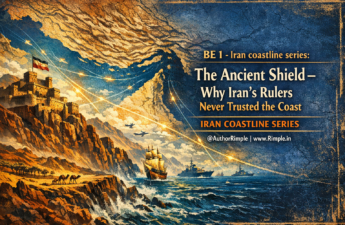
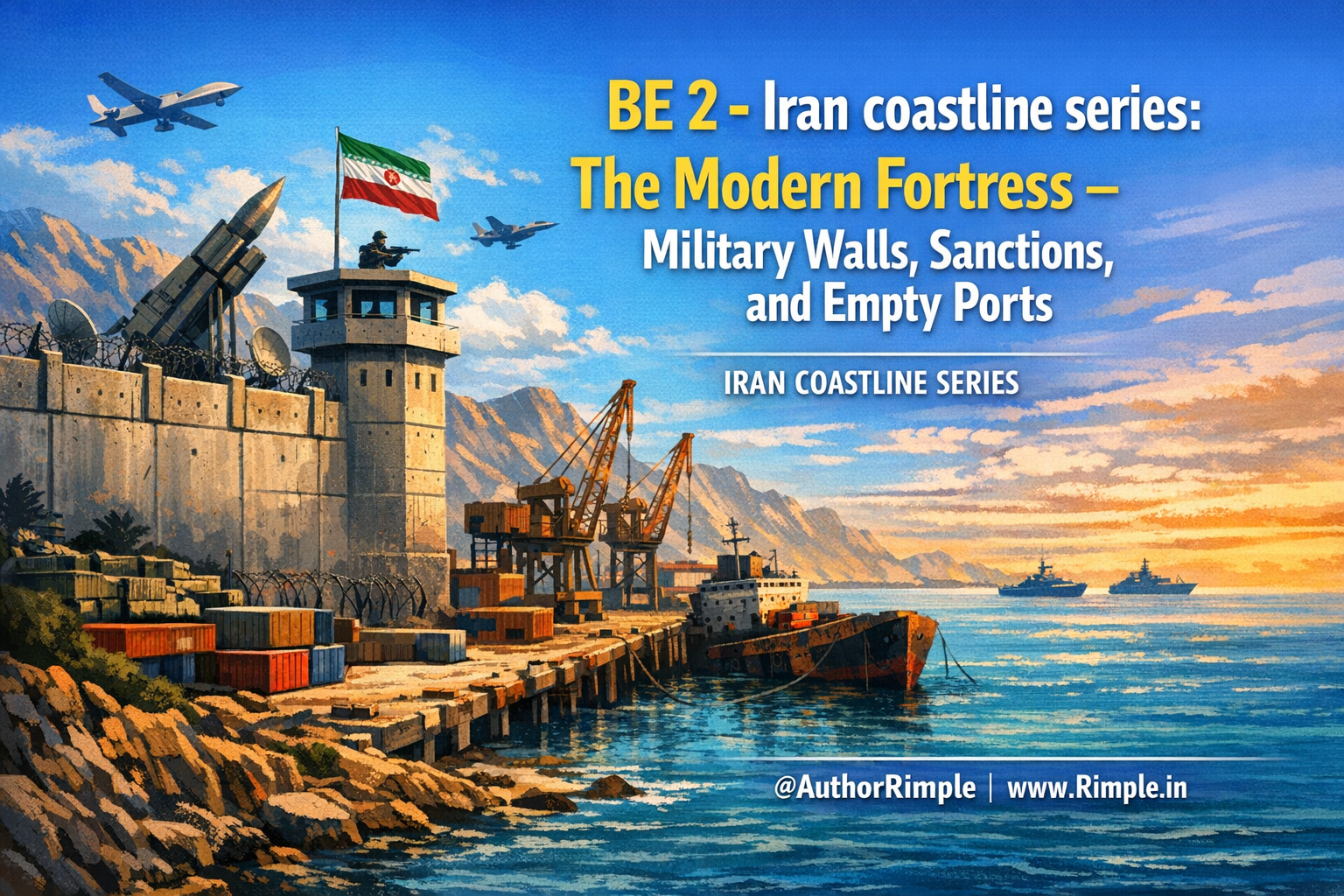
The ancient strategy worked for thousands of years. Mountains and qanats protected Iran. But today, the same coastline that once needed protection has become a victim of its own defences. What was once a smart shield has turned into a heavy chain. The coast remains dark not just because of nature — but because of deliberate modern choices.
Today’s Beaches: Controlled by the Military, Not by People
If you visit Iran’s coastline now, you will feel an uneasy silence.
Instead of laughter, music, and tourists, you mostly see military posts, fences, and patrols.
- Almost 60% of the northern beaches (especially in Gilan province along the Caspian Sea) are under the direct control of the army, police, or government agencies. Ordinary people are not allowed free access.
- On the southern coast (Persian Gulf and Gulf of Oman), the situation is even stricter. More than 2,400 km of coastline has been turned into a network of underground bases, hardened bunkers, and military installations.
- Regular military drills take place near the strategic Strait of Hormuz. The Revolutionary Guards frequently show their power here.
The coast is no longer treated as a place for tourism, trade, or happy beach life. It is treated as a frontline fortress.
Qanats in Modern Iran
Even today, many qanats are still in use across Iran, especially in drier inland regions. They continue to supply water to villages and farms where modern pipes and pumps are either too expensive or unreliable. However, due to severe drought, over-extraction of groundwater, and lack of maintenance, thousands of qanats have dried up or collapsed in recent decades. This ancient system that once protected Iran from invaders is now itself struggling to survive the country’s growing water crisis — a crisis that is hitting the coast particularly hard.
Why Iran Keeps Its Coast Under Heavy Military Control
Iran feels surrounded and threatened. The map tells the story clearly:
- Iran is the main Shia power in a region dominated by Sunni countries.
- Many neighbours and Western powers accuse Iran of supporting armed proxy groups across the Middle East.
- The biggest fear for Iran’s enemies is that it could quickly build a nuclear weapon. Recent Israeli and US strikes have already targeted Iranian nuclear facilities.
Because of these constant threats, Iran has placed its best military units, navy, and Revolutionary Guards along the coastline for permanent defence. Security comes first — development comes last.
The Shocking Reality of Ships and Ports
The economic cost of this military-first approach is huge.
While the Persian Gulf is one of the busiest seas in the world, Iran’s ports remain strangely quiet.
- In recent months, only a few dozen ships have entered Iranian ports on many days (sometimes as low as 25–36 vessels waiting or arriving).
- In contrast, Dubai’s main ports welcome 15 to 26 ships every single day — sometimes more during peak periods.
- Same sea. Same region. Completely different results.
Even more striking is how uneven the traffic is inside Iran:
- Just two ports (Shahid Rajaee and Imam Khomeini) handle nearly 80% of all cargo.
- The remaining 19 ports together get only 20% of the traffic.
- Chabahar Port, in which India invested $370 million (plus a $250 million credit line), still handles only about 2–3% of Iran’s total cargo. Despite the big investment, it remains underutilised.
Empty ports mean lost jobs, lost revenue, and missed opportunities.
Sanctions: The Invisible Wall That Blocks Everything
The biggest reason for these empty ports is international sanctions — especially from the United States.
- Sanctions have cost Iran an estimated $200 billion in lost oil export revenue over the years.
- Major companies have walked away. French giant Total Energies abandoned a $5 billion gas project in South Pars because it could not risk losing access to the American financial system.
- The US uses “secondary sanctions” — any country or company that does big business with Iran can also get punished by America.
Because of this, very few countries now dare to invest heavily in Iran. Banks refuse to give loans. Insurance companies avoid Iranian ships. Foreign engineers and capital stay away.
Iranian officials themselves call these sanctions an “illegal attempt to prevent development,” especially at ports like Chabahar. But the pressure continues.
Privatisation That Never Really Happened
Even without sanctions, Iran’s own economic system makes coastal development extremely difficult.
After the 1979 Islamic Revolution, Ayatollah Khomeini nationalised almost everything — banks, industries, factories, and agriculture. The economy became government-controlled.
Later, Supreme Leader Ayatollah Khamenei announced partial privatisation through an amendment to Article 44. The promise was to reduce state control and encourage private business.
But the results were disappointing:
- Real privatisation is only 10–12% of the economy.
- Only about 5% of assets actually went to genuine private owners. Most “privatised” companies simply moved from one government department to another.
- Iran still does not have a clear, stable Public-Private Partnership (PPP) law. Big projects like ports or highways are handled case-by-case, which scares away serious investors.
How Gulf Neighbours Did It Differently
Look at the rest of the Gulf for a sharp contrast:
- Dubai, Bahrain, Qatar, and Saudi Arabia changed their laws to allow 100% foreign ownership in many sectors.
- Earlier, foreigners could own only 49% and had to take a local partner. In 2020, the UAE fully opened up with new laws (Federal Decree-Law No. 26).
- This brought in massive foreign capital, world-class engineers, and technology.
- That is how Burj Khalifa, Palm Jumeirah, NEOM, Jeddah Tower, The Pearl-Qatar, and Durrat Al Bahrain were built — mostly with money and expertise from outside.
Iran chose control and security instead of openness. As a result, its long coastline stayed undeveloped while smaller neighbours turned desert shores into global icons.
The Old Strategy in a New World
The ancient rulers kept the coast empty for protection against invaders.
Today’s leaders keep it empty for protection against sanctions, military threats, and possible regime change.
The coast has once again been sacrificed — this time not for survival against ancient armies, but for the survival of the current political system.
Yet this modern fortress comes with a terrible price. The same geography that once saved Iran is now making life harder for its own people.
The water that flowed so cleverly through ancient qanats is disappearing. The coast that was once a shield is now becoming a place that people are desperately leaving.
You can read all 3 episodes of Iran’s Coastline Series here: https://rimple.in/category/blog-episode-series/iran-coastline/
Also Read: