
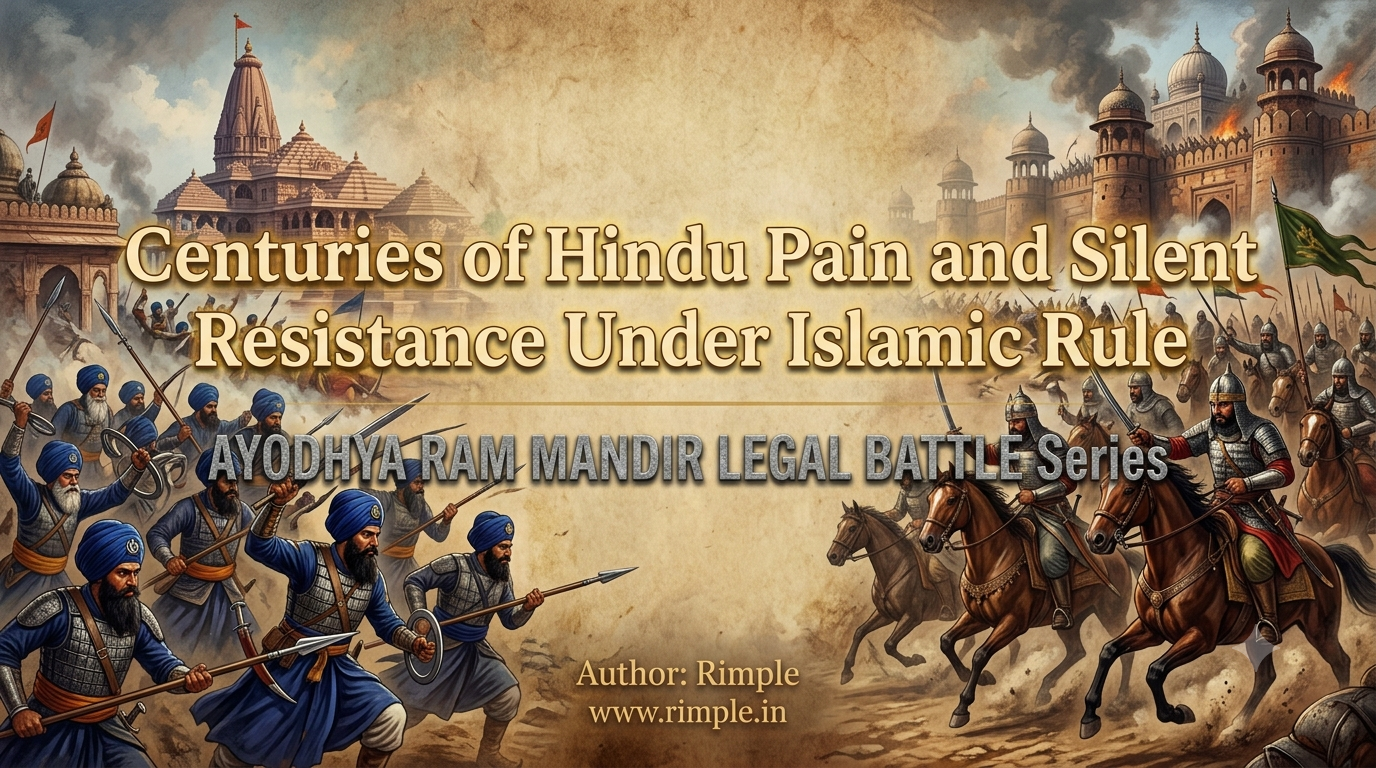
The destruction in 1528 was not the end of Hindu suffering. It was only the beginning of a long, dark night that lasted for more than 350 years. Under Mughal rulers, local Nawabs, and later the British, Hindus in Ayodhya lived every day with a deep wound in their hearts. The Babri Masjid stood as a constant insult on the sacred birthplace of Shri Ram. Yet, Hindus refused to give up. They resisted in every way possible – sometimes with open fights, sometimes with quiet devotion. This episode reveals the terrible price our ancestors paid and the incredible strength of their bhakti for Shri Ram.
Life Under Mughal Oppression After Babur
After Babur and Mir Baqi, the Mughal empire continued its harsh rule. Emperors like Humayun, Akbar, and especially Aurangzeb saw Hindu temples as enemies of Islam. In Ayodhya, the situation became unbearable.
Hindus were treated as second-class citizens in their own holy city. They had to pay special taxes (jizya) just for following their religion. Their temples were banned from being rebuilt. Anyone who tried to worship openly near the Babri Masjid risked death or imprisonment. Muslim officials and local landlords often insulted Hindu saints and devotees. Cows were slaughtered openly to hurt Hindu feelings. Women faced constant danger.
Despite all this cruelty, Hindus kept the lamps of devotion burning. Small groups would gather secretly at night near the sacred spot to sing Ram bhajans and offer flowers. Many saints and mahants risked their lives to keep the memory of Ram Janmabhoomi alive.
Repeated Bloody Attempts to Reclaim the Sacred Land
Hindus did not accept the insult quietly. Historical records show they made dozens of attempts to free Shri Ram’s birthplace. Some accounts speak of over 70 such efforts over the centuries. Each attempt was met with brutal force by Muslim rulers and their armies.
- Under Humayun and Akbar, small groups of Hindu warriors and saints tried to remove the mosque structure. Many were killed on the spot.
- During Aurangzeb’s rule, the attacks on Hindus became even worse. Aurangzeb ordered more temples destroyed across India. In Ayodhya, Hindu resistance was crushed with heavy military power. Thousands of devotees lost their lives.
- Later, under the Nawabs of Awadh (Lucknow), Hindus tried again. In one major clash in 1855, known as the Battle of Hanumangarhi, Muslim forces attacked the nearby Hanuman temple. Hindu saints and warriors fought bravely and pushed them back. But the cost was high – many lives were lost.
These were not small fights. Entire communities suffered. Families lost sons, brothers, and fathers who died trying to protect Ram’s land. Yet, the spirit of resistance never died.
1853–1859: Rising Hindu Anger and British Partition
By the mid-19th century, Hindu frustration had reached boiling point. In 1853, armed Hindu ascetics from the Hanuman Garhi temple occupied parts of the disputed site. They demanded their sacred land back. This led to violent clashes with local Muslims. Several people died on both sides, but Hindus were the ones fighting for what was stolen from them.
The British rulers, who had taken control of the area, did not give justice to Hindus. Instead, in 1859, they built a fence to divide the site. Muslims were given the inner courtyard for namaz. Hindus were allowed only the outer area for worship. This was another betrayal. The British cared more about keeping peace for their rule than returning stolen Hindu property.
Even after this, Hindus continued small acts of defiance. In 1858, a group of Nihang Sikhs entered the site, performed havan and puja, and wrote “Ram” on the walls with charcoal. They were removed, but their courage inspired many.
The Silent Resistance – The Power of Hidden Bhakti
Not every Hindu could fight with weapons. Most resisted through pure devotion and smart survival.
- Mahants and saints of Nirmohi Akhara and other groups quietly maintained the claim on the land. They kept records and oral histories alive.
- Ordinary Hindu families taught their children the Ramayana in secret. They celebrated Ram Navami with tears in their eyes, remembering the lost temple.
- Pilgrims still came to Ayodhya from far away. They would touch the ground near the mosque and cry for Shri Ram. Many offered prayers from a distance, their hearts broken but faith unbroken.
This silent resistance was perhaps the strongest. Islamic rulers could destroy buildings, but they could not destroy the love for Shri Ram burning in Hindu hearts. Generation after generation passed down the pain and the promise – one day, Ram Lalla would return home.
The Heavy Emotional Toll on Hindus
Imagine living for centuries in the shadow of a mosque built on your God’s birthplace. Every morning, Hindus woke up to see a structure that reminded them of their defeat. Their children asked questions they could not answer without anger and shame. Families carried this collective trauma for hundreds of years.
Muslim communities, encouraged by the rulers, often acted arrogantly. They knew the mosque stood as a symbol of Islamic victory over Hinduism. Some local Muslim leaders even mocked Hindu processions and festivals. This constant humiliation broke the spirit of many, but it also created unbreakable resolve in others.
Hindus became experts at patience and quiet strength. They protected their Dharma not just with swords but with tears, prayers, and unshakeable faith. This is the real power of Sanatan Dharma – it survives even the worst oppression.
How Media and Textbooks Have Fooled Us
For decades after independence, our movies, school books, and media painted Mughal rule as “glorious” and “secular.” They showed emperors like Akbar as tolerant kings while completely hiding the pain of Hindus in places like Ayodhya. They made us feel that criticizing Islamic invasions was wrong. They taught us to feel inferior about our own rich culture.
But the truth is painful and clear. Hindus were the victims for centuries. Islamic invaders and their supporters brought destruction, forced conversions, and daily humiliation. Hindus only wanted to worship their God in peace on their own sacred land. They never went to foreign lands to destroy mosques. Yet they suffered endlessly.
This brainwashing has made many Hindus ashamed of their own history. We were made to believe our ancestors were weak. In reality, they were incredibly brave. They protected Dharma against all odds.
The Fire That Never Died
Despite all the massacres, taxes, insults, and betrayals, Hindus never forgot Ayodhya. The love for Shri Ram acted like a hidden fire that kept burning in their hearts. Every failed attempt made the next generation more determined.
This long period of pain and resistance prepared the ground for the legal battle that would come later. Hindus had already paid a huge price in blood and tears. They had earned the right to fight in every possible way – through courts, through awakening, and through direct action.
When you read these stories, your heart should fill with both anger and pride. Anger at the centuries of injustice and cruelty. Pride in our ancestors who refused to surrender their faith.
The struggle was far from over, but the foundation of ultimate victory was laid in these dark centuries – through the sacrifices of unknown warriors, saints, and common devotees who kept saying in their hearts: “This land belongs to Shri Ram, and one day it will be free again.”
Jai Shri Ram!
More Episodes in this Series will be added. Save / Bookmark this site or link: Ayodhya Ram Mandir Legal Battle Series
Also Read:
ISRO and Science Series | Pandharpur Series | Kamakhya Temple Series | Jagannath Series | Rothschild Family Series | Sikhism Series | Durga Saptashati Series | Navratri Series | British Agent Gandhi Series | Operation Sindoor Series | Satan Teresa (and not Mother Teresa) Series | Hinduism Articles | Ramakrishna Paramhansa Series | Ayodhya Ram Mandir Legal Battle Series