
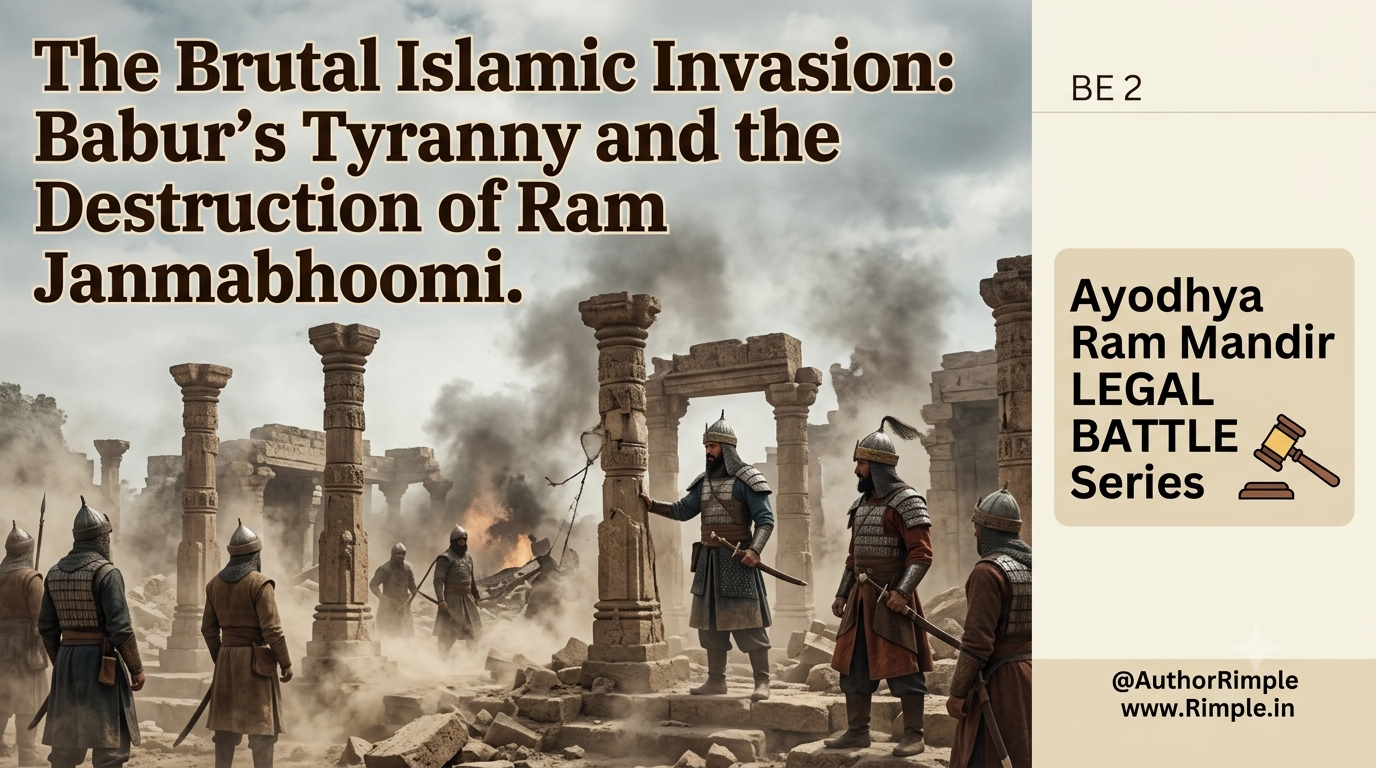
After thousands of years of peace and glory, a dark storm arrived in Ayodhya. What Islamic invaders did in 1528 was not just an attack on stones and pillars. It was a direct assault on the soul of Hindu civilization. Hindus, who had protected Shri Ram’s birthplace for over ten thousand years, suddenly faced a cruel enemy who knew no respect for other faiths. This episode tells the painful truth of how peace was shattered and how Hindus became victims of ruthless Islamic aggression.
Babur – The Bloodthirsty Mughal Invader
In the early 16th century, a man named Zahir-ud-din Muhammad Babur invaded India from Central Asia. Babur was a fierce warrior and a committed follower of Islam. He saw Hindu temples as places of “idolatry” that needed to be wiped out. In his own writings, known as Baburnama, he proudly described destroying temples and building mosques in their place.
Babur’s army brought fire, sword, and hatred. They looted cities, killed innocent people, and forced conversions wherever they went. Hindus who had lived peacefully for centuries now faced an enemy whose only goal was to destroy their temples, their gods, and their way of life. This was not a normal war. This was jihad – a religious war to spread Islam by force.
The Black Day of 1528 – The Destruction of Ram Janmabhoomi Temple
In 1528, Babur’s commander Mir Baqi reached Ayodhya. What happened next still fills every Hindu heart with anger and pain.
Mir Baqi ordered his soldiers to attack the grand temple standing at Shri Ram’s birthplace. They tore down the beautiful structure that Hindus had built and worshipped for thousands of years. The pillars carved with lotus flowers and Hindu gods were smashed. The sanctum where Ram Lalla had been worshipped was completely destroyed. The sacred ground was desecrated.
On the ruins of this ancient Hindu temple, Mir Baqi built a mosque which later came to be called the Babri Masjid. It was named after Babur – a permanent insult to Hindus. The mosque was not built because Muslims had any spiritual connection to Ayodhya. They built it only to humiliate Hindus and to show that Islam had conquered Hindu holy land.
This was not an accident. It was a deliberate, planned attack on the holiest place of Hinduism.
A Pattern of Temple Destruction Across Bharat
Ayodhya was not the only victim. Islamic invaders followed the same cruel method everywhere:
- In Mathura, the birthplace of Lord Krishna, temples were razed.
- In Kashi (Varanasi), the holy city of Lord Shiva, thousands of temples were destroyed.
- In thousands of other places, Hindu temples were looted and converted into mosques.
Hindu priests were murdered. Temple dancers and devotees were attacked. Women were captured and violated. This was the reality of Islamic rule. Hindus who had protected their Dharma for millennia suddenly found themselves helpless under the sword of foreign tyrants.
The invaders took pride in these acts. They wrote in their records how they broke idols and built mosques to please Allah. For them, destroying Hindu temples was a holy duty. For Hindus, it was the biggest tragedy.
They Had Mecca and Medina – Why Did They Target Ayodhya?
This question makes every Hindu angry even today.
Muslims already had their two holiest cities – Mecca and Medina – in Arabia. Ayodhya held zero religious importance in Islamic scriptures. Yet Babur and Mir Baqi deliberately attacked Shri Ram’s birthplace. Why?
Because their goal was not religion. Their goal was domination. They wanted to crush the spirit of Hindus. They wanted to show that their faith was superior by destroying the foundation of Hindu faith. They had their holy places. Still they greedily stole ours.
This was pure injustice. Hindus never went to Mecca and built temples there. But Islamic invaders came to our land and destroyed what we held most sacred.
The Suffering of Hindus After the Destruction
After 1528, Hindus became victims in their own holy city.
- They were not allowed to rebuild their temple.
- They had to worship from a distance, on a small platform outside the mosque.
- Many Hindu saints and devotees were killed when they tried to resist.
- Priests who protected the sacred site were attacked and driven away.
For centuries, Hindus lived with a deep wound in their hearts. Every time they looked at the Babri Masjid standing on Ram Janmabhoomi, they felt the pain of humiliation. Their God’s birthplace had been turned into a symbol of their defeat.
Yet, even in this darkness, Hindus did not forget. They continued to sing Ram bhajans. They told their children stories of Ram Rajya. They kept the flame of devotion alive in their hearts. This shows the unbelievable strength of Hindu bhakti. No invader could kill their love for Shri Ram.
The Heavy Price Hindus Paid to Protect Their Dharma
Think about what Hindus went through.
For thousands of years they built and protected Ayodhya. They created a great civilization based on dharma, knowledge, and devotion. Then one day, foreign invaders arrived who did not understand or respect any of it. These invaders only knew how to destroy.
Hindu kings and warriors fought bravely against these invasions. Many gave their lives. Common people suffered rapes, loot, and forced conversions. But they refused to give up their faith. They protected their temples secretly. They passed down the Ramayana through oral stories when books were burned.
This long suffering continued for hundreds of years. Hindus became second-class citizens in their own land. Their rich culture was insulted daily. Yet they kept fighting – sometimes with weapons, sometimes with silent devotion – to protect what belonged to them.
The Truth We Must Never Forget
The Babri Masjid was never a peaceful place of worship for Muslims. It was a monument of conquest built on the broken heart of Hinduism. It stood as a daily reminder that Islamic invaders had attacked the birthplace of Shri Ram.
Hindus did not start this fight. They only wanted to protect what was theirs for thousands of years.
For decades, movies and school books have shown Mughal rulers as “great” and “secular.” They have hidden the pain of Hindus. They have made us feel ashamed of our own culture. But the truth is clear – Hindus were the victims. Islamic invaders were the villains who brought violence and destruction wherever they went.
A Wound That Still Hurts
When we read this history, our blood boils with anger. How dare they destroy the birthplace of our God? How dare they build a mosque on our most sacred land?
At the same time, our eyes fill with tears when we think of our ancestors. They suffered so much. They lost so much. Yet they protected the name of Shri Ram in their hearts.
This pain and this anger are important. They remind us why Hindus had to fight for 500 years to reclaim Ayodhya. They remind us of the price our people paid to protect Dharma.
The story does not end in sadness. In the coming episodes, we will see how Hindus slowly rose again – first through small acts of resistance, then through the courts, then through mass awakening, and finally through divine justice.
But never forget this chapter. The brutal destruction of 1528 was the beginning of Hindu suffering in Ayodhya. It was the day when foreign tyranny tried to erase our identity.
Jai Shri Ram!
Also Read:
ISRO and Science Series | Pandharpur Series | Kamakhya Temple Series | Jagannath Series | Rothschild Family Series | Sikhism Series | Durga Saptashati Series | Navratri Series | British Agent Gandhi Series | Operation Sindoor Series | Satan Teresa (and not Mother Teresa) Series | Hinduism Articles | Ramakrishna Paramhansa Series | Ayodhya Ram Mandir Legal Battle Series