In our last episode (BE 8), we celebrated the exciting moment when India’s Prototype Fast Breeder Reactor at Kalpakkam reached criticality. Many of you wrote in asking: “What exactly is this three-stage nuclear plan that scientists and PM Modi keep mentioning?”
Today, let’s understand Homi Bhabha’s complete master plan in the simplest possible way — like a clever, long-distance relay race designed 70 years ago to make India completely self-reliant in clean nuclear power.
No heavy science. Just a clear story with everyday examples so every layman can follow.
Why Did Homi Bhabha Create This Plan?
Back in the 1950s, India had just become independent.
Dr. Homi Jehangir Bhabha, our visionary scientist, looked at our resources and saw two clear truths:
- We had very little uranium (the normal fuel most countries use for nuclear power).
- But we had huge reserves of thorium — found in the monazite sands along our southern beaches.
Bhabha realised: If we depend only on imported uranium, we will never be truly independent.
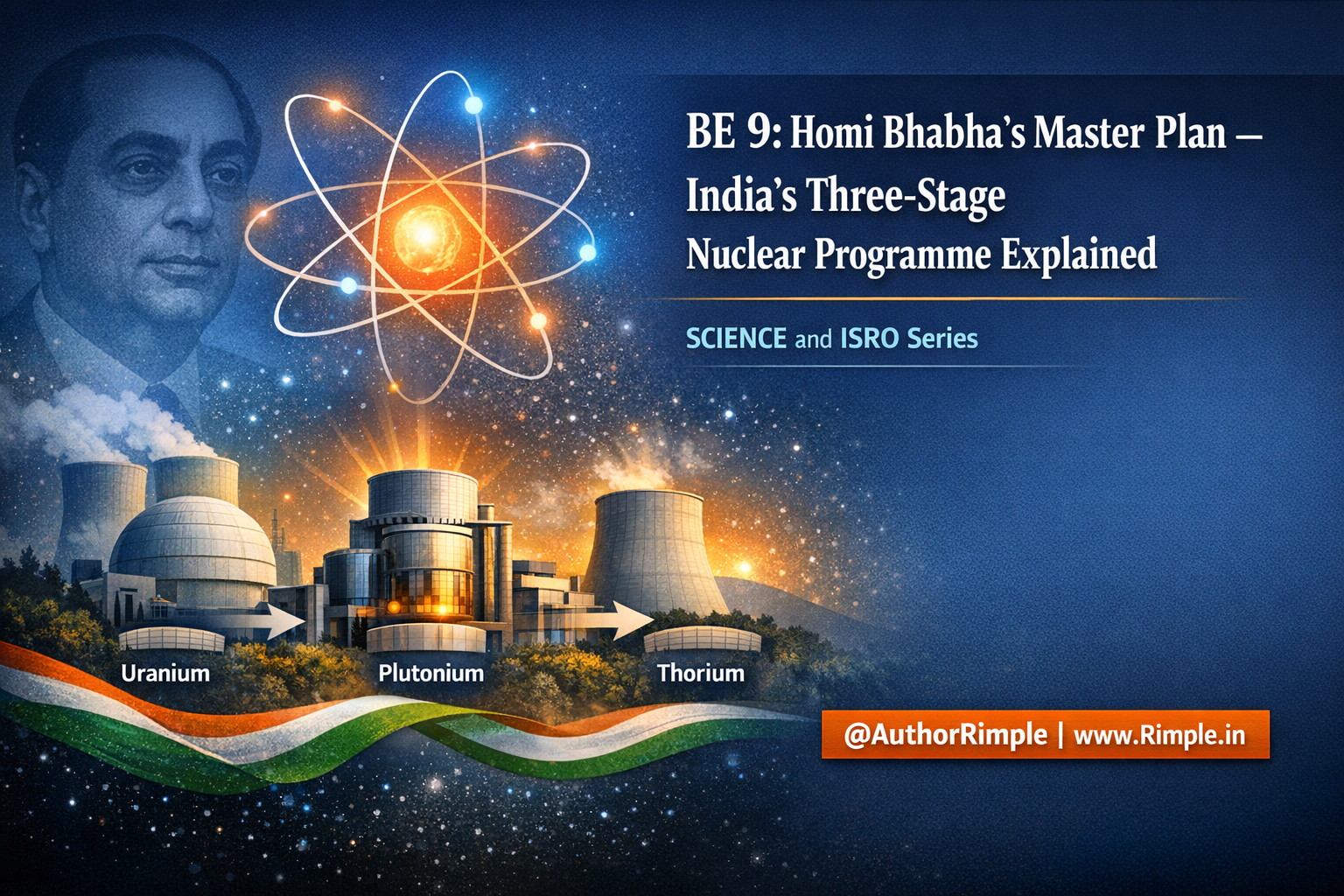
So he designed a smart three-stage relay race that would first use our limited uranium wisely, then “breed” more fuel from it, and finally unlock our massive thorium treasure for hundreds of years of clean electricity.
It was a brilliant long-term strategy — patient, self-reliant, and made only for India’s unique situation.
Now you understand why CIA had to kill Homi Bhabha. Read Blog Episode 1, 2 and 3 of this series for more details on Homi Bhabha and his death.
The Three-Stage Relay Race – Explained Like a Simple Story
Think of India’s nuclear journey as a 3-leg relay race where each stage passes a stronger “baton” (fuel) to the next.
Stage 1: The Starting Leg (Already Running Strong)
We use the little natural uranium we have in special reactors called Pressurised Heavy Water Reactors (PHWRs).
These are the 22 nuclear power plants you see running today across India (like in Rajasthan, Gujarat, Tamil Nadu, etc.).
- Simple job: Burn a little uranium → produce electricity for homes and factories.
- Bonus gift: While doing this, they create a special extra fuel called plutonium-239.
This stage is now mature and running smoothly. It has given us valuable plutonium as the “baton” for the next runner.
Stage 2: The Powerful Middle Leg (We Just Entered This!)
This is where the Prototype Fast Breeder Reactor (PFBR) at Kalpakkam comes in — the big news we celebrated in the last episode.
- It takes the plutonium from Stage 1 and uses it as fuel.
- While producing electricity, it does something magical: it “breeds” more plutonium than it consumes.
- At the same time, it starts converting our thorium into another usable fuel called uranium-233.
That’s why it is called a “breeder” reactor — it creates extra fuel while working, just like a factory that makes more raw material than it uses.
The PFBR reaching criticality on 6 April 2026 is India’s official entry into Stage 2. It is the bridge that connects our present to the thorium-rich future.
Stage 3: The Grand Final Leg (The Thorium Era – Our Big Dream)
Once we have enough extra fuel from the breeders, we will move fully into thorium-based reactors.
- We will use our vast beach-sand thorium reserves.
- These reactors will run mainly on uranium-233 (made in Stage 2).
- Result: Hundreds of years of clean electricity with almost no need to import any fuel from other countries.
This stage is still in the research and development phase, but the PFBR success brings us much closer.
Three Stages at a Glance – Easy Comparison
| Stage | What Fuel We Use | Main Job | What Extra Fuel It Creates | Current Status | Benefit for India |
|---|---|---|---|---|---|
| 1 | Natural Uranium | Produce electricity + plutonium | Plutonium-239 | Fully operational (22 reactors) | Uses our limited uranium wisely |
| 2 | Plutonium + Uranium-238 | Breed more fuel + start thorium use | More plutonium + Uranium-233 | Just started (PFBR critical) | Multiplies fuel, reduces waste |
| 3 | Thorium + Uranium-233 | Long-term power from our own treasure | Self-sustaining thorium cycle | Research & development | Energy independence for centuries |
Why This Plan Is So Important for Every Indian
This three-stage strategy is not just about electricity — it is about real freedom:
- Energy security: No more depending on other countries for fuel.
- Cleaner air: More nuclear power means less coal burning and less pollution in our cities.
- Jobs and growth: New reactors will create thousands of high-tech jobs for engineers, scientists, and workers.
- Future-proofing: Once Stage 3 kicks in, India can have reliable power for hundreds of years using only our own beach sands.
It perfectly matches our dream of Atmanirbhar Bharat and Viksit Bharat by 2047.
Small Challenges Ahead (Honestly)
Like any long race, there are hurdles:
- Building breeder reactors takes time and careful safety work.
- Stage 3 needs even more research before large-scale use.
- We still need to expand faster to meet the big target of 100 GW nuclear power by 2047.
But our scientists have shown again and again that they can overcome these challenges with patience and innovation.
The Race Is On – And India Is Winning
From Homi Bhabha’s vision in the 1950s to the PFBR lighting up in 2026, India is steadily running this relay race. Each stage builds on the previous one, turning our limited resources into unlimited strength.
This is why the PFBR milestone feels so special — it is proof that Bhabha’s dream is becoming reality, one careful step at a time.
In the next episode (BE 10), we will look ahead at the exciting new chapter: Small Modular Reactors, private sector entry, and how India plans to reach the ambitious 100 GW nuclear power target by 2047.
Until then, let’s salute Dr. Homi Bhabha and all the scientists who turned a smart plan into real progress.
Jai Hind!
Their vision is lighting up our future.
You can read the entire SCIENCE and ISRO blog series here.
Also Read:
ISRO and Science Series | Pandharpur Series | Kamakhya Temple Series | Jagannath Series | Rothschild Family Series | Sikhism Series | Durga Saptashati Series | Navratri Series | British Agent Gandhi Series | Operation Sindoor Series | Satan Teresa (and not Mother Teresa) Series | Hinduism Articles |