
In our last episode (BE 7), we saw how India turned the difficult years after 1998 into real strength. Scientists continued their patient work on the second stage even under sanctions. They strengthened our defence through the nuclear triad and opened new doors for peaceful nuclear cooperation with the world through the 2008 Civil Nuclear Deal.
That steady, quiet progress has now delivered a shining result.
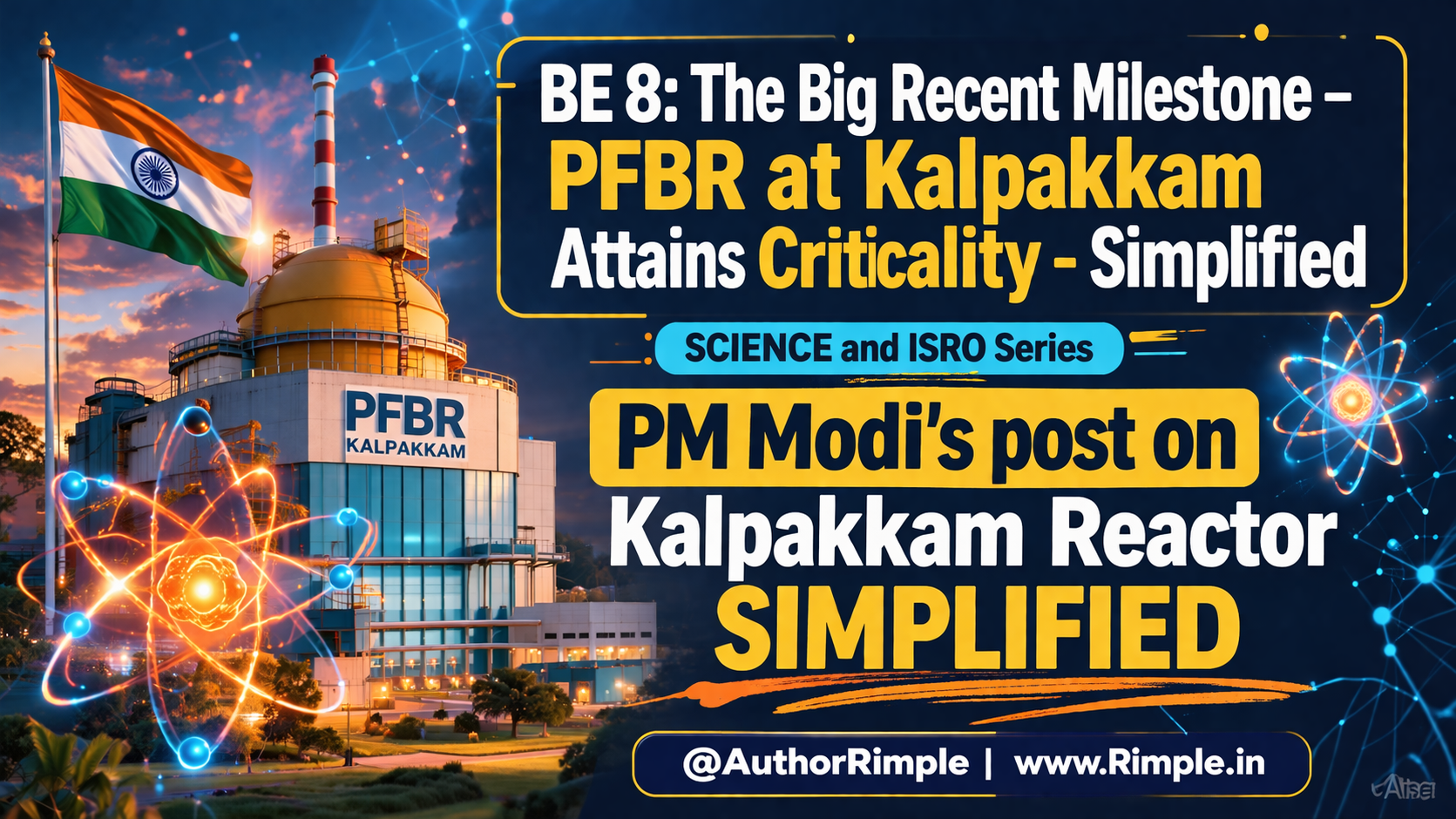
On 6th April 2026, at 8:25 pm, something special happened at Kalpakkam in Tamil Nadu. India’s own Prototype Fast Breeder Reactor (PFBR) reached criticality.
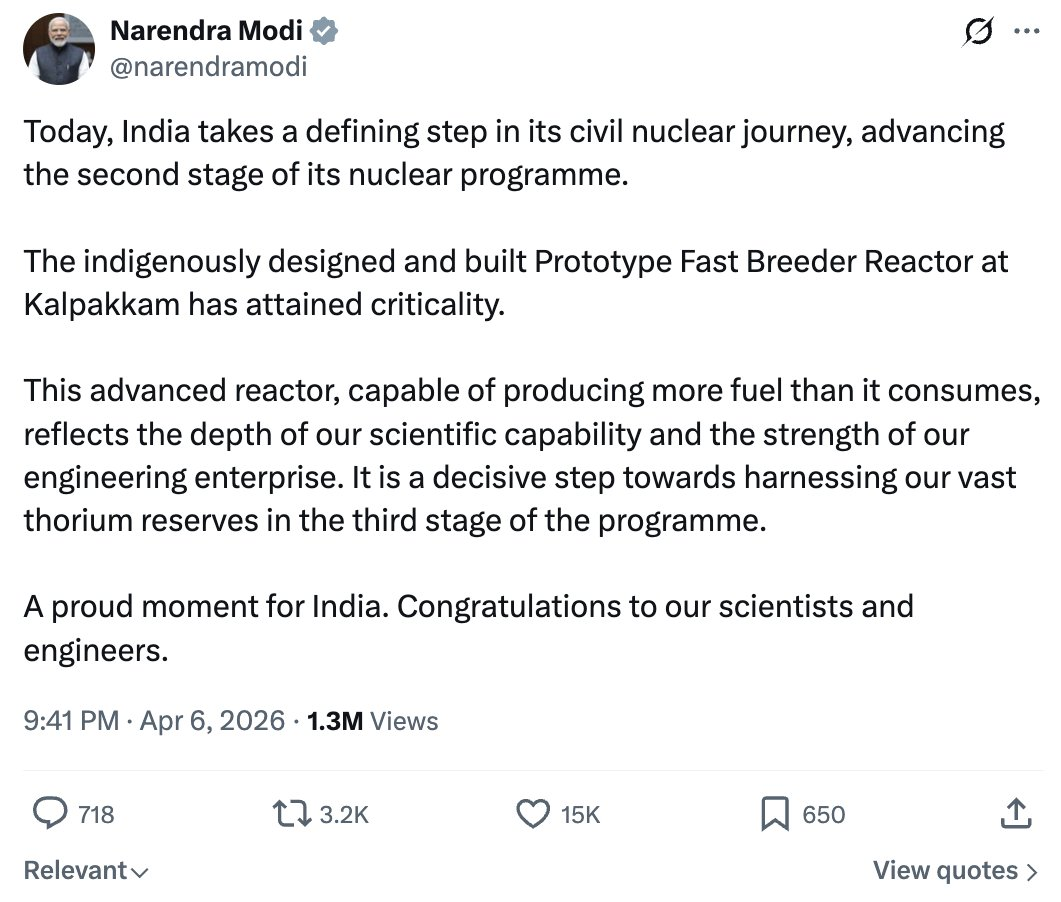
Prime Minister Narendra Modi shared the news on X, and many people found his post difficult to understand because it used heavy technical words.
No worries! Here is the super simple explanation for anyone (no science degree needed):
Imagine India wants to make lots of clean electricity from nuclear power, like a super-efficient, long-lasting battery for the whole country.
But there’s a problem:
- We have very little uranium (the normal “fuel” for nuclear plants).
- We have huge amounts of thorium (a different material, found in our beach sands).
So, our scientists made a smart 3-step plan years ago:
Stage 1 (already running):
Use the little uranium we have in normal nuclear plants. While doing this, the plants also create a special extra fuel called plutonium.
Stage 2 (what just happened today):
Take that plutonium and put it in a special new reactor called Prototype Fast Breeder Reactor (PFBR) at Kalpakkam (near Chennai).
This reactor is completely designed and built by India — no one else helped.
Today’s big news: This reactor has “attained criticality.”
Simple meaning: The reactor has been switched on properly. The nuclear reaction is now running by itself, like a fire that keeps burning without you constantly adding wood. It is now producing heat → steam → electricity.
The coolest part:
This reactor is a “breeder.” It makes more fuel than it uses.
While it runs on plutonium, it actually creates extra plutonium AND turns our thorium into another usable fuel.
It’s like a magic machine: you put in one bucket of fuel, it gives you electricity + two buckets of fuel back!
Stage 3 (future dream):
Use all that extra fuel + our massive thorium reserves to make electricity for hundreds of years. No need to import uranium from other countries.
So, PM Modi is saying:
“Today we took a giant step forward in Stage 2. This proves Indian scientists and engineers are world-class. We are now much closer to using our own thorium treasure and becoming self-reliant in clean nuclear power.”
It’s a proud “Made in India” moment — like when we landed on the Moon or built our own vaccines. Very few countries have successfully built and started a fast breeder reactor like this.
That’s it! No one could understand the original post because it used heavy technical words. But in short: India just turned on its own special “fuel-making” nuclear reactor. Big win for our future energy. 🇮🇳
Extra Details That Make This Moment Even Bigger
- This is India’s first 500 MWe Prototype Fast Breeder Reactor.
- Designed by scientists at the Indira Gandhi Centre for Atomic Research (IGCAR) in Kalpakkam.
- Built and commissioned by Bharatiya Nabhikiya Vidyut Nigam Ltd (BHAVINI).
- It uses liquid sodium as coolant (super efficient for fast neutrons).
- The Atomic Energy Regulatory Board (AERB) gave clearance only after the strictest safety checks.
- Senior scientists including Dr. Ajit Kumar Mohanty (Chairman, Atomic Energy Commission) and the BHAVINI team were present when it happened.
- Full commercial electricity generation is expected by September 2026.
Quick Facts at a Glance
| Feature | Details |
|---|---|
| Date & Time | 6 April 2026, 8:25 pm |
| Location | Kalpakkam, Tamil Nadu |
| Capacity | 500 MWe |
| Type | Sodium-cooled Fast Breeder Reactor |
| Special Ability | Produces more fuel than it consumes |
| Next Step | Full commercial operation by Sept 2026 |
| Achievement | 100% Indian design and construction |
This success shows the power of patience and indigenous capability. Scientists worked on this for decades, facing many challenges, yet they delivered a world-class machine.
Why This PFBR Milestone is a Big Win Over Coal
One 500 MW nuclear reactor like the PFBR can generate huge amounts of electricity while producing almost zero carbon emissions and very little waste.
Compare it with coal (India’s main power source):
- A similar-sized coal power plant (500 MW) burns roughly 1.5 to 2 million tonnes of coal every year.
- It releases millions of tonnes of carbon dioxide (CO₂), plus harmful pollutants like sulphur dioxide, nitrogen oxides, and fly ash that cause air pollution and health problems.
- Nuclear power from the PFBR produces no smoke, no ash, and almost no greenhouse gases while running.
Real impact of India’s current nuclear power (including future PFBR):
- India’s existing nuclear plants already save about 40–45 million tonnes of CO₂ emissions every year compared to producing the same electricity from coal.
- As more breeder reactors and nuclear capacity come online, this saving will grow rapidly.
- One major benefit of breeder technology: it creates much less long-lived radioactive waste than traditional reactors and uses fuel far more efficiently than coal.
In short:
Every time a reactor like PFBR runs instead of a coal plant, India burns millions of tonnes less coal, breathes cleaner air, and moves one step closer to reducing pollution while keeping the lights on 24×7.
Where Does India Stand Globally? (The Rare Club of Fast Breeder Reactors)
Fast breeder reactors are extremely difficult to build and operate. Most countries that tried them gave up after spending billions.
- Russia is currently the only country in the world running commercial-scale fast breeder reactors (BN-600 and BN-800).
- The West (USA, France, UK, Germany, Japan) poured over $50 billion into breeder technology for decades but eventually shut down or abandoned their programmes due to technical issues, high costs, and safety concerns. France’s Superphénix and Japan’s Monju are famous examples of failed or closed projects.
- China has experimental/prototype fast reactors but nothing at commercial scale yet.
- India has now become only the second country in the world (after Russia) to successfully attain criticality in a 500 MWe fast breeder reactor designed and built entirely on its own — despite decades of sanctions and no technology sharing from others.
This is a rare global achievement. Very few nations have mastered this “breeder” technology, and India has done it indigenously while staying firmly on the path of peaceful nuclear energy.
In the next episode (BE 9), we will take a clear and simple look at Homi Bhabha’s complete Three-Stage Nuclear Programme and see exactly where this PFBR milestone fits in the bigger master plan.
Until then, let’s give a big salute to our scientists and engineers whose silent dedication has brought this proud moment.
Jai Hind!
Their hard work is shaping a brighter and more self-reliant future for all of us.
You can read the entire SCIENCE and ISRO blog series here.
Also Read:
ISRO and Science Series | Pandharpur Series | Kamakhya Temple Series | Jagannath Series | Rothschild Family Series | Sikhism Series | Durga Saptashati Series | Navratri Series | British Agent Gandhi Series | Operation Sindoor Series | Satan Teresa (and not Mother Teresa) Series | Hinduism Articles |