After centuries of pain, destruction, and silent resistance, Hindus decided it was time to fight back in a new way. They took their battle for Ram Janmabhoomi to the courts. The first brave step was taken in 1885 by a determined Hindu saint. This was the beginning of a long legal war that would last 134 years. It shows how Hindus, tired of violence and oppression, tried every peaceful method to reclaim what was stolen from them.
Mahant Raghubar Das – A Saint Who Refused to Stay Silent
Mahant Raghubar Das was the head of the Nirmohi Akhara, a respected group of Hindu ascetics who had protected the Ram Janmabhoomi area for generations. He had seen the daily humiliation of Hindus. He had watched devotees cry while praying from a distance. He could no longer bear the sight of the Babri Masjid standing on Shri Ram’s birthplace.
Mahant Raghubar Das was not a rich man or a powerful king. He was a simple saint whose life was dedicated to Shri Ram. His heart burned with bhakti. He believed that even under British rule, justice might be possible through the law. With this hope, he took a bold step that would inspire millions of Hindus in the future.
The Historic Suit of January 29, 1885
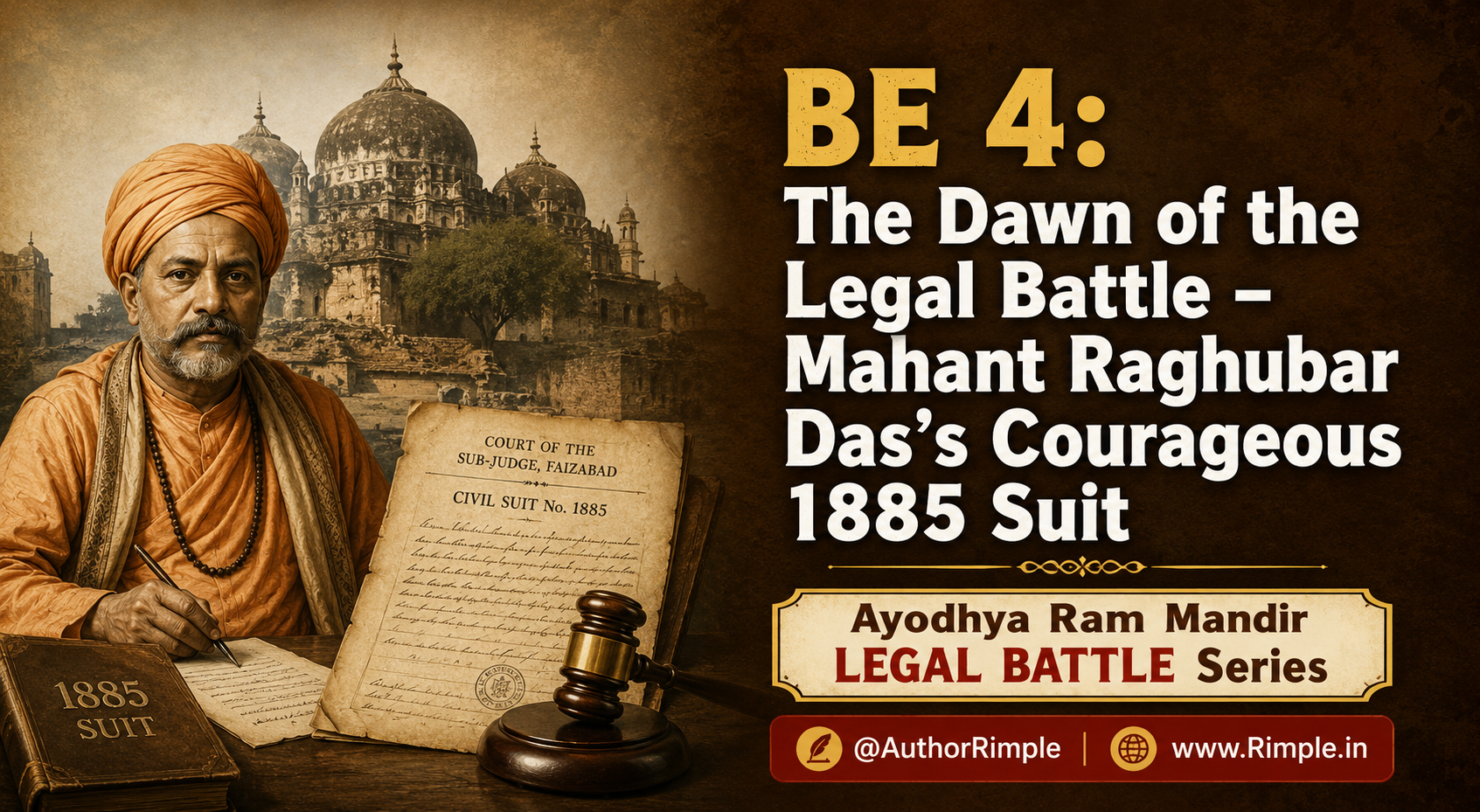
On January 29, 1885, Mahant Raghubar Das filed a civil suit in the Faizabad Sub-Judge Court. This was the first formal legal case for Ram Janmabhoomi.
What did he ask for?
- Permission to build a small temple on the Ram Chabutra – a raised platform measuring about 17 feet by 21 feet in the outer courtyard.
- The right to install the Charan Paduka (sacred footprints) of Lord Shri Ram there.
- Recognition that Hindus had been worshipping at this spot for centuries.
He did not even ask for the entire site at that time. He only wanted a small piece of land next to the mosque so Hindus could worship their God properly without fear.
This humble request shows the patience of Hindus. After 357 years of waiting since 1528, they were still willing to start small, hoping for basic religious rights on their own sacred land.
The Powerful Arguments Presented by Hindus
In the court, Mahant Raghubar Das and his team presented clear reasons:
- The Ram Chabutra was the exact birthplace area of Lord Shri Ram.
- Hindus had worshipped there continuously for hundreds of years, even after the temple was destroyed.
- The platform already had sacred marks and was used for puja by saints and devotees.
- Building a small temple there would not disturb anyone and was a matter of religious freedom.
Supporting evidence included local traditions, witness accounts from elderly people, and the long history of Hindu devotion at the site. Mahant ji argued with the fire of bhakti. For him, this was not just a property case. It was about giving Shri Ram his rightful place.
British Court and Muslim Opposition
The British judge, Pandit Hari Kishan, heard the case. The Muslim side, supported by British officials, strongly opposed the request. They argued:
- The entire area belonged to the mosque since 1528.
- Allowing any Hindu construction would create “law and order problems.”
- Muslims had been using the inner part peacefully.
The British rulers were not interested in true justice. They only wanted to keep control over India. Giving Hindus their rights might anger the Muslim community, so they preferred to maintain the status quo that favored the mosque.
On December 24, 1885, the Sub-Judge dismissed the suit. He accepted that Hindus had a strong religious connection but said building a temple could lead to riots. The decision was a big blow to Hindu hopes.
The Appeals – Justice Denied Again and Again
Mahant Raghubar Das did not give up easily. He fought hard through the appeal process:
- First appeal went to the District Judge. It was rejected in 1886.
- Second appeal went to the Judicial Commissioner of Oudh. This too was dismissed.
The higher courts repeated the same excuse – “maintaining peace” was more important than Hindu religious rights. The British clearly sided with the side that had built the mosque on stolen land. They cared more about avoiding trouble than correcting a historical wrong.
This was another painful chapter for Hindus. Even when they tried the peaceful path of law, the system betrayed them.
The Emotional Pain and Anger of Hindus
Imagine the feelings of Mahant Raghubar Das and thousands of devotees after the court dismissed their plea.
They had waited centuries. They had suffered under Mughals and Nawabs. Now, under British rule, which claimed to be fair and modern, they were still denied basic rights on their own holy land. The pain was deep. Many Hindus felt angry and helpless. Why should they beg for permission to worship their own God in their own country?
Yet, this rejection did not kill their spirit. It only made their resolve stronger. Mahant Raghubar Das became a symbol of courage. His effort proved that Hindus would use every tool – law, devotion, and determination – to reclaim Ram Janmabhoomi.
The Real Cost of This Legal Fight
Filing this case was not easy. Mahant Raghubar Das and his supporters faced threats. They spent time and money. They had to stand in courts run by people who did not understand or respect Hindu sentiments. Many ordinary devotees who supported the case were watched by authorities and local Muslim leaders.
This 1885 suit marked the shift from only physical and silent resistance to organized legal resistance. It showed the world that Hindus were not going to forget the injustice. They would keep fighting, no matter how long it took.
Lessons from Mahant Raghubar Das’s Courage
Mahant Raghubar Das taught us an important lesson. Even when the system is against you, even when powerful forces say no, you must keep trying for Dharma. His bhakti gave him strength to face rejection and continue.
His case also exposed how both Islamic remnants and British rulers worked together to deny Hindus their rights. Muslims wanted to keep the symbol of their past victory. British wanted peace for their empire. Hindus were left alone to fight for their God.
For decades, our education system and media have hidden these stories. They never told us how our saints fought peacefully through courts while facing constant humiliation. They made us believe Hindus were the aggressors. But reading the truth fills us with anger at the injustice and deep respect for our ancestors.
The Spark That Would Become a Fire
The 1885 suit may have been dismissed, but it planted an important seed. It proved that the legal route, though slow and painful, was possible. Future generations would build on this foundation. More suits would come. More Hindus would join the struggle.
Mahant Raghubar Das’s effort reminds every Hindu today that protecting Dharma requires patience, courage, and unshakeable faith. Shri Ram was watching. The fight had only just begun in the courts.
The coming years would bring new hope, new miracles, and new challenges. But the spirit shown by this brave mahant in 1885 became the foundation for the long legal battle ahead.
Jai Shri Ram!
More Episodes in this Series will be added. Save / Bookmark this site or link: Ayodhya Ram Mandir Legal Battle Series
Also Read:
ISRO and Science Series | Pandharpur Series | Kamakhya Temple Series | Jagannath Series | Rothschild Family Series | Sikhism Series | Durga Saptashati Series | Navratri Series | British Agent Gandhi Series | Operation Sindoor Series | Satan Teresa (and not Mother Teresa) Series | Hinduism Articles | Ramakrishna Paramhansa Series | Ayodhya Ram Mandir Legal Battle Series