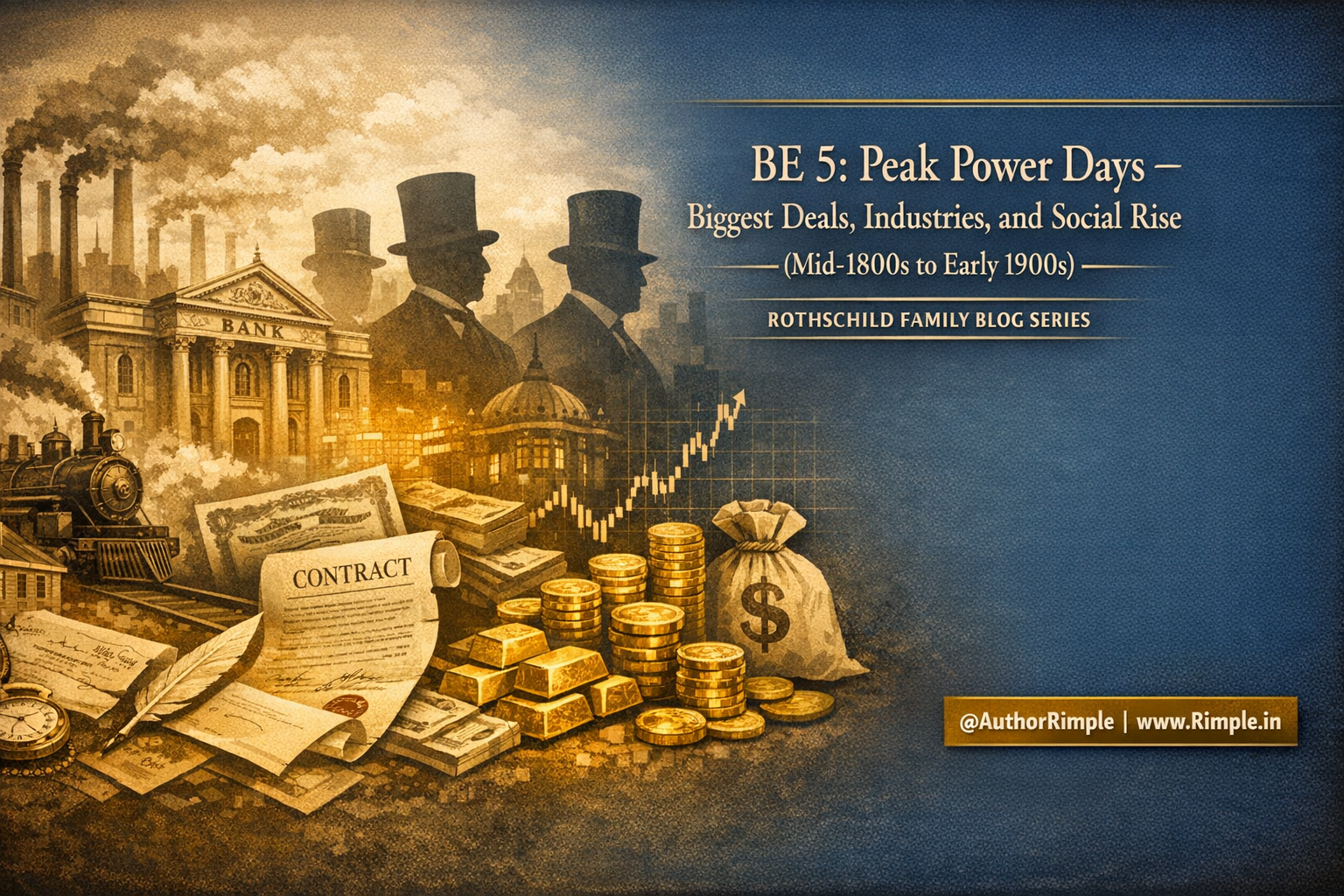
Blog Episode 5 in Rothschild Family Series.
The family tree was now locked tight. Marriages inside the family kept the money safe. Marriages outside opened doors to kings, prime ministers, and big businessmen. With this strong foundation, the Rothschilds reached the highest point of their power from the middle of the 1800s to the early 1900s.
By the 1850s, they were already the richest private banking family the world had ever seen. Their banks held more ready cash than many governments. But they did not stop at banking. They used their money to buy into the biggest new projects of the time. They financed entire industries, built giant companies, and became part of high society.
This was their peak. Wars had given them the first fortune. Now smart deals made that fortune grow bigger and safer than anyone could imagine. Let us look at each big move, one by one, exactly as it happened.
The Time of Greatest Power Begins
After the Napoleonic Wars ended, Europe was changing fast. Factories were opening. Trains were being built. New countries needed money for roads, ships, and mines. The Rothschild brothers and their children saw these changes and jumped in.
They did not just lend money. They became part-owners of the new projects. This way, they earned interest on loans plus extra profit when the projects succeeded. By the 1870s, their wealth was so large that they could fund deals no one else could touch.
Suez Canal Financing – Buying Control of the World’s Most Important Waterway
In 1875, the biggest deal of the century happened almost overnight.
The ruler of Egypt (called the Khedive) was in deep debt. He owned nearly half the shares in the new Suez Canal – the shortcut between Europe and Asia that ships used to reach India and the Far East. He needed cash fast and offered to sell his shares.
British Prime Minister Benjamin Disraeli (a close friend of Lionel de Rothschild in London) knew Britain must own this canal to protect its empire. But the British government could not get the money from Parliament in time.
Lionel stepped in. Over dinner, he agreed to lend the full £4 million (a fortune equal to hundreds of millions today) on a simple gentleman’s promise – no paperwork, no security except the word of the British government. The money moved in just 48 hours. Britain bought the shares.
The loan was repaid in five months with interest. But more important than the profit was the power: Britain now controlled the Suez Canal, and the Rothschild name was tied to one of the most important trade routes in the world. Every ship that passed through paid tolls that helped keep the family strong.
Railways – Building the Tracks That Connected the World
Trains were the internet of the 1800s. They moved people, goods, and coal faster than ever before. Governments needed huge loans to lay thousands of miles of track. The Rothschilds became the main bankers for this revolution.
James in Paris started early. In 1845, he helped build the Northern Railway in France – linking Paris to the industrial north and ports. He raised 200 million francs (a massive sum) by selling shares across Europe. The family network made it easy: one brother found investors in London, another in Vienna.
They went on to finance railways in:
- Italy (the Lombardo-Venetian line, over 600 miles)
- Austria
- Russia
- Brazil (lines like Bahia & San Francisco)
- India
- South Africa
By the late 1800s, the Rothschild banks had helped build a very large part of Europe’s railways and many lines around the world. They earned money two ways: interest on the loans, and shares in the railway companies themselves. Trains carried coal to factories, food to cities, and soldiers in wars. Every mile of track made the family richer and more necessary.
Mining – Digging Up Diamonds, Copper, and Riches from the Earth
In the 1880s, the world was hungry for raw materials. The Rothschilds moved into mining the same way they moved into railways – by lending money and then owning big pieces of the companies.
They took control of Rio Tinto, a giant copper mine in Spain. By the 1880s, they restructured the company, poured in fresh money, and turned it profitable. By 1905, the family owned more than 30 percent of the shares. Rio Tinto became one of the biggest mining groups on earth.
In South Africa, they backed Cecil Rhodes. In 1887, they gave him a million-pound guarantee to buy diamond mines in Kimberley. This created De Beers Consolidated Mines. Nathaniel Rothschild (Lionel’s son) sat on the board. De Beers soon controlled most of the world’s diamonds. The family earned huge profits from every diamond sold.
These mines gave them steady income from copper, gold, and diamonds for generations. The money from the ground flowed straight back into their banks.
Vineyards – Owning the World’s Finest Wines
Not all business was about heavy industry. In 1868, James Mayer Rothschild bought the famous Château Lafite estate in Bordeaux, France, for 4.4 million francs. It was one of the best wine-making lands in the world.
The name changed to Château Lafite Rothschild. Even after James died, his sons kept it in the family. They improved the vineyards, built better cellars, and turned it into a symbol of the very best French wine.
Today, bottles of Lafite Rothschild still sell for thousands of pounds each. This was not just a hobby. It was another smart way to own real assets that grew in value every year and gave the family a respected place in high society.
Rising High in Society – Titles, Estates, and Respect
With all this new wealth, the family moved from the ghetto to the top of society. They bought grand estates and palaces across Europe. Waddesdon Manor in England became a famous example – filled with art, gardens, and luxury.
They also won titles and political power:
- In 1858, Lionel de Rothschild became the first practising Jewish Member of Parliament in Britain after an 11-year fight. He had to change the oath to swear on the Hebrew Bible instead of the Christian one.
- In 1885, his son Nathaniel became the first Jewish peer in the House of Lords.
These steps were huge. For the first time, a Jewish family sat at the very heart of British power. The Rothschild name now opened every door in London, Paris, and Vienna.
Giving Back – Philanthropy for Jewish Causes and Palestine
The family never forgot their roots. They gave away large sums to help Jewish people everywhere.
Edmond de Rothschild (one of James’s sons) became the biggest supporter of early Jewish settlements in Palestine. Starting in the 1880s, he spent millions of pounds buying land, building villages, planting vineyards and orange groves, and setting up schools and hospitals.
He helped dozens of settlements survive when they were close to failing. Farmers learned new crops like grapefruit and avocado. Factories and wineries were started. Edmond became known in Israel simply as “the Baron” or “the Known Benefactor.” His work laid important early foundations for what would later become the modern state of Israel.
The Smart Way They Controlled It All – Vertical Power
The real genius was how everything connected.
They financed a railway → the railway needed coal and iron → they financed the mines that supplied the coal and iron → the mines shipped goods on Rothschild railways → the profits from mines and railways all flowed back into Rothschild banks.
This was called vertical control. One business fed the next. Nothing happened outside the family web. By the early 1900s, the Rothschilds did not just lend money. They owned pieces of the industries that made the modern world run.
The peak power days showed what one family could build when money, brains, and connections worked together. From a small ghetto shop, they now sat at the centre of global trade, politics, and industry.
In the next article, you will see how this same family helped shape the modern money system itself – the central banks, the way governments borrow, and the system that still decides how much interest you pay on loans today.
This was the golden age of the Rothschilds. The next part explains how their ideas became the rules that every country still follows.
Also Read: