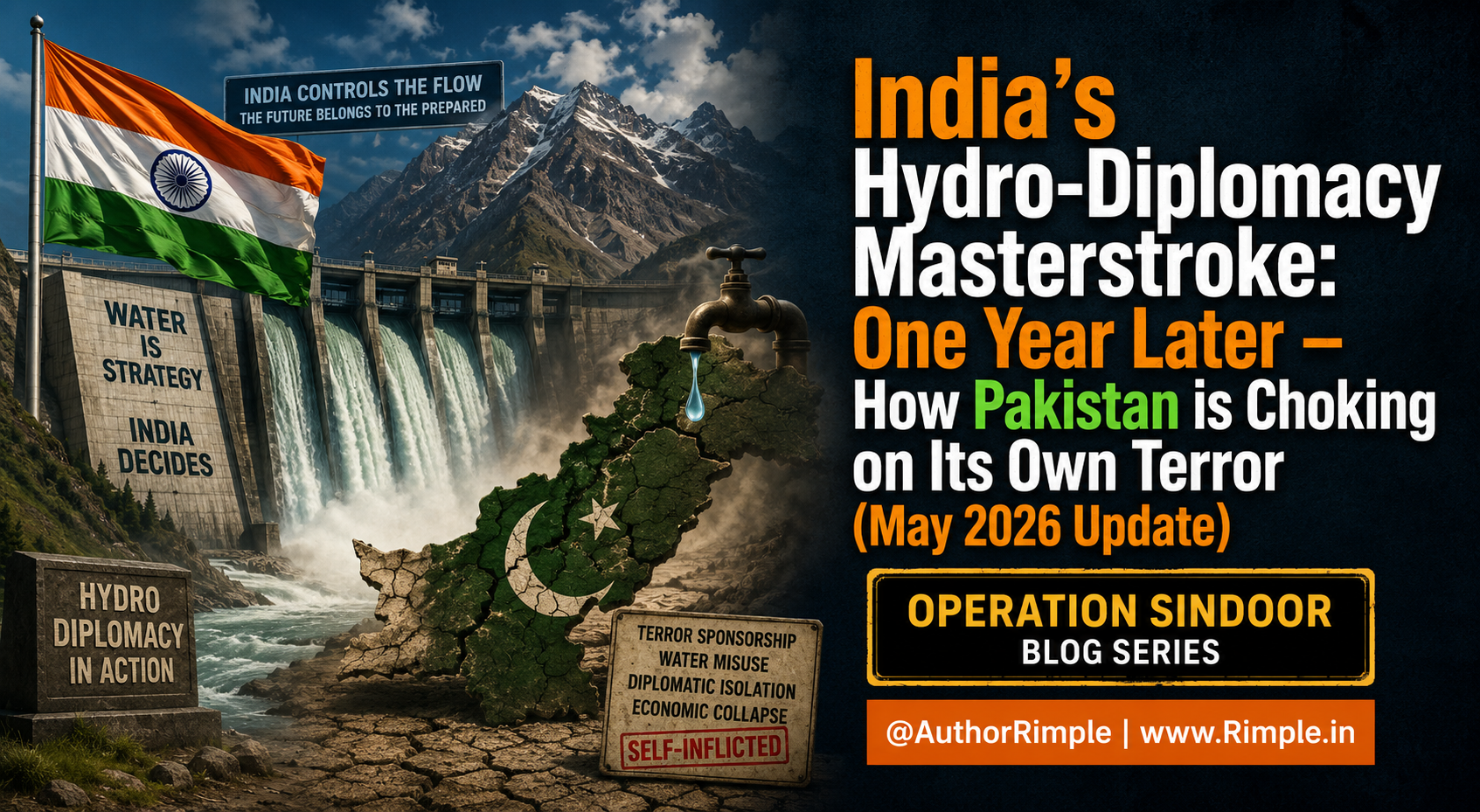
One year ago, on April 22, 2025, Pakistan-backed terrorists carried out a brutal attack in Pahalgam, Jammu and Kashmir. They killed 26 innocent civilians in cold blood, asking victims if they were Hindus, forcing them to read the Kalma, and then shooting them. India responded firmly with Operation Sindoor and, most importantly, launched a powerful hydro-diplomacy strategy by suspending the 1960 Indus Waters Treaty. This was a brilliant masterstroke by PM Narendra Modi and the Jal Shakti Ministry. India put the treaty in abeyance until Pakistan ends its support for terrorism. No more free data sharing. India started fully controlling its dams on the rivers. One year on, Pakistan is suffering badly — its farms are failing, economy is hurting, people are angry, and its leaders are begging. Here is a simple explanation for every common person.
What India Did and Why It Matters
The old treaty gave Pakistan most of the water from the western rivers — Indus, Jhelum, and Chenab — even though Pakistan always supported terrorists against India. After Pahalgam, India said “Blood and water cannot flow together.” India stopped following the old rules that favoured Pakistan. It started flushing dams, reducing flows at times, releasing sudden surges, and building new projects. This created uncertainty and shortages for Pakistan. The results after one full year are clear and painful for Pakistan.
Major Actions in April-May 2025 and Their Continuing Impact One Year Later
Action 1: Suspension of the Indus Waters Treaty (April 23, 2025)
Foreign Secretary announced the treaty in abeyance. Baglihar Dam gates on Chenab closed.
One Year Impact: Pakistan lost advance river data completely. Irrigation for 80% of its farmland (24% of GDP, 45% of workforce) remains disrupted. Farmers in Punjab and Sindh still face sowing problems for wheat and rice. Food insecurity is higher. Pakistan’s per capita water availability has worsened.
Action 2: Flushing Operations at Baglihar and Salal Dams (April 24, 2025)
Desilting done in dry season.
One Year Impact: Chenab flows stayed unpredictable. Fields in Sindh’s Hyderabad and Sukkur suffered repeated dry spells. Groundwater overused, costly, and depleting fast. Protests in Sindh grew stronger with loud “Sindhudesh” demands.
Action 3: Three-Step Plan to Stop Every Drop (April 25, 2025)
Minister Gajendra Singh Shekhawat announced regular flushing, new canals, and Tulbul Navigation Project revival on Jhelum.
One Year Impact: Long-term panic in Pakistan. Farmers fear desert-like conditions in large areas. Separatist feelings in Sindh and Balochistan became much stronger. Potential 10-15% permanent water cut looming.
Action 4: Full Stoppage of Ravi River (May 1, 2025)
Shahpurkandi Dam completed, all flow stopped at Madhopur Headworks and redirected to Indian states.
One Year Impact: 150,000 acres in Pakistan’s Narowal and Shakargarh still badly affected. Lahore drinking water problems continue. Rice export losses in billions. Sindhudesh movement gained more supporters.
Action 5: Complete Baglihar Closure (May 5, 2025)
One Year Impact: Chenab levels hit lows repeatedly. Pakistan reported big drops in irrigation. Cotton and other crops suffered heavy losses. Protests erupted in Sialkot, Gujrat and other places. IRSA admitted major flow reductions.
Actions 6-19: Repeated Flushing, Reductions and Surges on Multiple Rivers
India did flushing at Kishanganga (May 4 & 17), Ratle expansion (May 7), controlled releases and reductions on Chenab, Jhelum, Sutlej, Ravi at different dams and dates (Salal, Uri, Bhakra, Harike, etc.). Sudden high releases caused floods, low flows caused drought.
One Year Impact: Pakistan’s farmers stayed confused and helpless. Crops worth billions in rice, cotton, wheat damaged repeatedly. CPEC projects hit. Sudden floods destroyed infrastructure and farmlands in Sialkot, Gujranwala, Lahore areas. Exports crashed. Punjab and Sindh agriculture remains weak. IRSA struggles without Indian data.
Pakistan’s Nuclear Facilities Now Vulnerable
Pakistan’s six nuclear facilities and reactors need millions of gallons of water daily for cooling. Places like Chashma (on Chenab), Khushab (Jhelum), Karachi, Kahuta, and others depend on these rivers. India’s control has created real risks. Reduced or unpredictable flows threaten operations. This weakens Pakistan’s military power without India firing a single shot — a true masterstroke.
Sindh’s Severe Water Crisis and Explosive Unrest
Sindh depends heavily on the Indus. One year later, many areas still see dry riverbeds and parched lands (visible in satellite images). Crops like rice and cotton failed in large parts. Angry mobs torched army officers’ homes in Hyderabad (May 20, 2025) and PML-N offices in Sukkur (May 22). People blamed the army and Punjab for stealing water. “Sindhudesh” banners and appeals to Modi grew. Protests turned violent with demands for independence. Water stealing and fights over tankers became common. Outside Punjab, water flow almost stopped in many places.
Unrest Spreads to Balochistan, KPK, and Southern Punjab
- Balochistan: Dry canals in Quetta and Gwadar. Protests attacked government offices. Baloch groups used the crisis to push separation. Reports of Balochistan declaring independence push in mid-2025.
- KPK: Farmers in Peshawar and Kohat burned leaders’ effigies after Jhelum cuts.
- Southern Punjab: Shortages led to vandalism of irrigation offices in Bahawalpur.
People came out on streets, targeted authorities, and in some cases attacked army-linked properties for water. Shortages caused real hardship — no water for weeks in many villages, higher diseases, and daily fights.
Pakistan Leaders Begging and Admitting Defeat
Pakistan’s parliament and media were full of panic one year ago, and the suffering continues:
- PM Shehbaz Sharif called it a “death sentence for the economy.”
- Bilawal Bhutto, Khawaja Asif, Maryam Nawaz, Jam Khan Shoro, Ishaq Dar — all pleaded for water, begged India, and ran to World Bank, UN, ICJ.
They openly admitted India won this bloodless war. Decades of terrorism finally cost them dearly.
India’s Smart Move with Afghanistan
India discussed and advanced funding for Shahtoot Dam on Kabul River. This can cut another 10-15% water to Pakistan and affect Tarbela Dam (20% of Pakistan’s power). A perfect diplomatic tightening of the noose.
One Year Later – The Full Devastating Picture in Pakistan
- Agriculture Collapse: 24% of GDP ruined in many areas. Huge losses in wheat, rice, cotton. Food shortages and price rise hurting common people.
- Economy: Billions lost in exports. Military funds diverted to crisis management.
- Very Low Water Storage: Only 90 days of water storage compared to the world’s 300 days — leaving no safety net during dry periods.
- Internal Chaos: Provinces blaming each other. Sindh vs Punjab tensions at peak.
- Separatism Rising: Separatist movements stronger in Sindh and Balochistan.
- Public Anger: Protests, violence, theft of water, attacks on government and army properties. Trust in leaders collapsed.
- Strategic Weakness: Nuclear plants and CPEC under pressure. China also lost money on projects.
Pakistan’s Water Situation Today: Only Months Left
Pakistan’s government recently stated it has only about 90 days of water storage capacity. Regional peers have over 120 days; global standard is around 300 days.
- Major dams (Tarbela on Indus, Mangla on Jhelum) often hover near critical levels, especially in dry periods.
- In 2025-26, inflows dropped. Reports showed 10-15% lower water releases in Punjab compared to previous year. Dams neared “dead levels” (below which water can’t be drawn effectively).
- Snow persistence in the Hindu Kush-Himalaya (source of meltwater) is down sharply – 18% below normal in Indus basin in 2026, fourth year of decline. This means less water in early summer.
Result: Pakistan relies on seasonal monsoon (80% of water in 4 months) but has tiny buffers for the other 8 months. Climate change (erratic rains, melting glaciers) makes it worse. India’s actions add timing uncertainty.
Why Pakistan Struggles More (Its Own Issues)
India’s move exposed and worsened existing weaknesses:
- Very low storage (no major new dams in decades due to politics between provinces).
- Inefficient irrigation – huge losses in canals.
- Overuse of groundwater.
- Population boom and climate vulnerability.
Has It Achieved India’s Goals?
- Strategic pressure: Yes. Pakistan feels the pinch in a key sector without full war.
- Terror angle: India links it to stopping cross-border support. Suspension remains until credible action.
- Development: India builds more clean hydropower for its needs.
- Long-term: More storage and projects in J&K strengthen India’s position as upper riparian.
Critics said it wouldn’t work because of geography. But real-world data shows measurable pain in Pakistan’s water-dependent economy.
India’s Leadership Shines – Pakistan’s Failure Exposed
Anti-national voices in India like Mehbooba Mufti and Rahul Gandhi called this “inhumane.” They were wrong. PM Modi and Minister Gajendra Singh Shekhawat showed real courage and vision. They corrected Nehru’s big 1960 mistake of giving away too much water to a enemy nation.
Pakistan brought all this pain on itself — through Kargil, Mumbai 26/11, Pulwama, Pahalgam and constant terrorism. Its people are suffering because its rulers chose terror sponsorship over peace and development.
Conclusion
One year after India’s hydro-diplomacy began, the results are outstanding for India and painful for Pakistan. Rivers are now India’s strongest weapon. Pakistan’s farms, economy, unity, and military strength are all weakened. Its leaders beg while its people revolt. This bloodless strategy proves India’s smart power. As long as Pakistan harbours terrorists, it will face a dry, dark future. India stands strong and secure.
Jai Hind! Water has spoken louder than bullets. This is true justice.
Read All Articles on Operation Sindoor here.
Also Read:
ISRO and Science Series | Pandharpur Series | Kamakhya Temple Series | Jagannath Series | Rothschild Family Series | Sikhism Series | Durga Saptashati Series | Navratri Series | British Agent Gandhi Series | Operation Sindoor Series | Satan Teresa (and not Mother Teresa) Series | Hinduism Articles | Ramakrishna Paramhansa Series |