
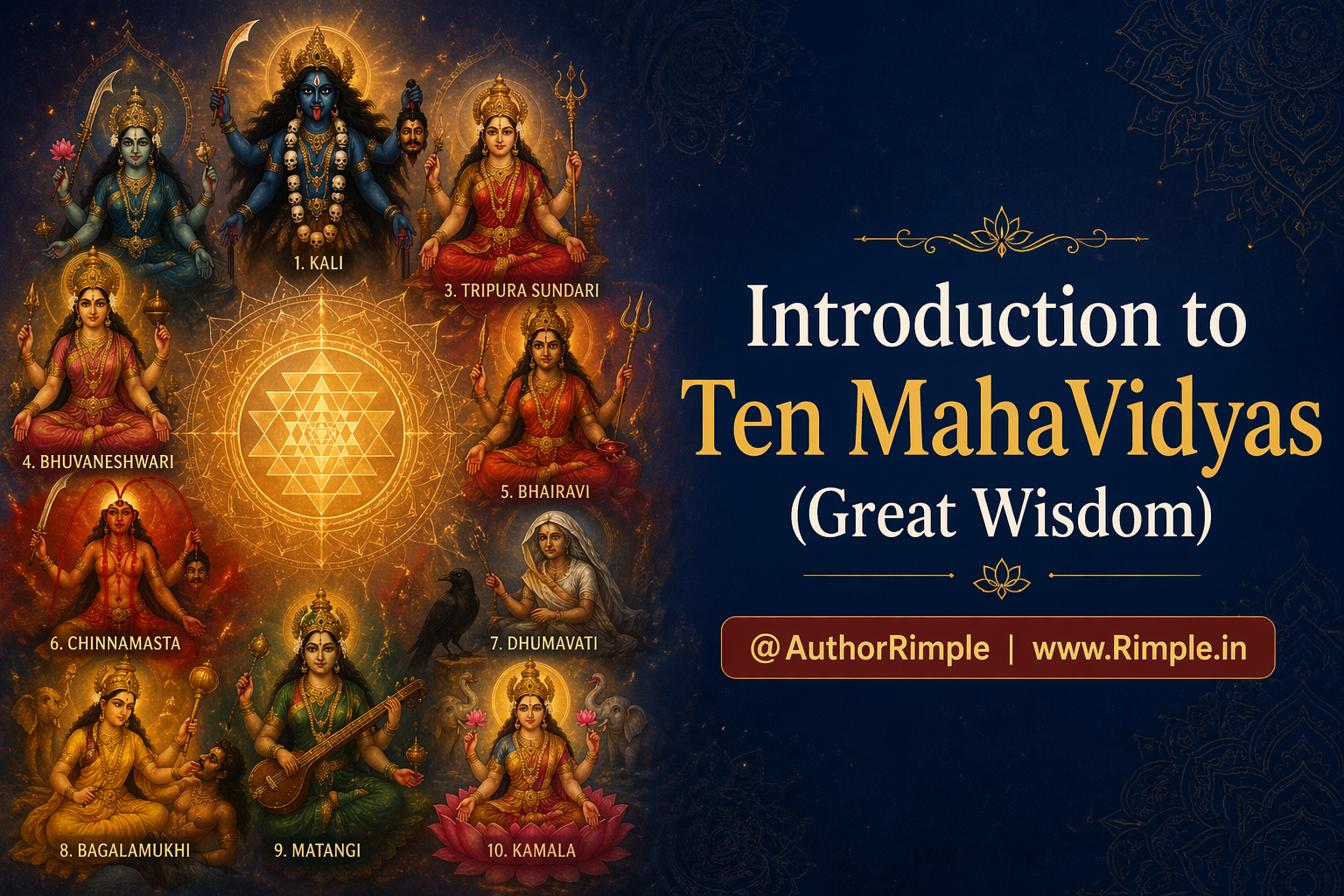
Imagine you are standing in front of a vast, mysterious ocean. The waves look scary at times, calm and beautiful at others. Sometimes the water is dark and deep, sometimes sparkling with light. That ocean is the Divine Mother — the one great energy that creates, protects, and transforms everything in the universe.
In Hinduism, especially in the powerful path called Tantra, this Divine Mother shows herself in ten special forms. These are called the 10 Mahavidyas (Dasa Mahavidyas).
- “Maha” means great.
- “Vidya” means wisdom or knowledge.
So, Mahavidya means Great Wisdom. Each of these ten goddesses is not a separate person — they are different faces of the same loving yet powerful Mother. Together, they teach us every lesson life has to offer: courage in fear, peace in chaos, beauty in darkness, and freedom from suffering.
They are like ten loving mothers who guide us through the ups and downs of life. Some look fierce to scare away our inner enemies (like ego, anger, or fear). Others look gentle to fill our hearts with love and abundance. Worshipping them with pure heart brings strength, wisdom, protection, and inner peace — even for ordinary people like us who are not experts in rituals.
The Beautiful Story Behind the 10 Mahavidyas
Long ago, Goddess Sati (an form of the Divine Mother and wife of Lord Shiva) wanted to attend a grand yagna (fire ceremony) at her father Daksha’s palace. Shiva advised her not to go because she would not be welcomed. But Sati’s heart was set.
When Shiva tried to stop her, her anger and determination burst forth. In that powerful moment, she transformed into ten different forms, each standing in one direction — north, south, east, west, and even above and below. These ten forms surrounded Shiva so completely that he could not move. They showed him that the Divine Mother’s power is everywhere and unstoppable.
These ten forms became the 10 Mahavidyas. They are all aspects of the same eternal Mother (Adi Shakti). Some are linked to fierce energy (like Kali), others to gentle grace (like Kamala). But all of them lead us toward ultimate truth and freedom.
Now, let us meet each one simply, like friends. We will see how she looks, what she teaches, and why she feels so powerful and beautiful in our hearts.
1. Kali — The Fierce Mother Who Frees Us from Fear
Kali is the first and most famous Mahavidya. She is dark like the night sky, with wild hair, a garland of skulls, and a skirt of severed arms. Her tongue sticks out, and she stands on Lord Shiva’s chest.
Why does she look so scary? Because she destroys our deepest fears — fear of death, fear of change, fear of the unknown. She is the power of Time (Kaal) itself. She devours ego, ignorance, and everything that holds us back. But for her true children, she is the most loving mother. She gives courage, protection, and ultimate freedom.
- Lesson she teaches: Embrace change. Nothing is permanent except the divine truth inside you.
- Beautiful side: In her calmness, she shows that even darkness holds light. She is the mother who hugs you tightly after a storm.
People pray to Kali when they need strength to face difficulties or to overcome inner darkness.
2. Tara — The Compassionate Guide Across the Ocean of Life
Tara looks similar to Kali — blue-skinned, fierce yet motherly. She holds a sword, a lotus, and a skull cup. She is often shown rescuing her devotees from danger.
Tara means “star” or “saviour”. Like a bright star in the dark sky, she guides us safely through the stormy ocean of life’s problems, lies, and confusions. She is full of compassion and helps us reach the shore of wisdom and peace.
- Lesson she teaches: Even in the darkest times, help and light are near. She offers knowledge that saves us.
- Beautiful side: She is the caring mother who pulls you out of danger and nourishes you like her own child.
Many seekers pray to Tara for protection during tough journeys — physical or spiritual.
3. Tripura Sundari (Shodashi) — The Goddess of Supreme Beauty
Also called Shodashi (the sixteen-year-old) or Lalita, she is incredibly beautiful, with a golden glow like the rising sun. She sits on a throne made of gods, holding a bow of sugarcane, arrows of flowers, a noose, and a goad.
She represents the beauty of the three worlds (heaven, earth, and the inner world of mind). She brings harmony, love, joy, and balance in life.
- Lesson she teaches: True beauty is not just outside — it is the sweet harmony inside your heart and soul.
- Beautiful side: She fills life with sweetness, attraction, and divine love. She is the queen who rules with grace.
Devotees worship her for happiness, attraction of good things, and spiritual bliss.
4. Bhuvaneshwari — The Queen of the Universe
Bhuvaneshwari means “Ruler of the Worlds”. She has a glowing red or golden complexion and sits on a lotus. She holds a noose and a goad, and her form is vast and peaceful.
She is the space in which everything exists — the vast sky, the womb of creation. She teaches us to expand our minds beyond small limits.
- Lesson she teaches: You are not small or trapped. You are part of the infinite universe. See the bigger picture.
- Beautiful side: She gives a feeling of freedom and vast love, like standing under an open sky full of stars.
She helps with creation, growth, and overcoming feelings of being stuck.
5. Bhairavi — The Fierce Power of Discipline and Tapas
Bhairavi has a red complexion, wears a garland of skulls, and looks terrifying yet full of energy. She is the power behind all fierce goddesses.
She represents the fire of discipline (tapas) that burns away laziness and weakness. She gives courage to face challenges with determination.
- Lesson she teaches: Real growth comes through focused effort and inner fire. Face your fears bravely.
- Beautiful side: Her discipline leads to great inner strength and victory.
Worshipped for power, protection from evil, and success in difficult tasks.
6. Chhinnamasta — The Selfless Giver
This form is shocking at first: Chhinnamasta holds her own severed head in one hand while blood flows into the mouths of two attendants. She stands on a couple in union.
She symbolizes the power of sacrifice and awakening of inner energy (Kundalini). By cutting her own head, she shows that true giving comes from transcending the ego.
- Lesson she teaches: Let go of selfishness. Feed others with your own energy and wisdom. True freedom is beyond the body and mind.
- Beautiful side: Her act is the highest form of compassion and self-realization.
She helps in awakening spiritual energy and overcoming deep attachments.
7. Dhumavati — The Wise Widow of Transformation
Dhumavati is an old, widow-like goddess riding a chariot pulled by crows. She is smoky and carries a winnowing basket. She looks inauspicious at first.
She represents the power hidden in loss, emptiness, and endings. She teaches us to accept sorrow, detach from material things, and find wisdom in what remains after everything is gone.
- Lesson she teaches: Life has seasons of emptiness. In that emptiness lies deep wisdom and freedom from desires.
- Beautiful side: She turns pain into profound understanding and inner peace.
Pray to her during times of grief or when you need to let go.
8. Bagalamukhi — The Crusher of Enemies
Bagalamukhi has a golden-yellow complexion. She sits on a throne and holds a club in one hand while pulling the tongue of a demon with the other.
She is the power that silences negativity, enemies (outer or inner), and harmful speech. She brings victory, control, and stillness.
- Lesson she teaches: Master your tongue and mind. Stop negativity in its tracks. Victory comes through focused power.
- Beautiful side: She creates peace by removing all disturbances.
People seek her help in legal matters, debates, or to overcome hidden enemies.
9. Matangi — The Outspoken Goddess of Inner Truth
Matangi has a dark-green or emerald complexion. She is often shown with a parrot or veena (musical instrument). She is associated with knowledge, arts, and speech.
She represents the raw, authentic voice — even the parts society may call “impure” or unconventional. She blesses creativity, learning, and speaking truth.
- Lesson she teaches: Express your true self without fear. Knowledge and art flow from inner honesty.
- Beautiful side: She makes your words powerful and your mind sharp.
Worshipped by artists, students, and those who want to speak with confidence.
10. Kamala (Kamalatmika) — The Lotus of Prosperity and Grace
Kamala is the most gentle and beautiful form — radiant like Goddess Lakshmi. She sits on a lotus, surrounded by lotuses and elephants pouring water on her. She holds lotuses in her hands.
She brings wealth, beauty, purity, and spiritual as well as material abundance. She is the grace that blooms even in muddy waters.
- Lesson she teaches: Purity and devotion attract all good things. Rise above difficulties like a lotus.
- Beautiful side: She fills life with joy, kindness, and overflowing blessings.
She is the perfect ending to the ten — reminding us that after all transformations, we receive divine grace and prosperity.
Why the 10 Mahavidyas Feel So Powerful and Beautiful
These ten goddesses together paint the full picture of life. Life is not only sweetness — it has darkness, loss, struggle, beauty, silence, and joy. The Mahavidyas embrace every part with love.
They remind us:
- Fear is not the end — it can become courage (Kali).
- Chaos can lead to guidance (Tara).
- Emptiness can become wisdom (Dhumavati).
- Sacrifice can awaken greatness (Chhinnamasta).
For a simple person like you and me, remembering them brings comfort. You don’t need to be a scholar. Just call them with a pure heart — “Mother, help me” — and feel their energy around you.
They are not distant gods in temples. They live inside every human heart as different powers: the power to destroy fear, the power to create beauty, the power to speak truth, and the power to bloom with grace.
May the 10 Mahavidyas bless you with wisdom, strength, and the beautiful light of the Divine Mother in every step of your life.
ॐ ऐं ह्रीं श्रीं क्लीं श्रीमात्रे नमः
Also Read: