
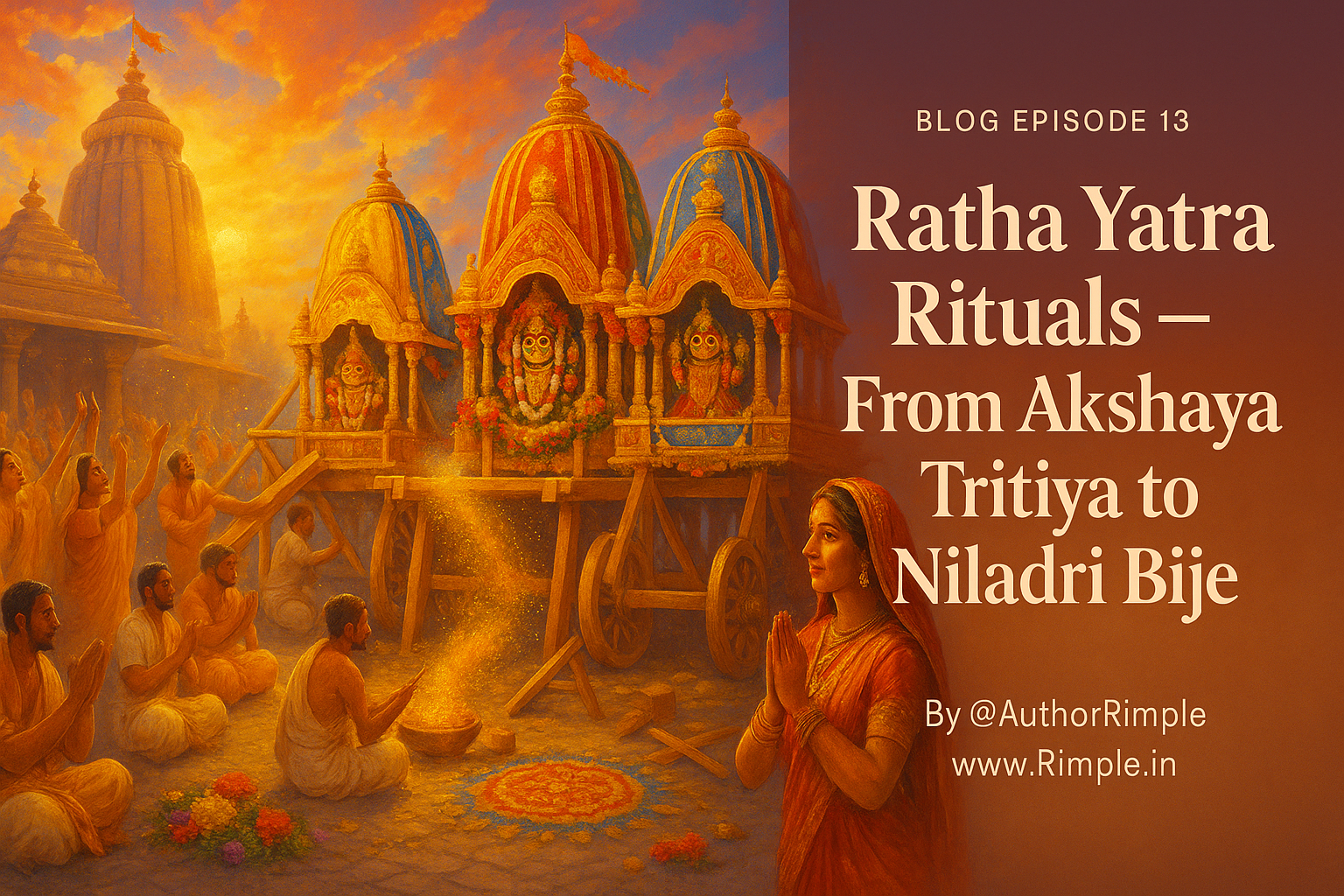
From the vibrant chariot journey of Ratha Yatra, where Bhagwan Jagannath, Balabhadraji, and Subhadraji roll through Puri’s Bada Danda, uniting bhakts in Shri Krishna’s boundless love, we dive into the sacred rituals that weave this divine festival into a tapestry of bhakti. Spanning from Akshaya Tritiya to Niladri Bije, these ceremonies, steeped in Pauranic tradition, fill Puri with the scent of fresh wood, rosewater, and jasmine, the rhythmic chants of Vedic mantras, and the vibrant colors of Hinduism—crimson silks, emerald garlands, and golden lamps. Each ritual, from the crafting of chariots to Jagannathji’s playful return, pulses with divine energy, drawing bhakts closer to Shri Krishna’s heart in Kali Yuga, a radiant celebration of love and unity.
The Sacred Rituals of Ratha Yatra
The Ratha Yatra festival unfolds through a series of divine rituals, each a thread in the vibrant fabric of bhakti, guiding the deities and their devotees through a sacred cycle.
- Akshaya Tritiya (April 30, 2025): The festival begins with the auspicious day of Akshaya Tritiya, when construction of the chariots—Nandighosa, Taladhwaja, and Darpadalana—starts at the Ratha Khala near Shri Mandir. The air hums with the scent of fresh neem wood, sawdust swirling like sacred dust, as artisans hammer and carve under the golden sun. Bhakts gather, their prayers mingling with the rhythmic clank of tools, the crimson and yellow cloths draped on the chariot frames fluttering like promises of Jagannathji’s journey. This sacred start, blessed by Vedic chants, sets the stage for the divine procession, the ground warm with bhakti’s anticipation.
- Snana Purnima (June 12, 2025): The ceremonial bath, detailed in Snana Yatra, sees Jagannathji, Balabhadraji, and Subhadraji bathed with 108 pots of consecrated water on the Snana Mandap. The air sparkles with rosewater mist, the splash of water echoing like prayers, as the deities, adorned in Hati Besha, glisten under marigold garlands. Bhakts chant “Jai Jagannath!” their voices blending with conch shells’ hum, as Shri Krishna’s purifying love cleanses all, leading to the deities’ retreat into Anasara’s seclusion.
- Anasara (June 12–26, 2025): Following Snana Purnima, the deities enter the Anasara Ghar for fifteen days of rest, tended by Daitapatis with herbal pastes, the air thick with tulsi and camphor’s fragrance. Bhakts, longing for darshan, find solace in Anasar Pati paintings, their vibrant reds, yellows, and greens glowing under oil lamps, a divine bridge to Jagannathji’s presence. The temple’s stillness, pierced by soft kirtans, deepens bhakti, preparing hearts for the Ratha Yatra.
- Gundicha Marjana (June 26, 2025): On the eve of Ratha Yatra, the Gundicha Temple, Jagannathji’s aunt’s abode, is purified in the Gundicha Marjana ritual. Priests and sevakas, their white dhotis glowing, cleanse the temple with rosewater and sandalwood paste, the air alive with Vedic chants and the soft swish of brooms. The sanctum’s stone floors sparkle, adorned with lotus rangoli, as bhakts pray, their voices echoing like waves, preparing the sacred space for the deities’ arrival, a divine homecoming steeped in love.
- Hera Panchami (July 1, 2025): On the fifth day of Ratha Yatra, Devi Lakshmi, playfully seeking Jagannathji at Gundicha Temple, arrives in a flower-adorned palanquin, its crimson and gold silks swaying in the breeze. Bhakts laugh and sing, their voices mingling with the scent of jasmine and the jingle of her anklets, as Lakshmi pretends to scold Jagannathji for leaving her behind. This charming leela, rooted in Shri Krishna’s divine play with Shri Radha, fills Puri with joy, the air sparkling with bhakts’ giggles and lamp-lit devotion.
- Bahuda Yatra (July 4, 2025): The return journey to Shri Mandir, known as Bahuda Yatra, sees the chariots roll back from Gundicha Temple, pulled by thousands of bhakts dancing in ecstasy. The air thunders with drums, cymbals, and cries of “Hari Bol!” as Jagannathji’s Nandighosa, Balabhadraji’s Taladhwaja, and Subhadraji’s Darpadalana sway, their canopies of crimson, green, and black glowing under Puri’s starry sky. Bhakts shower marigolds, their petals scattering like blessings, as the deities’ radiant faces bless all, the sea’s roar echoing their divine return.
- Niladri Bije (July 8, 2025): The festival culminates with Niladri Bije, when Jagannathji, Balabhadraji, and Subhadraji re-enter Shri Mandir. In a playful act, Jagannathji offers rasgullas to appease Devi Lakshmi, who feigns anger at His prolonged absence. The temple gates swing open, the air alive with joyous chants and the sweet aroma of rasgullas, as bhakts weep, their hearts swelling with Shri Krishna’s love. The deities, adorned in golden silks, ascend the Ratnabedi, their lotus eyes shining, uniting all in bhakti’s radiant embrace.
Pauranic Significance and Stories
These rituals are steeped in Puri’s Pauranic history, each a divine thread in Jagannathji’s love:
- Akshaya Tritiya’s Eternal Start: The Skanda Purana links Akshaya Tritiya to creation’s auspicious beginnings, the scent of neem wood symbolizing Jagannathji’s eternal journey to His bhakts, uniting all in Kali Yuga.
- Hera Panchami’s Divine Play: A Pauranic tale tells of Lakshmi’s playful pursuit, mirroring Shri Radha’s love for Shri Krishna, her palanquin’s flowers scattering like Vrindavan’s blossoms, filling Puri with laughter and bhakti.
- Niladri Bije’s Reconciliation: A story recounts Jagannathji’s rasgulla offering as a gesture of love, the sweet’s milky fragrance soothing Lakshmi, teaching bhakts the joy of divine reunion.
The Spiritual Heart of Ratha Yatra Rituals
Each ritual, from the chisel’s rhythm on Akshaya Tritiya to the rasgullas of Niladri Bije, weaves a vibrant tapestry of bhakti, uniting Vaishnavas, tribal bhakts, and all under the golden Neelachakra. The air sparkles with rosewater, jasmine, and sandalwood, the vibrant colors—crimson canopies, emerald garlands, golden silks—reflecting Hinduism’s unity. In Kali Yuga, these rituals remind bhakts that Jagannathji’s love is a journey, each step a call to Shri Krishna’s embrace, cleansing souls with His mercy.
To capture this divine cycle, let us turn to an Odia verse from traditional Jagannath bhakti poetry, sung in Puri’s sacred streets:
Odia Verse (Devanagari):
रथयात्रा कर्म दीपति, जगन्नाथ प्रेम हृदये जागे।
विश्वं सर्वं संनादति, श्रीमन्दिरे शान्त्या प्रकाशति॥
Poetic English Translation:
Ratha Yatra’s rites do brightly glow, Jagannath’s love wakes the heart,
The world in harmony sings as one, in Shri Mandir’s sacred art.
Meaning of the Verse:
This verse celebrates Ratha Yatra’s rituals as a radiant path of love, awakening bhakti in every heart. It unites the world in harmony and light, making Shri Mandir a beacon in Kali Yuga, guiding bhakts to Shri Krishna’s eternal embrace.
As Niladri Bije fills Shri Mandir with joyous chants, under Puri’s starry sky, bhakts revel in Jagannathji’s return. But what makes Gundicha Temple, the deities’ garden abode, so sacred? The answer lies in its serene sanctity, waiting to unfold in its divine embrace.
Also Read:
Some topics cannot be covered in 1 article. Read them in Blog Episodes. Below are some amazing Blog Series to read. Click on the link to read…
Pandharpur Series https://rimple.in/category/blog-episode-series/pandharpur-series
Kamakhya Series https://rimple.in/category/blog-episode-series/kamakhya-series
Jagannath Series https://rimple.in/category/blog-episode-series/jagannath-puri-series
Russia-Ukraine War Series https://rimple.in/category/blog-episode-series/russia-ukraine-war/
Alternative in the menu, go to Blog Series.