From the mystical renewal of Nabakalebara, where the radiant new forms of Bhagwan Jagannath, Balabhadraji, and Subhadraji shine with Shri Krishna’s eternal love, we step into the vibrant embrace of Snana Yatra, a celestial festival that bathes Puri in divine purity. On Jyeshtha Purnima, under a golden sun, the Jagannath Temple awakens with the joyous anticipation of the deities’ first public appearance, their lotus-like eyes sparkling with playful grace. The air hums with the fragrance of jasmine garlands, the rhythmic clang of bells, and the vibrant colors of Hinduism—crimson silks, emerald leaves, and golden lamps. As bhakts gather, their hearts swelling with bhakti, Snana Yatra unfolds as a sacred act of purification, guiding souls toward Shri Krishna’s mercy in Kali Yuga.
The Divine Bath on Snana Mandap
Snana Yatra, celebrated in June, marks the divine bath of Bhagwan Jagannath, Balabhadraji, Subhadraji, and Sudarshan Chakra, a ritual believed to cleanse and prepare them for the year ahead. The Snana Mandap, a grand platform near the temple’s eastern wall, glows in the morning light, its stone floor adorned with intricate rangoli of yellow and red powders. Bhakts throng the Bada Danda, their saffron robes swaying, their voices chanting “Jai Jagannath!” as the sea’s gentle roar blends with the conch shells’ deep call.
The Pahandi ritual begins, as Daitapatis, their faces radiant with bhakti, carry the deities from the Ratnabedi to the Snana Mandap. Jagannathji, draped in crimson and gold, sways gently, His large eyes twinkling like stars. Balabhadraji, in white silks, stands tall with divine strength, while Subhadraji, golden and serene, smiles like a loving sister. The air pulses with mridangam beats and Vedic mantras, the scent of sandalwood incense weaving through the crowd, as bhakts weep, overwhelmed by the deities’ divine presence.
Priests pour 108 pots of consecrated water from the sacred Suna Kua well over the deities, the water sparkling like liquid diamonds under the sun. The splash of each pot echoes like a prayer, the air filled with the cool mist and the fragrance of rosewater mixed with herbs. Bhakts watch in awe, their hearts purified, as the deities’ silks glisten, their wooden forms glowing with a divine aura. The water, blessed by Shri Krishna’s touch, is believed to carry Jagannathji’s mercy, healing souls in Kali Yuga.
The Hati Besha – A Divine Play of Forms
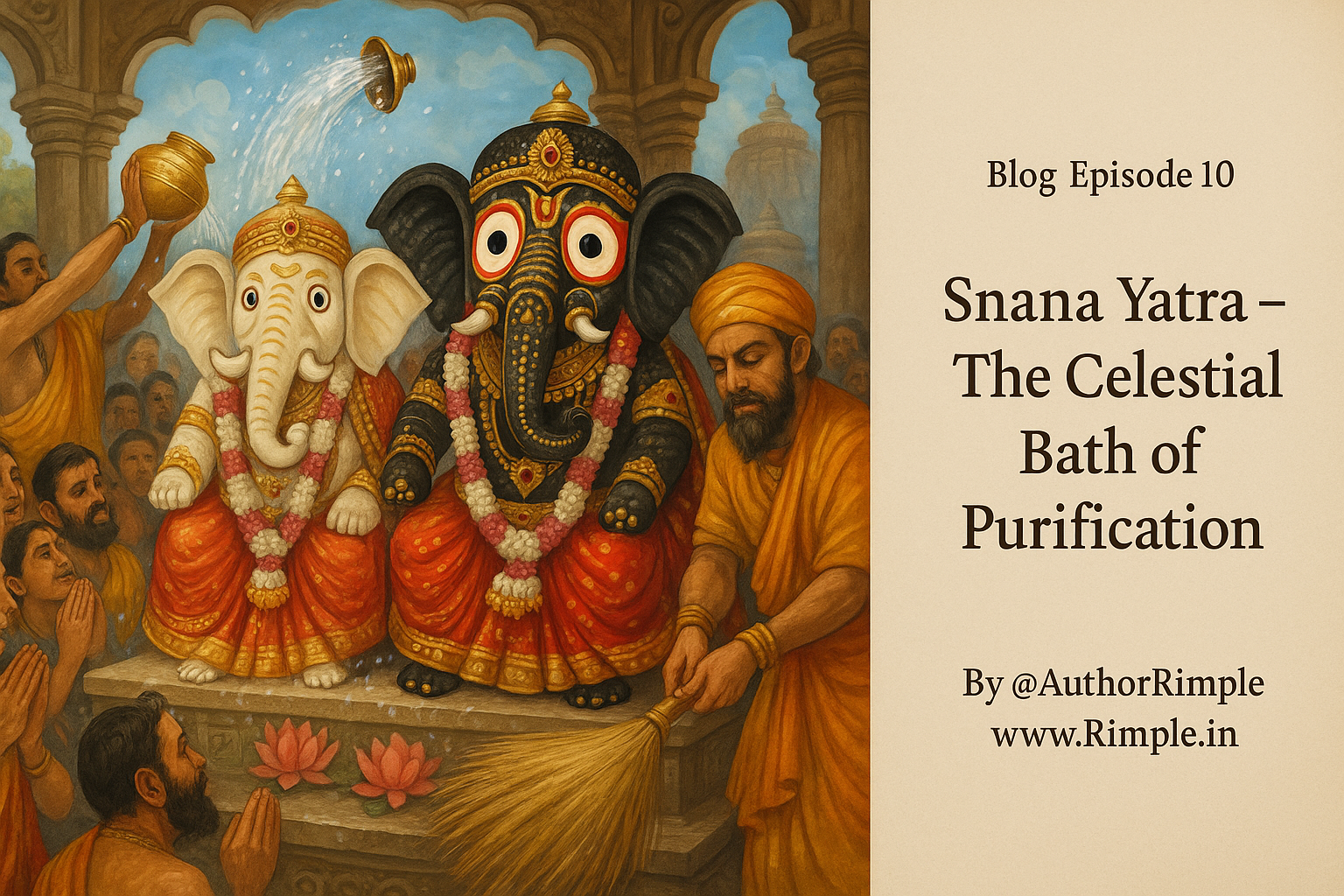
After the bath, the deities are adorned in the Hati Besha, the elephant attire, a playful transformation inspired by a Pauranic tale. A bhakt named Ganapati Bhatta, longing to see Jagannathji as Shri Ganesha, prayed with tears of bhakti. Moved by his love, Jagannathji blessed the Snana Yatra with this unique besha, His form draped in black and gold cloth, adorned with an elephant trunk and ears, sparkling with gem-encrusted ornaments. Balabhadraji and Subhadraji, too, wear vibrant silks shaped like elephant motifs, their eyes gleaming with divine mischief. The Snana Mandap transforms into a celestial stage, the air alive with the scent of lotus garlands and the joyous chants of bhakts, as the deities’ playful forms evoke Shri Krishna’s leela.
The Gajapati Maharaj, Puri’s king, performs the Chhera Pahanra, sweeping the Snana Mandap with a golden broom, his saffron turban glowing in the sunlight. The soft bristles’ sound mingles with the crowd’s “Hari Bol!” chants, a humble act of bhakti that unites all, from king to commoner, in Jagannathji’s love. Bhakts feel the deities’ gaze, their Hati Besha radiating warmth, as if Shri Krishna Himself dances in Puri’s sacred air.

Pauranic Significance and Stories
Snana Yatra is steeped in Puri’s Pauranic history, a divine ritual that purifies and renews:
- Ganapati Bhatta’s Bhakti: The Skanda Purana recounts how Ganapati Bhatta’s fervent bhakti led to the Hati Besha. His tears, falling like pearls, moved Jagannathji to appear as Shri Ganesha, blending Vaishnava and Shaiva devotion, the air fragrant with his offered jasmine as bhakts sang praises.
- Shri Krishna’s Purification: A Pauranic tale says Snana Yatra mirrors Shri Krishna’s baths in Vrindavan’s Yamuna, where He purified the waters with His divine touch. In Puri, Jagannathji’s bath blesses bhakts, the water’s cool mist carrying His mercy, uniting all in Kali Yuga.
- The Divine Fever: Tradition holds that the deities “fall ill” after their bath, retreating to Anasara. A story tells of a bhakt who dreamt of Jagannathji resting, His voice soft as a flute, asking for herbal care, the air heavy with ayurvedic scents, teaching bhakts the deities’ human-like love.
The Spiritual Heart of Snana Yatra
Snana Yatra is a divine act of renewal, cleansing both the deities and their bhakts. The festival weaves a vibrant tapestry of Hinduism’s unity—Vaishnavas chant Shri Krishna’s name, Shaivas honor the Hati Besha, and tribal bhakts offer wildflowers, all under the temple’s golden Neelachakra. The air sparkles with crimson banners, emerald garlands, and the glow of oil lamps, as bhakts feel Jagannathji’s lotus eyes wash away their impurities.
In Kali Yuga, when hearts seek purity amid chaos, Snana Yatra is a celestial call to bhakti. The deities’ bath, their playful Hati Besha, and the Gajapati’s humble sweeping symbolize Shri Krishna’s love, accessible to all. Bhakts who witness the festival or touch the sacred water are blessed, their souls renewed, as if Jagannathji Himself embraces them. The festival’s vibrant colors—saffron silks, green leaves, golden ornaments—shine like a beacon, guiding all to His mercy.
To capture this divine purification, let us turn to an Odia verse from traditional Jagannath bhakti poetry, sung in Puri’s sacred courtyards:
Odia Verse (Devanagari):
स्नानयात्रा शुद्धि संनादति, जगन्नाथ प्रेम हृदये जागे।
विश्वं सर्वं पावनं भासति, श्रीमन्दिरे दीप्तं प्रकाशति॥
Poetic English Translation:
Snana Yatra’s purity softly sings, Jagannath’s love wakes the heart,
The world in sacred light does glow, in Shri Mandir’s radiant art.
Meaning of the Verse:
This verse celebrates Snana Yatra as a purifying festival that sings of Jagannathji’s love, awakening bhakti in every heart. It bathes the world in sacred light, making Shri Mandir a beacon in Kali Yuga, guiding bhakts to Shri Krishna’s eternal embrace.
As the deities glisten on the Snana Mandap, under Puri’s golden sun, bhakts sing bhajans, the air alive with rosewater’s mist and conch shells’ chime. The grandeur of Jagannathji, Balabhadraji, and Subhadraji, purified in Snana Yatra, fills every soul. But what follows this celestial bath? The answer lies in Anasara, a time of divine rest and bhakti’s anticipation, waiting to unfold in its sacred serenity.
Also Read: