
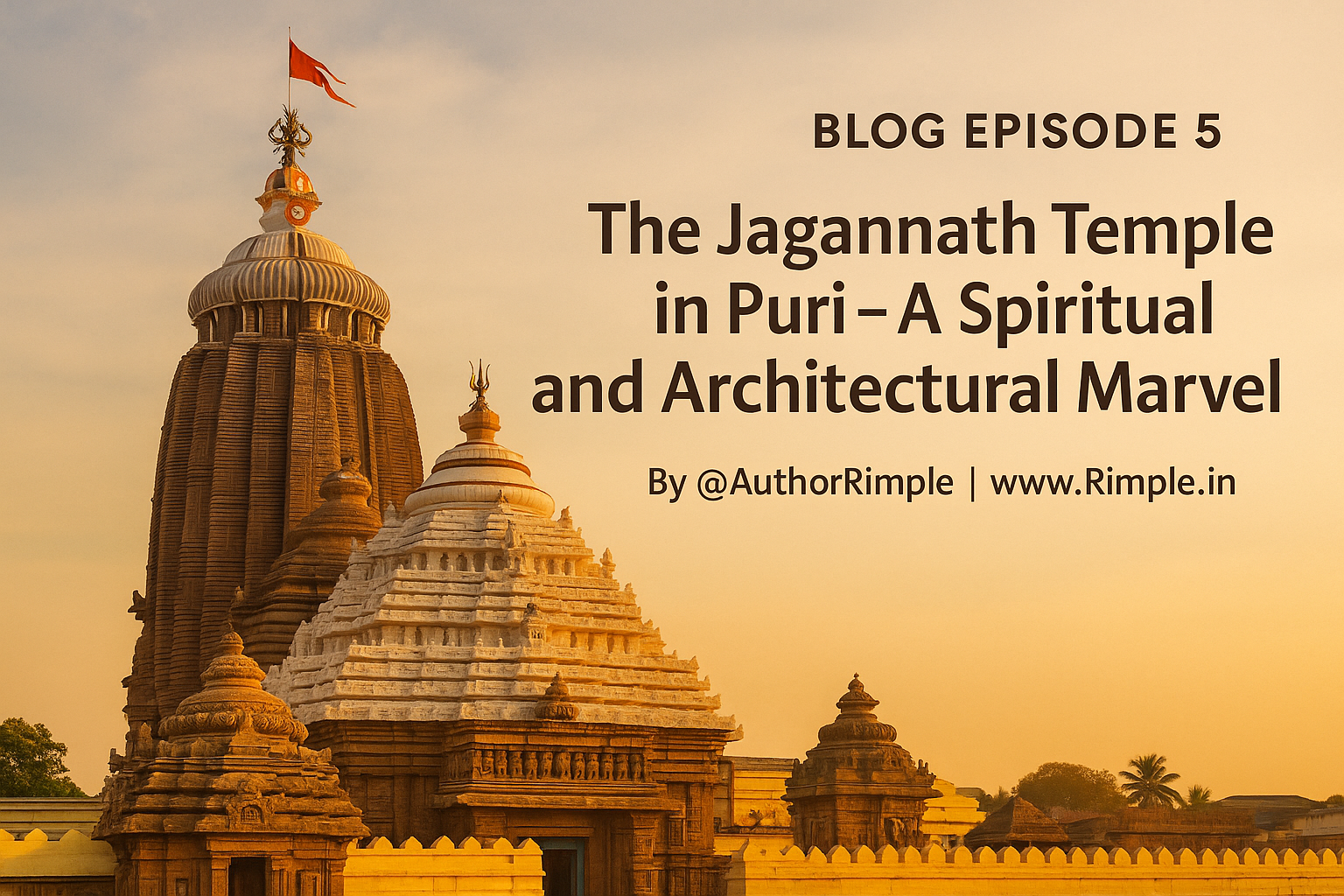
From the sacred moment when Vishwakarma’s chisel crafted the divine forms of Bhagwan Jagannath, Balabhadraji, and Subhadraji, their lotus eyes and radiant smiles ready to embrace the world, we step into the golden sands of Puri, where a majestic temple rose to cradle their eternal love. The Jagannath Temple, kissed by the sun’s golden rays on Odisha’s shores, stands as a divine haven, its towering spire touching the heavens, its halls alive with the melody of bhakti. Here, the vibrant colors of Hinduism—crimson silks, emerald garlands, and golden lamps—dance in every corner, calling bhakts to feel the grandeur of Jagannathji, Balabhadraji, and Subhadraji, whose divine presence lights up Kali Yuga with Shri Krishna’s boundless mercy.
A Divine Welcome at the Gates
Imagine walking toward the temple, the salty breeze from Puri’s sea brushing your face, carrying the sweet scent of jasmine flowers offered by bhakts. The Jagannath Temple, one of the sacred Char Dham, has four grand gates, each with a divine story, guarding the path to Jagannathji’s heart:
- Singhadwara (Lion Gate, East): The main entrance, where two mighty stone lions roar with strength, welcoming bhakts with the power of Bhagwan Vishnu. Legend says these lions are blessed by Hanumanji, who stands nearby as Patitapabana Jagannath, a small idol visible to all, even those outside the temple. The air here hums with the chant of “Jai Jagannath!” and the fragrance of camphor, stirring bhakti in every heart.
- Ashwadwara (Horse Gate, South): Guarded by stone horses, this gate tells of Jagannathji’s journey during Ratha Yatra, when He rides to Gundicha Temple. Bhakts offer red hibiscus flowers here, their scent mingling with the sea’s breath, as they pray for strength like Shri Krishna’s divine steed.
- Vyaghradwara (Tiger Gate, West): Tigers carved in stone stand fierce, symbolizing the courage needed to walk the path of bhakti. It is said that Bhagwan Shiva, in his fierce form, blesses this gate, protecting the temple’s sanctity. The soft glow of oil lamps lights the path, filling the air with warmth.
- Hastidwara (Elephant Gate, North): Adorned with stone elephants, this gate recalls the divine Hati Besha, when Jagannathji dresses as Ganesha during Snana Yatra. Bhakts offer lotus flowers, their petals soft and pink, as the sound of conch shells echoes, inviting all to the divine embrace.

The Divine Connection of Shri Ram and Hanumanji
The Jagannath Temple is woven with the love of Shri Ram, for Bhagwan Jagannath is Shri Krishna, who carries the essence of Shri Ram in His heart. Pauranic tales whisper that Shri Ram, in His Treta Yuga glory, blessed Puri’s shores, knowing His bhakt Hanumanji would guard Jagannathji’s abode. Long ago, the ocean, wild with roaring waves, threatened to flood the temple, its waters crashing like a storm. Hanumanji, his heart burning with bhakti for Shri Ram and Jagannathji, lay down on Puri’s shore, his mighty form a mountain of strength. The waves bowed before him, their fury calmed, and the sea vowed never to cross his sacred guard. Bhakts now visit Hanumanji’s temple nearby, offering red hibiscus and betel leaves, their scent blending with the salty air, thanking him for shielding Jagannathji’s home.
Another tale tells of Hanumanji’s daily darshan. Every night, he flies from Ayodhya to Puri, his tail sweeping the sky, to bow before Jagannathji. The temple gates close early, they say, to honor Hanumanji’s private moment of bhakti, the air tingling with the divine bond between Shri Ram’s eternal bhakt and Shri Krishna’s sacred form. This connection fills bhakts’ hearts with joy, seeing Jagannathji as the bridge between Shri Ram’s valor and Shri Krishna’s love, uniting all in Kali Yuga’s embrace.

The Architectural Splendor
The Jagannath Temple, built by King Anantavarman Chodaganga Deva in the 12th century, is a masterpiece of Kalinga architecture, its stone walls singing of bhakti. The temple’s structure is a divine vision:
- Meghanada Pacheri: A massive 20-foot-high wall encircles the temple, like a fortress of faith, its stones carved with floral patterns glowing in the sunlight.
- Vimana (Main Spire): The 65-meter spire soars like a mountain, its curved Deula shape reaching for the heavens, painted in shades of gold and red during festivals.
- Natamandapa (Dance Hall): A hall where Odissi dancers perform, their anklets tinkling, as bhakts watch under the glow of oil lamps, the air rich with incense.
- Mukhasala (Audience Hall): A space where bhakts gather for darshan, the cool marble floor soothing their feet, the walls adorned with carvings of Shri Krishna’s leelas.
- Ratnabedi (Jewel Throne): In the sanctum, Jagannathji, Balabhadraji, and Subhadraji sit, their throne draped in crimson, gold, and emerald silks, sparkling with pearls.
The temple’s carvings—dancers, gods, and lotuses—come alive in the morning light, shifting from soft pink to fiery orange, as if blessed by divine hands. The air hums with Vedic chants, the fragrance of sandalwood swirling, and the rhythmic clang of bells, drawing bhakts closer to Jagannathji’s heart.
The Divine Triad
In the sanctum, on the Ratnabedi, Bhagwan Jagannath shines, His large, lotus-like eyes gazing with love that melts all sorrow, His wooden form pulsing with the sacred Darubrahma, the eternal heart of Shri Krishna. Balabhadraji, radiant in white, stands like a protective mountain, his plough gleaming with strength. Subhadraji, glowing in golden hues, smiles gently, her presence a sister’s tender hug. As bhakts bow, their eyes fill with tears, their hearts swelling with bhakti, feeling Shri Krishna’s love flow through Jagannathji’s compassionate gaze, uniting all in a vibrant bond of Hinduism’s colors—saffron robes, green garlands, and golden crowns.
Mysteries of the Temple
The Jagannath Temple is a treasure of divine mysteries, each a testament to Jagannathji’s grandeur:
- The Fluttering Flag: The flag atop the spire flutters against the wind, as if dancing to Jagannathji’s divine will, its red and yellow colors glowing under the sun.
- No Shadow: The temple casts no shadow, as if bathed in celestial light, its stones absorbing the sun’s rays in a divine embrace.
- Silent Sea: The ocean’s roar falls silent within the temple’s walls, hushed by the presence of Jagannathji, Balabhadraji, and Subhadraji.
- No Birds or Planes Above: No birds or planes fly over the temple, as if the skies bow to the Neelachakra’s divine power, guarding the sacred space.
- Climbing the Flagpole: Every day, a priest climbs the 65-meter spire without ropes to change the flag, his bhakti defying gravity, blessed by Jagannathji.
- Unchanging Food: The Mahaprasad, offered to Jagannathji, never runs short, feeding thousands, its taste divine, as if touched by Shri Krishna’s hands.
- Reverse Cooking Sound: In the temple’s kitchen, the sound of cooking pots stacked upward is heard in reverse when unstacked, a miracle of divine order.
These mysteries, woven with Hanumanji’s protection, fill bhakts with awe, their hearts trembling with bhakti as they stand before the temple, feeling Jagannathji’s eternal presence.
A Beacon in Kali Yuga
In Kali Yuga, when hearts often wander in darkness, the Jagannath Temple is a guiding star, where Jagannathji’s lotus eyes call every bhakt to bhakti. It is a sanctuary where all paths meet—Vaishnavas chanting Shri Krishna’s name, Shaivas offering prayers, tribal bhakts with wildflowers, and Shaktas honoring Subhadraji. The temple’s vibrant colors—saffron, emerald, and gold—reflect Shri Ram’s valor, Shri Krishna’s love, and Hanumanji’s bhakti, welcoming all to Jagannathji’s divine embrace.
To capture this divine splendor, let us turn to a Sanskrit verse from the Skanda Purana, sung by bhakts in Puri’s sacred halls:
Sanskrit Verse (Devanagari):
जगन्नाथ मन्दिरं रम्यं, भक्तिहृदये समुज्ज्वलति।
विश्वं प्रेमेण संनादति, सर्वं शान्त्या प्रकाशति॥
Poetic English Translation:
Jagannath’s temple, bright and grand, in bhakt’s heart does shine,
With love it sings, the world it binds, in peace and light divine.
Meaning of the Verse:
This verse glorifies the Jagannath Temple as a radiant abode of bhakti, glowing in the hearts of bhakts. It resonates with Jagannathji’s universal love, uniting the world in a harmonious song of peace and divine light, a beacon for Kali Yuga’s spiritual journey.
As the sun sets, painting the temple’s spire in golden hues, bhakts gather in the courtyard, their voices rising in bhajans, the air alive with the scent of camphor and the soft chime of conch shells. The grandeur of Jagannathji, Balabhadraji, and Subhadraji, blessed by Hanumanji’s protection and Shri Ram’s love, fills every heart. But how does this sacred temple pulse with life each day? The answer lies in the daily rituals, where bhakti weaves a vibrant tapestry of love, waiting to unfold with the dawn’s first light.
This is Blog Episode 5 of Jagannath Series. If you missed earlier articles then visit the website and from the menu select “Blog Series >>>> Jagannath Series” to read all articles. Or click the link below:
https://rimple.in/category/blog-episode-series/jagannath-puri-series
If you like this series, then also read “Pandharpur Series”. Here’s the link:
https://rimple.in/category/blog-episode-series/pandharpur-series
Also Read: