
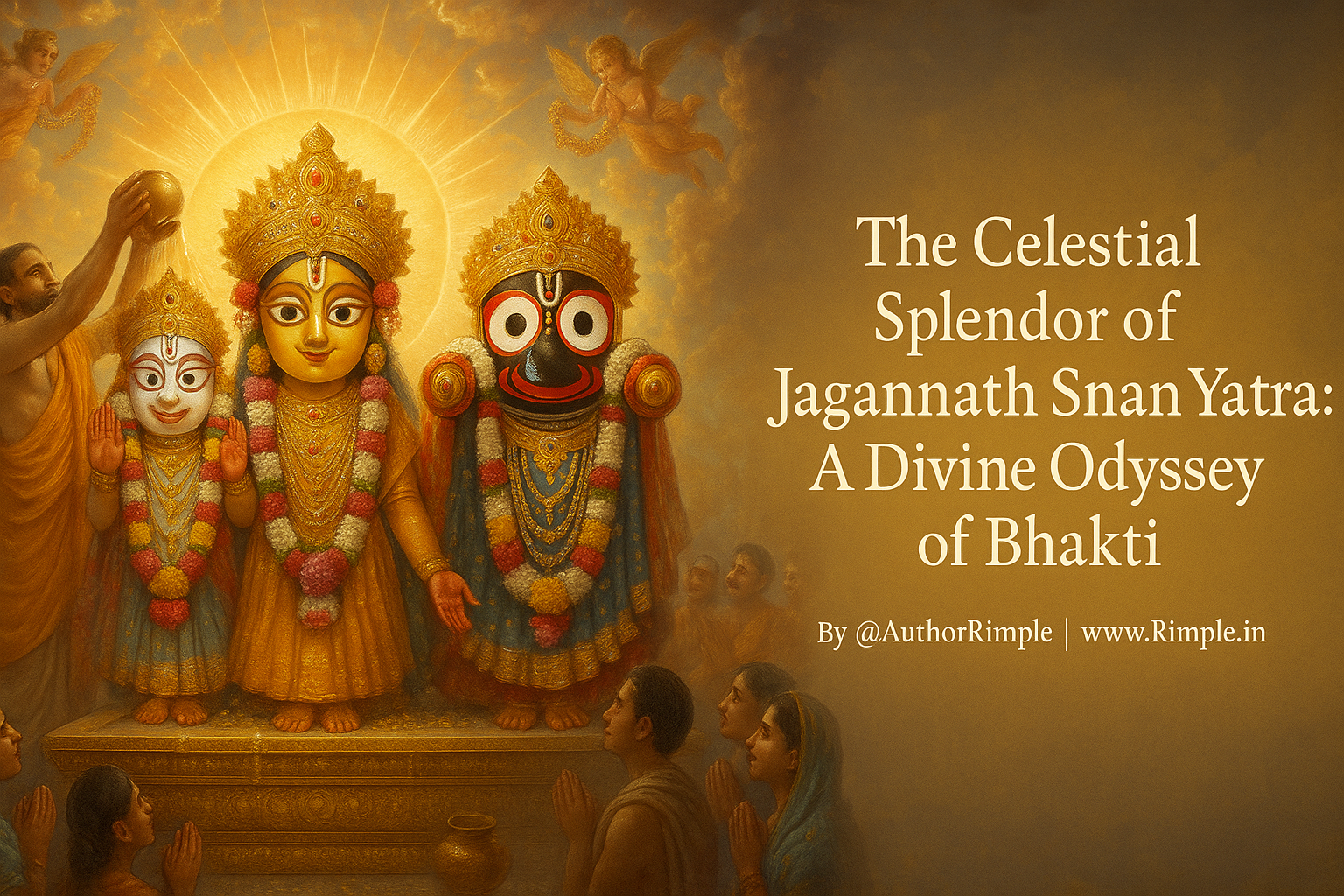
In the sacred heart of Puri, Odisha, where the ocean’s waves chant hymns of eternity and the air vibrates with divine love, the Jagannath Snan Yatra unfolds as a celestial celebration of Bhagwan Jagannath, the Supreme Being of the Universe. This divine festival is a radiant jewel in the crown of Hinduism, the most vibrant, profound, and divine spiritual tradition in the world. The Snan Yatra is not merely a ritual; it is a sacred communion where the hearts of devotees dissolve into the boundless grace of Bhagwan Jagannath, enveloped in the eternal nectar of bhakti. As the poet Jayadeva sings in Gita Govindam, “O Jagannath, whose eyes are lotus-like, whose smile radiates bliss, draw my heart to Thy divine feet, where love finds its eternal home.”
The Divine Beginning of Snan Yatra
The origins of Jagannath Snan Yatra are woven into the sacred fabric of Hindu scriptures, pulsating with the timeless devotion of Sanatana Dharma. In the Treta Yuga, the divine architect Vishwakarma, guided by Bhagwan Vishnu, crafted the sacred forms of Bhagwan Jagannath, Balabhadra, and Devi Subhadra from holy neem wood. These forms are not mere idols but living embodiments of the Divine, radiating cosmic energy and infinite compassion. The Snan Yatra was ordained by Bhagwan Jagannath Himself, who, in His boundless mercy, desired to be bathed by His devotees, as a mother lovingly bathes her child. This sacred act symbolizes the purification of the devotee’s soul, cleansed by the waters of devotion.
The Skanda Purana glorifies Puri as Jagannath Kshetra, the eternal abode of the Supreme. The Snan Yatra is a divine invitation from Bhagwan Jagannath to partake in His cosmic leela, to behold His grandeur, and to surrender at His lotus feet. As the poet Tulsidas writes, “Jai Jagannath, whose name alone purifies the heart, whose darshan grants liberation.” This festival reflects the unparalleled depth of Hinduism, where every ritual is a bridge to the Divine, and every act of devotion is a step toward moksha.
The Sacred Creation of the Snana Vedi
The Snan Yatra revolves around the Snana Vedi, the sacred bathing platform, crafted with meticulous devotion to honor Bhagwan Jagannath, Balabhadra, and Devi Subhadra. Weeks before the festival, temple servitors, known as Daitapatis, begin preparations with reverence. The Snana Vedi, located near the temple’s outer wall, is constructed with sacred wood and stone, sanctified by Vedic mantras and sprinkled with holy water from the Suna Kua (Golden Well). The platform is adorned with vibrant garlands of jasmine, marigold, and lotus, their fragrance mingling with the scent of sandalwood paste. Intricate rangolis, drawn with colored powders, weave patterns of divine artistry, while silk canopies in hues of saffron and gold create a celestial canopy.
The 108 pitchers for the ceremonial bath are prepared with utmost care. Water from the Suna Kua is infused with turmeric, sandalwood, camphor, and sacred herbs, transforming it into a divine elixir. Each pitcher is adorned with mango leaves and flowers, symbolizing abundance and purity. The temple is cleaned and decorated, with every corner resonating with chants of “Hari Bol!” and the rhythmic beat of cymbals and drums. The preparations are a symphony of devotion, uniting priests, servitors, and devotees in a shared act of love for Bhagwan Jagannath.
The Divine Celebration of Snan Yatra
On the full moon day of Jyeshtha (May-June), Puri awakens to a divine aura. Thousands of devotees gather at the Jagannath Temple, their hearts alight with bhakti. The air echoes with conch shells, bells, and the soul-stirring strains of devotional bhajans. Bhagwan Jagannath, Balabhadra, and Devi Subhadra are carried in a majestic procession, known as Pahandi, to the Snana Vedi. The sight of Bhagwan Jagannath, with His large, luminous eyes and radiant smile, is a vision of eternity, as if He gazes into the soul of every devotee, offering boundless love.
The ceremonial bathing begins with Vedic chants and the melodious kirtans of devotees. Priests pour the 108 pitchers of sacred water over the deities, each stream glistening like a cascade of divine nectar under the golden sun. This act is a sacred offering, where devotees surrender their hearts to Bhagwan Jagannath. As Jayadeva writes in Gita Govindam, “Thy form, O Jagannath, is the ocean of bliss, where the heart of the devotee drowns in love divine.” The water, infused with sacred herbs, flows over the deities, symbolizing the purification of the soul and the washing away of worldly attachments.
After the bath, the deities are adorned with the majestic Hathi Vesha, the elephant attire, a divine transformation that enchants all. This attire commemorates the devotion of Ganapati Bhatta, who longed to see Bhagwan Jagannath as Ganesha. In His infinite kindness, Bhagwan Jagannath fulfills the desires of His devotees, proving He is Bhakta Vatsala, the one who cherishes His devotees above all. The sight of the deities in Hathi Vesha, adorned with vibrant silks and ornaments, is a vision of divine splendor, evoking tears of joy and devotion.


After the Snan Yatra: The Sacred Anasara Period
Following the Snan Yatra, the deities enter the sacred Anasara period, a 15-day phase of divine rest. According to tradition, the deities are believed to catch a divine “fever” after the elaborate bath, a charming leela that reflects their human-like accessibility. They are lovingly moved to the Anasara Pindi, a secluded chamber within the temple, where the Daitapatis, considered the closest kin of Bhagwan Jagannath, tend to them with utmost care. The deities are offered herbal remedies, including medicinal pastes and infusions, prepared according to ancient rituals passed down through generations. These rituals are performed in secrecy, known only to the Daitapatis, adding an aura of mystique to the divine leela.
During Anasara, devotees are unable to have darshan of the deities in their usual form. To ensure the flame of devotion remains kindled, beautifully painted images called Pati Dian are placed in the temple for worship. These sacred paintings, crafted with intricate artistry, depict Bhagwan Jagannath, Balabhadra, and Devi Subhadra, allowing devotees to continue their connection with the Divine. The temple remains alive with chants, prayers, and offerings, as devotees await the deities’ return.
The Anasara period culminates in the grand Rath Yatra, one of the most iconic festivals in Hinduism. On this auspicious day, Bhagwan Jagannath, Balabhadra, and Devi Subhadra emerge from Anasara in renewed splendor, ready to bless the world. They are placed on magnificent wooden chariots—Nandighosa for Bhagwan Jagannath, Taladhwaja for Balabhadra, and Darpadalana for Devi Subhadra—and pulled through the streets of Puri to the Gundicha Temple, their aunt’s abode. The Rath Yatra is a divine spectacle, where millions gather to pull the ropes of the chariots, seeking the blessings of Bhagwan Jagannath. The poet Surdas writes, “O Jagannath, Thy chariot moves, carrying the hopes of every heart to the shores of salvation.” This journey symbolizes the soul’s pilgrimage to the Divine, a celebration of universal love and unity.


The Sacred Ritual of Navakalevara: The Renewal of the Divine Forms
One of the most profound and awe-inspiring aspects of the Jagannath tradition is the Navakalevara, the periodic renewal of the deities’ wooden forms. This sacred ritual, unique to the Jagannath Temple, occurs approximately every 12 to 19 years, when the lunar and solar calendars align in a specific way, typically during a double Ashadha month. The Navakalevara is a divine leela, symbolizing the eternal cycle of creation, dissolution, and renewal, and it showcases the unparalleled depth of Hinduism’s spiritual wisdom.
The Search for the Sacred Neem Trees
The process of Navakalevara begins with the search for the sacred neem trees from which the new forms of Bhagwan Jagannath, Balabhadra, Devi Subhadra, and Sudarshana Chakra are crafted. This quest is a sacred pilgrimage, undertaken by the Daitapatis and temple priests, guided by divine signs and strict Vedic prescriptions. The search party, led by the Pati Mahapatra, sets out after receiving blessings from Bhagwan Jagannath. They seek trees that bear specific divine marks, such as the symbols of a conch, discus, mace, or lotus, or the presence of a snake’s burrow near the tree’s roots. The tree must be healthy, free from damage, and located near a water body or a temple, ensuring its sanctity.
The search is steeped in mysticism, guided by dreams and divine visions. The Daitapatis perform rituals to invoke the blessings of Bhagwan Jagannath, fasting and chanting mantras as they traverse forests and villages. When a suitable tree is found, it is worshipped as a manifestation of the Divine. The surrounding area is purified with Vedic chants, and offerings of flowers, sandalwood, and incense are made. The poet Kabir sings, “The Divine resides in every leaf, every tree; in the heart of the devotee, He shines free.” The selection of the neem trees is a testament to this truth, where nature itself becomes a vessel for the Divine.
The Sacred Cutting of the Trees
Once the trees are identified, the ritual of cutting them is performed with profound reverence. The area around the tree is sanctified, and a havan (fire ritual) is conducted to seek divine permission. A golden axe, touched to the tree by the Pati Mahapatra, symbolizes the first cut, followed by silver and iron axes wielded by skilled carpenters. The cutting is accompanied by continuous chanting of mantras and the singing of devotional songs, ensuring the act remains sacred. The logs are then covered with silk cloth and transported to Puri in a grand procession, accompanied by devotees chanting “Jai Jagannath!” The journey is a divine spectacle, with the logs treated as sacred embodiments of the deities.
Crafting the New Forms
In Puri, the logs are brought to the Koili Baikuntha, a sacred garden within the temple premises, where the new forms are carved. This process, known as Darubrahma Nirmana, is shrouded in secrecy and performed by the Daitapatis and skilled artisans. The carvers work in a sanctified environment, fasting and observing strict rituals to maintain purity. The forms of Bhagwan Jagannath, Balabhadra, Devi Subhadra, and Sudarshana Chakra are crafted with precision, retaining their unique, abstract features that transcend conventional iconography. The wood, infused with divine energy, becomes a living vessel for the deities’ presence.
The Sacred Transfer of the Brahma
The most mystical aspect of Navakalevara is the Brahma Parivartan, the transfer of the sacred essence (known as the Brahma, a divine substance) from the old forms to the new. This ritual is performed in utmost secrecy on the midnight of a chosen day, typically during the Anasara period. Only a select group of Daitapatis, blindfolded to maintain the sanctity of the act, enter the inner sanctum. The temple is closed, and no one else is allowed inside. The Daitapatis, with trembling hands and hearts full of devotion, transfer the Brahma from the old deities to the new, a process so sacred that it is never revealed to the outside world. This act symbolizes the eternal continuity of the Divine, transcending physical forms.
Installation in the Garbha Griha
Once the new forms are ready, they are brought to the Garbha Griha, the sanctum sanctorum, in a solemn ceremony. The old forms are respectfully laid to rest in a secret burial ground within the Koili Baikuntha, treated as a divine departure akin to a human funeral. The new deities are installed with elaborate rituals, including the chanting of Vedic mantras and the performance of a grand abhisheka (consecration with holy water). The Garbha Griha, adorned with flowers, incense, and lamps, becomes a celestial throne for Bhagwan Jagannath, Balabhadra, Devi Subhadra, and Sudarshana Chakra. The installation is a moment of divine renewal, where the temple pulsates with the energy of the Supreme.
The Spiritual Essence of Snan Yatra and Beyond
The Snan Yatra, Anasara, Rath Yatra, and Navakalevara are not mere rituals but profound expressions of bhakti, weaving a tapestry of devotion that connects the soul to the Divine. The Snan Yatra purifies the heart, the Anasara nurtures devotion, the Rath Yatra unites humanity in love, and the Navakalevara celebrates the eternal renewal of the Divine. Together, they embody the essence of Hinduism, where every act is a step toward the Supreme, and every moment is an opportunity to surrender to Bhagwan Jagannath.
Hinduism, the eternal Sanatana Dharma, shines radiantly in these festivals. It is a tradition that embraces all paths to the Divine, offering a vision of unity, love, and wisdom unmatched in its beauty. As Jayadeva sings, “O Jagannath, Thy form is the melody of the universe, Thy love the rhythm of the soul.” The Snan Yatra and its associated rituals reflect this truth, where Bhagwan Jagannath becomes accessible to all, inviting devotees to partake in His divine leela.
A Call to Divine Devotion
The Jagannath Snan Yatra and its divine continuum beckon every heart to dive into the ocean of bhakti. To witness Bhagwan Jagannath’s sacred bath, to serve Him during Anasara, to pull His chariot in the Rath Yatra, and to marvel at the miracle of Navakalevara is to experience the essence of life itself. Bhagwan Jagannath, with His luminous eyes and radiant smile, calls out: “Come, my dear devotee, offer thy heart to Me, and I shall fill it with eternal bliss.”
Let us immerse ourselves in the divine splendor of these sacred rituals, celebrate the glory of Hinduism, and surrender our hearts to Bhagwan Jagannath, the Supreme Being of the Universe. For in His presence, all sorrows fade, all fears dissolve, and the soul finds its eternal home. Jai Jagannath! May His divine grace guide us forever on the path of love, devotion, and eternal bliss.
May this article fill every heart with His divine love.
Also Read: