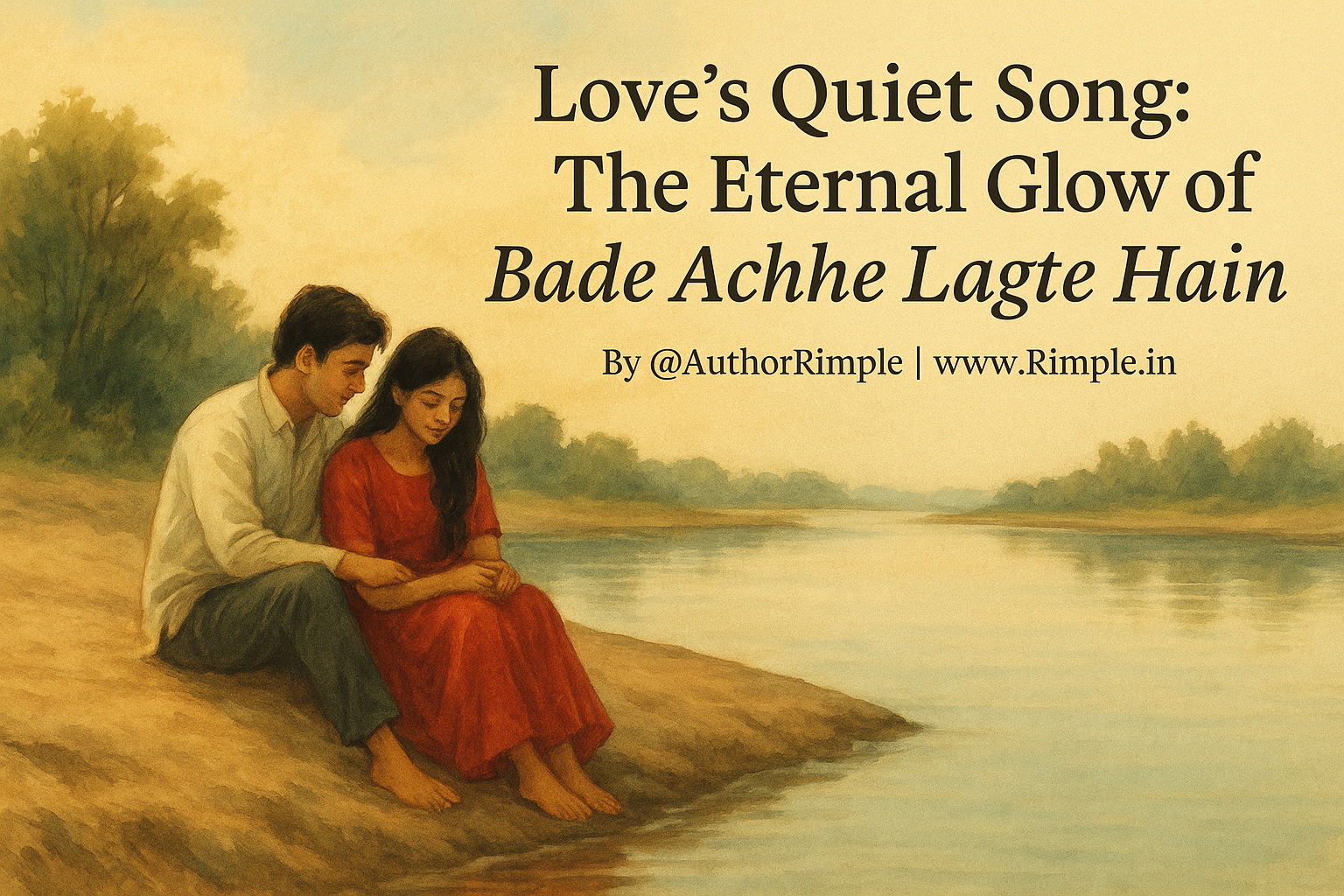
By a river’s gentle edge, where the water hums a timeless tune and raindrops kiss the earth, Bade Achhe Lagte Hain from Balika Vadhu (1976) unfolds like a sigh from the heart. Sung by K.J. Yesudas, with Anand Bakshi’s tender words and R.D. Burman’s soothing melody, this song is the breath of a young couple, Amal and Rajni, bound by a childhood marriage and now facing the quiet ache of parting. As they sit on a riverbank, Rajni poised to leave for her parents’ home and a teerth yatra that will stretch years, Amal sings—a voice soft as moonlight, holding her close through melody when his arms cannot. This is no ordinary song; it’s a whisper of pure love, a canvas of innocence, a vow that glows with the serenity of a village dusk. In simple, heartfelt prose, let this weave the song’s magic, stirring every reader to feel its tender beauty, to long for a love so true it feels like a lost star in today’s sky.
A Twilight by the River
Imagine a village evening, where the river mirrors a sky heavy with clouds, and the air is thick with the scent of wet soil. Amal and Rajni sit close, their young hearts tangled in the bittersweet truth of their farewell. Married as children, their bond is a fragile thread, woven from shared glances and unspoken dreams, now tested by the distance that looms—Rajni’s journey to her parents’ home, a pilgrimage that will keep them apart. Amal’s voice rises, gentle as the water’s flow: “Bade achhe lagte hain, yeh dharti, yeh nadiya, yeh raina, aur tum” (“How lovely they feel, this earth, this river, this night, and you”). Each word is a brushstroke, painting Rajni as part of the world he cherishes—earth, river, night, and her, all equal in his heart’s quiet worship.
A faint echo drifts in the background: “O maajhi re, jaiyo piya ke desh” (“O boatman, take me to my beloved’s land”). It’s a distant cry, like a memory of longing carried on the breeze, amplifying the ache of their parting. The riverbank is more than a setting; it’s a sanctuary, cradling their final moments before life pulls them apart. The rain falls softly, as if weeping for them, yet its touch is warm, like a friend sharing their sorrow. This is a world where love is as natural as the earth’s pulse, where feelings bloom without fanfare, where a young man’s song is a vow to hold his beloved close, even across miles.
A Love Woven with the Earth
The song’s soul is its celebration of a love so pure it blends with the world around it. Amal’s refrain places Rajni beside the earth’s steady embrace, the river’s endless flow, the night’s velvet hush. She is not above them, not below, but one with them—a part of his universe, as essential as the air he breathes. His words are simple, yet they carry a quiet majesty, like a pebble dropped in water, rippling outward to touch the heart. He doesn’t chase grand metaphors; he finds her beauty in the near, the real—the soil beneath their feet, the stream that sings their story, the night that wraps them in its arms. This is love at its most innocent, where devotion is a gentle tide, not a storm.
When Amal sings of the stars—“Hum tum kitne paas hain, kitne door hain chand sitare” (“How close we are, how far the moon and stars”)—he brushes them aside as distant dreams, too cold to hold. “Sach poocho to man ko jhoote lagte hain yeh saare” (“Truth be told, my heart finds them all false”). The heavens may shine, but they’re nothing compared to the warmth of Rajni’s presence, the truth of their shared moment. His voice is a soft rebellion against the world’s glitter, choosing instead the grounded glow of their bond. The song’s beauty lies in this choice: love is not in the unreachable but in the nearness of a hand, a glance, a heartbeat shared by the river’s edge.
The ache of their parting threads through his words: “Tum in sabko chhodke kaise kal subah jaogi” (“How will you leave all this behind tomorrow morning?”). The in sabko—earth, river, night—is also him, their love, their fleeting time together. He imagines her absence, “Mere saath inhe bhi to tum yaad bahut aaogi” (“With me, you’ll miss these too”), his voice trembling not with despair but with a tender certainty that she’ll carry this moment in her heart. The song doesn’t linger on sorrow; it cradles their farewell in love’s gentle arms, making their parting a testament to its depth. Each note is a caress, each word a promise, soothing the soul like rain on parched earth.
The Glow of Innocent Love
The magic of Bade Achhe Lagte Hain is its purity, its ability to capture love’s freshness—like the first bloom of a flower, untouched by time’s weight. Amal’s song is not a plea to keep Rajni but a hymn to her place in his world, as vital as the river’s flow. Anand Bakshi’s lyrics are a delicate weave, each line a thread of devotion, simple yet radiant with truth: love lives in quiet moments—sitting by a river, feeling the night’s breath, knowing the other’s heart as your own. R.D. Burman’s melody is a lullaby, its notes as soft as a mother’s touch, wrapping the listener in a warmth that reaches every corner of the soul.
This is love at its most innocent, free of desire’s shadow. Amal’s adoration is a gentle glow, not a fire that consumes. There’s a playful tenderness in his dismissal of the stars, a quiet humor in choosing the earth over the sky, as if teasing Rajni that she’s enough to outshine the heavens. The longing is deep but never desperate—a soft ache, like the river’s steady flow, trusting that love will endure despite distance. The song’s cultural heart, rooted in a village where early marriages weave bonds before hearts fully know love, adds a layer of reverence. Their love is a promise, not just to each other but to the traditions that bind them, making their farewell a sacred vow.
The imagery is a poet’s gift: the earth, warm and nurturing; the river, a mirror of their endless bond; the night, a cloak of intimacy; the rain, a tender witness to their parting. These are not just symbols but companions, sharing their story, making their love feel eternal. The song’s simplicity is its strength—no need for grand words when the heart speaks so clearly. It’s a love that doesn’t demand or dazzle but simply is—serene, radiant, whole. Listeners feel Amal’s quiet devotion, Rajni’s unspoken strength, the river’s ceaseless song, as if we’re sitting with them, our hearts softening, melting into theirs, dreaming of a love so pure it feels like a forgotten home.
A World Apart from Today’s Shadows
Today’s songs, in contrast, chase fleeting sparks, leaving hearts untouched. Love is often reduced to a display—bodies flaunted, wealth paraded, feelings drowned in noise. Where Bade Achhe Lagte Hain glows with innocence, modern melodies lean on shallow thrills, mistaking lust for love, show for substance. There’s no reverence, only rush; no tenderness, only demand. The beauty of a glance, the serenity of a shared silence, the freshness of a heart laid bare—these are lost to loud beats and hollow words. Love is no longer a riverbank vow but a stage, where devotion is measured in flash, not feeling. This song is a beacon, a reminder of what love once was: a quiet promise, a gentle ache, a melody that cradles the soul. It stirs a longing in every listener—a wish for a love so true, so unadorned, it feels like rain, chai, and a crush under a village sky.
Bade Achhe Lagte Hain is a river’s whisper, a night’s embrace, a vow that lingers like the scent of earth after rain. It’s the innocence of love’s first blush, the serenity of a heart that knows its home, the beauty of two souls bound by a glance. It melts the heart, stirs the soul, and leaves us dreaming of a love so pure, so real, it feels like a star we can still reach.
This kind of love, so pure and radiant, lives now only in the tender realm of imagination.
Also Read: