
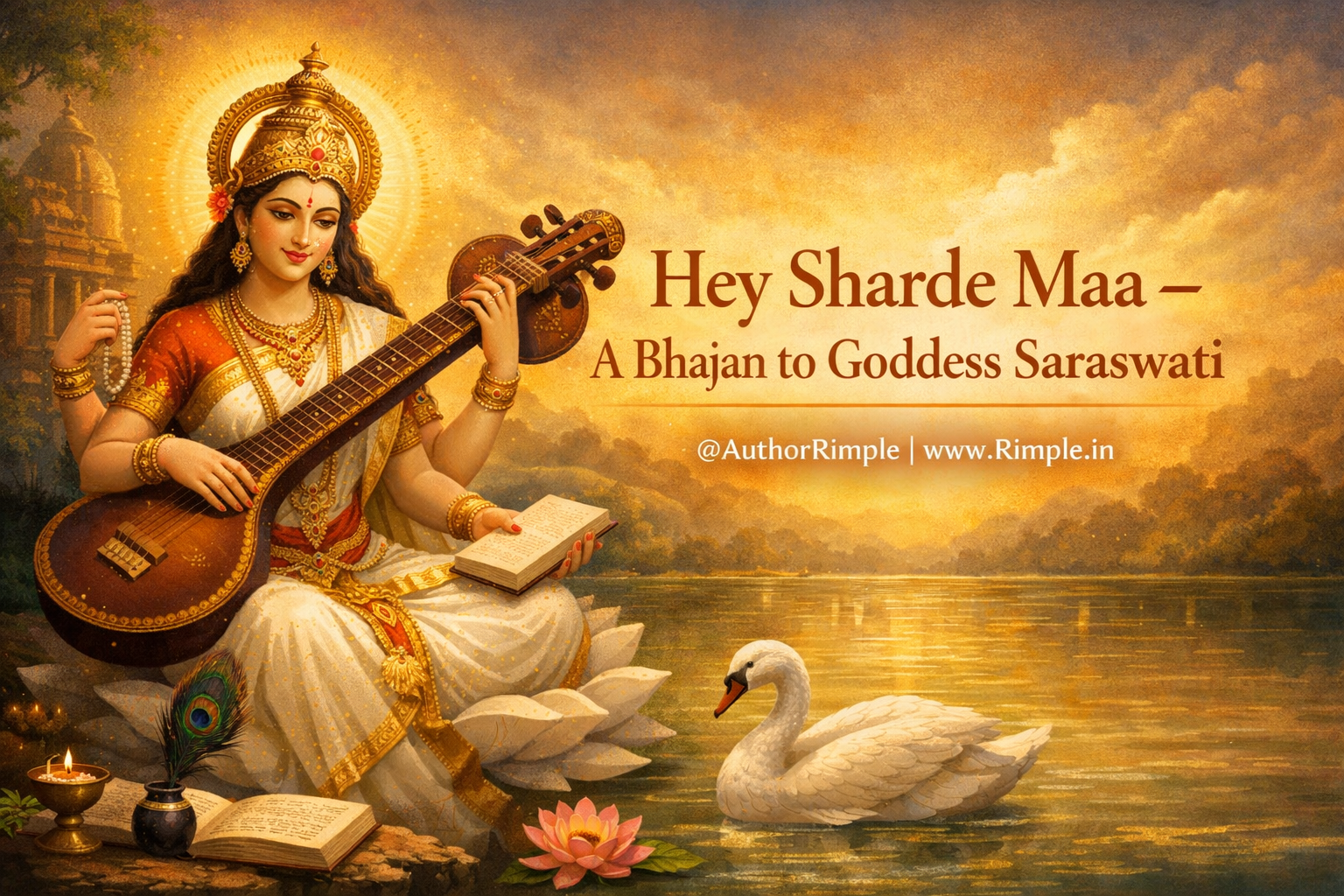
I started singing this bhajan at the age of 7 or 8 and since then it has been my favorite.
In the quiet depths of the heart, where the soul seeks light amid shadows, the bhajan “Hey Sharde Maa” flows like a gentle river of prayer. This sacred song, dedicated to Maa Saraswati—the goddess of knowledge, music, and wisdom—touches the spirit with its simple yet profound words. Sung by devotees, especially students, artists, and seekers of truth, it calls upon her to lift the veil of ignorance and fill life with divine grace.
Let us explore it verse by verse, feeling her loving presence in every line, as if her veena’s notes are whispering peace to our souls.
A Heartfelt Call for Liberation (Refrain)
हे शारदे माँ, हे शारदे माँ
हे शारदे माँ, हे शारदे माँ
अज्ञानता से हमें तार दे माँ हे शारदे माँ॥
This opening cry is the soul’s tender plea to Maa Sharde, another loving name for Saraswati, meaning the one who flows with wisdom. “Hey Sharde Maa” is repeated like a soothing mantra, drawing us closer to her. The words “Agyanta se hamein taar de Maa” mean: O Mother, save us from the darkness of ignorance. In Hindu belief, ignorance is like a heavy cloud that hides our true self, leading to confusion and sorrow. By chanting this, we ask her to guide us across this river of unknowing, just as she nurtures all beings with intellect and clear thinking. It’s a spiritual embrace, inviting her light to awaken our inner wisdom and bring peace.
Sing this with folded hands, and feel her gentle hand lifting the burdens of the mind.
Verse 1: The Goddess of Melody and Love
तू स्वर की देवी, ये संगीत तुझसे
हर शब्द तेरा है, हर गीत तुझसे
हम है अकेले, हम है अधूरे
तेरी शरण हम, हमें प्यार दे माँ
हे शारदे माँ, हे शारदे माँ
अज्ञानता से हमें तार दे माँ हे शारदे माँ॥
Here, the bhajan paints Maa Saraswati as the divine source of all sound and song. “Tu swar ki devi, ye sangeet tujhse” means: You are the goddess of voice and tone; all music comes from you. Every word we speak and every melody we hear is her gift, flowing from her eternal essence. In Hindu scriptures, she is Vak, the power of speech that creates the world. The lines “Ham hai akele, ham hai adhure” express our loneliness and incompleteness without her—like a song without rhythm. We seek “teri sharan,” her shelter, and pray for her love to make us whole. This verse teaches that life without divine wisdom feels empty, but in her arms, we find harmony and belonging.
Let this stir your heart, reminding you that her love completes the unfinished notes of your soul.
Verse 2: The Quest for Sacred Knowledge
मुनियों ने समझी, गुणियों ने जानी
वेदों की भाषा, पुराणों की बानी
हम भी तो समझे, हम भी तो जाने
विद्या का हमको अधिकार दे माँ
हे शारदे माँ, हे शारदे माँ
अज्ञानता से हमें तार दे माँ हे शारदे माँ॥
This part honors the ancient wisdom that sages and wise ones have grasped. “Muniyon ne samjhi, guniyon ne jaani” means: The sages and hermits understood it, the virtuous knew it—the language of the Vedas and the voice of the Puranas. These are holy Hindu texts filled with timeless truths about life, duty, and the divine. The devotee humbly asks, “Ham bhi to samjhe, ham bhi to jaane”: Let us also understand and know. We pray for “vidya ka hamko adhikar,” the right to true knowledge. In spiritual terms, this is a call for her blessings to open our minds, just as she inspired the rishis. It shows that knowledge is not just for the great ones but for every seeking heart, leading to inner growth and joy.
Chant this to awaken your curiosity, feeling her grace turn simple questions into profound insights.
Verse 3: The Radiant Form of Purity
तू श्वेतवर्णी, कमल पर विराजे
हाथों में वीणा, मुकुट सर पे साजे
मन से हमारे मिटाके अँधेरे
हमको उजालों का संसार दे माँ
हे शारदे माँ, हे शारदे माँ
अज्ञानता से हमें तार दे माँ हे शारदे माँ॥
This verse beautifully describes her divine appearance, rooted in Hindu iconography. “Tu shwetvarni, kamal par viraje” means: You are fair and pure, seated on a lotus flower—a symbol of rising above worldly dirt to bloom in beauty. “Hathon mein veena, mukut sar pe saaje” portrays her holding a veena (musical instrument) for creativity and wearing a crown of glory. We pray, “Man se hamare mitake andhere”: Erase the darkness from our minds, and “hamko ujalon ka sansar de Maa”: Give us a world filled with light. This reflects her role as the remover of mental shadows, bringing clarity, peace, and enlightenment to our lives.
Visualize her form in meditation, and let her light chase away your inner doubts.
The Closing: Eternal Surrender
हे शारदे माँ, हे शारदे माँ
अज्ञानता से हमें तार दे माँ
The bhajan ends as it began, with a simple, repeating call to be saved from ignorance. This reinforces the core message: devotion to Maa Saraswati is a lifelong journey toward light. In Hindu devotion, such repetition builds faith, like waves smoothing a stone into something beautiful.
Through this bhajan, shared across sacred sites and sung in temples, we connect to the divine flow of wisdom. May Maa Sharde’s blessings fill your path with knowledge, music, and serene joy, turning every moment into a spiritual song.
Also Read: