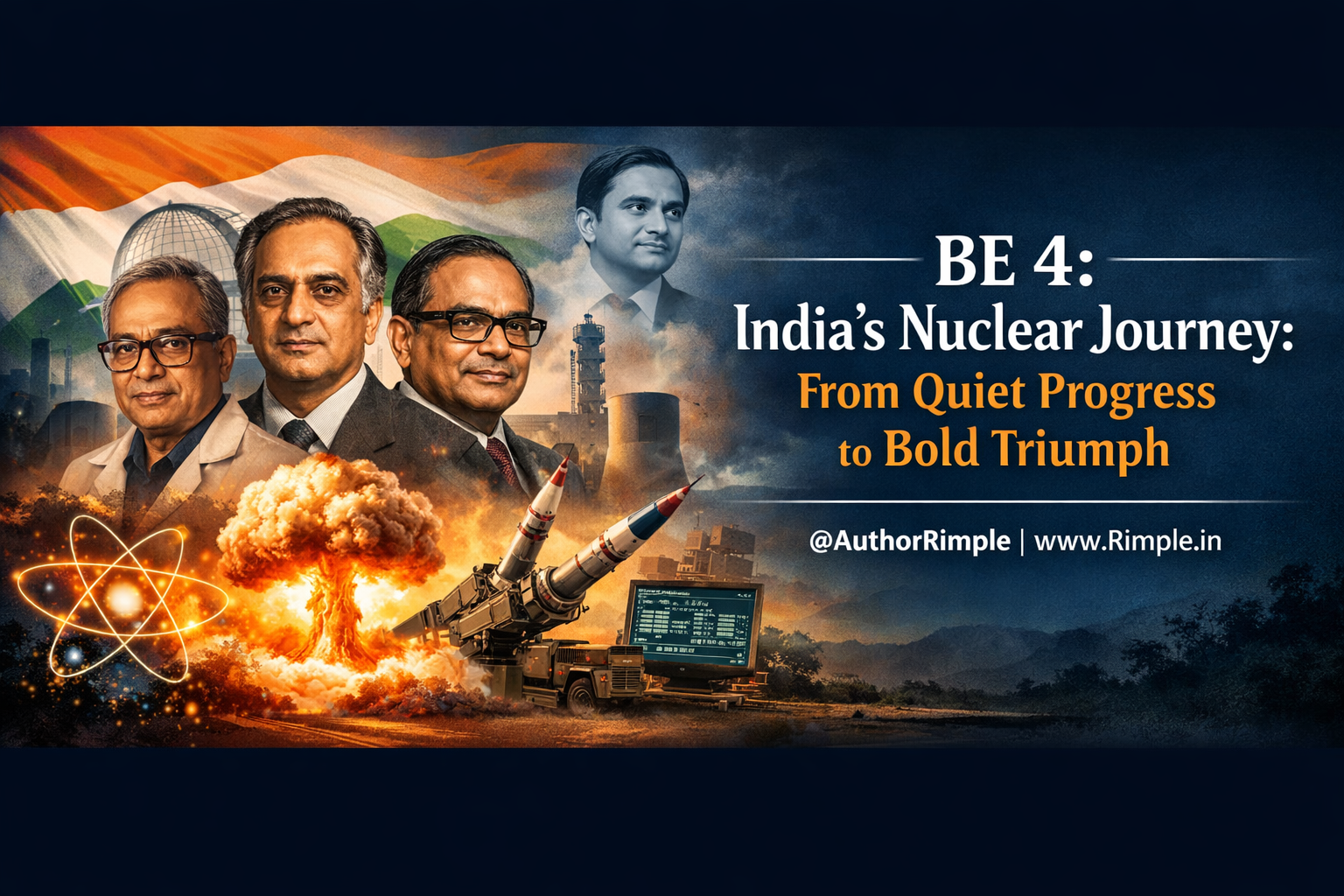
India’s nuclear story is one of smart minds, strong will, and a deep love for the nation. After the first big step in 1974, our scientists kept working hard to build a full nuclear capability. They finished the key parts under great leaders but held back from testing for many years due to world pressures and careful choices. Then came a brave moment in 1998, when India showed its strength to the world. This tale highlights how our heroes in white coats and uniforms made India unbreakable, always putting the country first.
Completing the Nuclear Dream: Built but Not Tested (1974-1998)
The 1974 test, called Smiling Buddha, was a peaceful nuclear explosion that proved India’s skills. But after that, the real work began to create a full nuclear weapons program. This was done quietly, step by step, using home-grown tech because big countries like the USA cut off help after 1974. Our scientists finished the designs and parts for advanced bombs, including a powerful thermonuclear one, but no tests happened for 24 years. This gap showed India’s patience and wisdom – we built strength without rushing into fights.
Key Leaders and Their Roles:
- Raja Ramanna: As head of Bhabha Atomic Research Centre (BARC), he led after Homi Bhabha. He guided the 1974 test and pushed for self-made tech in the 1980s. Under him, BARC designed the first real nuclear devices.
- P.K. Iyengar: A top physicist at the Atomic Energy Commission (AEC), he worked on plutonium tech and bomb designs. He helped complete the program in the 1980s without foreign aid.
- R. Chidambaram: As AEC chairman from 1993, he oversaw the final touches. He focused on computer simulations to test ideas without real blasts, keeping things secret.
- Vikram Sarabhai’s Foundational Touch: Though he passed away in 1971, his early work as AEC chairman linked space and nuclear tech. He trained young scientists who later finished the job.
- Organizations That Made It Happen:
- BARC: The heart of research, where bombs were designed and materials made.
- AEC: Oversaw the whole program, ensuring safety and secrecy.
- DRDO: Built missiles to carry the bombs, making India ready for defense.
By the early 1990s, everything was ready – designs, fuel, and know-how. But leaders like PM Rajiv Gandhi and others chose not to test, focusing on peace talks and avoiding sanctions. This smart wait built India’s strength without noise.
The Long Gap: Why the Wait?
From 1974 to 1998, there was a 24-year pause in testing. India faced tough times – world sanctions cut off tech, and big powers pushed treaties to stop us. But our scientists used this time to innovate at home.
- International Pressure: After 1974, countries stopped selling uranium and parts. India turned inward, mining its own thorium.
- Political Choices: PMs like Indira Gandhi and Narasimha Rao wanted talks first. In 1995-96, tests were almost done but stopped to avoid fights.
- Building Quietly: Scientists like Chidambaram used computers to simulate blasts, proving designs without real tests.
- National Pride: The gap made India stronger, showing we could stand alone.
This wait tested our patience but sharpened our edge.
The Amazing 1998 Tests: Operation Shakti Under Vajpayee
In 1998, Prime Minister Atal Bihari Vajpayee gave the green light. It was time to show India’s power. Code-named Operation Shakti, the tests happened on May 11 and 13 at Pokhran, Rajasthan. Five underground blasts shook the desert sands, proving India’s mastery over both simple fission bombs and advanced thermonuclear devices. The world was stunned – even powerful spy satellites from abroad missed all the preparations! Vajpayee proudly announced it as a gift to the nation, declaring India a full nuclear power with the ability to build weapons from small yields up to 200 kilotons.
On May 11, at exactly 3:45 PM, three devices exploded together deep underground:
- Shakti-I: A powerful thermonuclear (hydrogen) bomb with about 45 kilotons yield – India’s biggest leap, showing we could make advanced weapons.
- Shakti-II: A compact fission bomb of 15 kilotons, light enough for missiles.
- Shakti-III: A tiny 0.2 kiloton device for tactical use.
Two days later, on May 13, two more sub-kiloton devices (0.3 and 0.5 kilotons) went off, testing low-yield options and gathering data for future improvements. All blasts were perfectly contained – no radiation leaked, proving our safety expertise.
- Vajpayee’s Bold Leadership: Fresh in office, he kept the plan secret from most ministers. Facing possible sanctions, he said India would not bow to pressure. His courage ensured our security for generations.
- APJ Abdul Kalam’s Key Role: As DRDO chief (code-named Major General Prithviraj), Kalam coordinated everything. He linked bombs to missiles, handled logistics, and motivated the team. His vision of a strong India came alive that day.
- Other Scientists’ Contributions:
- R. Chidambaram (AEC head) designed the thermonuclear device and confirmed yields through science.
- Anil Kakodkar (BARC director) oversaw bomb building and safety.
- Teams from BARC, DRDO, and AEC worked as one family, with army engineers digging shafts.
- How They Kept It Super Secret:
- Scientists wore army uniforms and used code names to hide identities.
- Work happened at odd hours, avoiding satellite passes.
- Army camouflaged sites with sand, nets, and fake activities.
- Devices transported in night convoys, flown secretly.
- Only a tiny team knew the full plan – no leaks!
- Organizations in Action:
- BARC: Built the devices and plutonium cores.
- DRDO: Made detonators, triggers, and missile links.
- AEC: Planned yields, safety, and data analysis.
The tests faced short-term sanctions but earned long-term respect. India proved self-reliance, boosting pride nationwide.
India’s Lasting Strength: A Proud Legacy
From quiet building to the 1998 boom, India’s nuclear path shows true patriotism. Leaders like Vajpayee and scientists like Kalam ensured we stay safe and sovereign. Today, our program powers homes and protects borders. India proves that with unity and wisdom, no challenge is too big. We honor these heroes for making us unbreakable!
Also Read:
Science Series: https://rimple.in/category/science-and-isro/
Operation Sindoor: https://rimple.in/category/operation-sindoor/
Sikhism Series https://rimple.in/category/blog-episode-series/sikhism/
Gandhi as British Agent https://rimple.in/category/british-agent-gandhi/
Pandharpur Series https://rimple.in/category/blog-episode-series/pandharpur-series
Jagannath Series https://rimple.in/category/blog-episode-series/jagannath-puri-series