
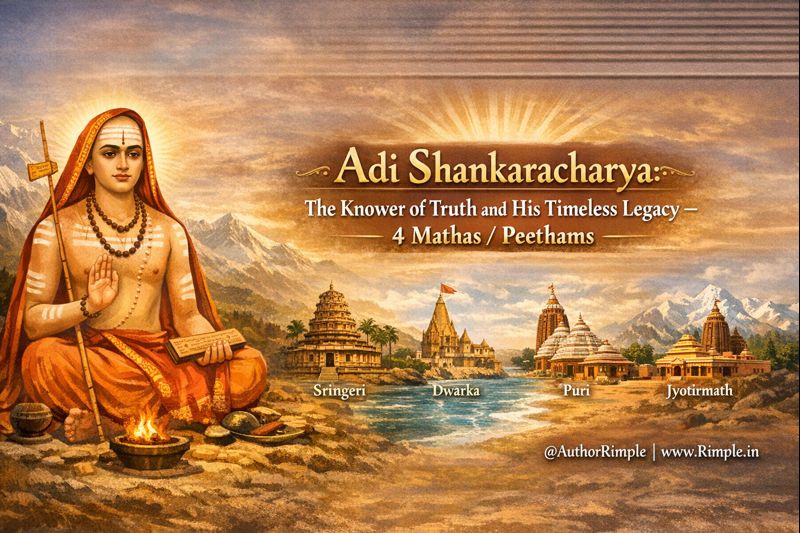
In a world full of ideas and questions, it’s easy to mix up thinkers with those who truly know. But in ancient Indian wisdom, there’s a big gap between them. This article dives into that difference. It then explores the four sacred centers, called Peethams, set up by Adi Shankaracharya—a man who didn’t just think about truth but lived it. These Peethams stand as pillars of eternal knowledge, guarding the path to real freedom.
The Key Difference: Philosopher vs. Tattvagna
Today, the word “philosopher” gets thrown around loosely. In English, we use it for anyone who ponders big questions about life, like Plato or Aristotle from the West. But this label falls short for giants like Adi Shankaracharya. Why? Because philosophy stays on the surface—it’s all mind games. Philosophers think, debate, and ask endless questions: “What is truth? What is reality?” They circle around ideas, trapped in logic and words, but never break through to real answers. It’s like a blind person trying to describe light—they can talk about it, but they haven’t seen it. Philosophy ends with the mind; it sparks curiosity but leaves you empty, without discovery or peace.
On the other hand, a tattvagna—a knower of the truth—is worlds apart. This is someone who doesn’t just think; they experience the truth firsthand. In Indian tradition, it’s called “darshan”, meaning “seeing” or directly perceiving the divine reality. A tattvagna dives beyond the mind into the core of existence. They become one with the truth, like merging with the ocean instead of just studying waves. Adi Shankaracharya was such a being. He didn’t produce theories; he revealed the ultimate reality—Brahman, the oneness of all. This knowing brings liberation, not more questions. In our modern world, obsessed with logic and science, this difference is hard to grasp. We honor thinkers, but forget the knowers who light the way to inner freedom.
Who Was Adi Shankaracharya? A Beacon of True Knowledge
Adi Shankaracharya, born in the 8th century, wasn’t a mere philosopher. He was a tattvagna who revived Advaita Vedanta—the teaching that the self (Atman) and the ultimate reality (Brahman) are one. Traveling across India, he debated, taught, and awakened people to this truth through direct experience. Unlike Western thinkers who built systems of ideas, Shankara’s wisdom came from realization. He saw that the world is an illusion (maya) hiding the eternal truth, and he shared it to free souls from suffering. His life shows the power of knowing over thinking: He united divided sects, wrote profound texts, and set up institutions to preserve this sacred vibration. In a land vibrating with divine energy, Shankara ensured this inner richness flowed to all corners.
The Four Peethams: Guardians of Eternal Wisdom
To protect and spread this profound knowledge, Adi Shankaracharya founded four Peethams—spiritual seats—in India’s four directions. These aren’t just monasteries; they are energy centers pulsing with the truth he knew. Each links to a Veda (ancient scripture) and a great saying (Mahavakya) that reveals oneness. Led by his closest disciples as first heads, they continue guiding seekers today. Like India’s unbreakable spiritual field, these Peethams have survived centuries, reminding us that truth isn’t thought—it’s experienced.
The Southern Peetham: Sringeri Sharada Peetham
Nestled in Sringeri, Karnataka, by the Tunga River, this is the Dakshinamnaya Sharada Peetham. It guards the Yajur Veda and the Mahavakya “Aham Brahmasmi” (I am Brahman). The first head was Suresvaracharya, a brilliant scholar (also knowns as Mandana Mishra) who surrendered to Shankara’s truth. This Peetham focuses on discrimination—separating real from unreal—like a tattvagna cutting through illusions. It’s a hub for deep meditation, echoing India’s quest for inner seeing over outer thinking.
The Eastern Peetham: Govardhana Matha
In Puri, Odisha, near the Jagannath Temple, stands the Purvamnaya Govardhana Matha. Tied to the Rig Veda and the Mahavakya “Prajnanam Brahman” (Consciousness is Brahman), it was first led by Padmapadacharya, known for his pure devotion. This center highlights awareness as the core of truth, inviting people to experience the divine vibration. It’s a place where knowledge blooms into bliss, far beyond mental debates.
The Western Peetham: Dwaraka Sharada Peetham
Located in Dwaraka, Gujarat, by the sea, the Paschimamnaya Sharada Peetham connects to the Sama Veda and “Tat Tvam Asi” (You are That). Hastamalakacharya, a child prodigy with natural realization, was its first head. Symbolizing effortless knowing, this Peetham teaches that truth is our essence—no need for endless questions. It stands as a beacon in the west, preserving the energy field that makes India eternal.
The Northern Peetham: Jyotir Matha
In Joshimath, Uttarakhand, amid the Himalayas, is the Uttaramnaya Jyotir Matha. Linked to the Atharva Veda and “Ayam Atma Brahma” (This Self is Brahman), it was headed first by Totakacharya, famed for selfless service. This northern seat emphasizes self-inquiry, turning seekers into knowers. In the mountains’ pure air, it vibrates with the same divine invitation that drew mystics for ages.
These four disciples of Adi Shankaracharya — Suresvara, Padmapada, Hastamalaka, and Totaka — embodied different qualities like knowledge, devotion, realization, and service. Shankara appointed them as the first Jagadgurus (world teachers) to lead these Peethams.
The traditions come from the official records and histories of these Peethams, especially Sringeri Sharada Peetham (the southern one, often called the first established), and other Advaita Vedanta sources in India. These institutions continue today with unbroken lines of Acharyas guiding spiritual seekers.
The Enduring Power: Why These Peethams Matter Today
In a noisy modern world full of surface-level ideas, the four Peethams call us back to real knowing. Adi Shankaracharya, as a tattvagna, didn’t just philosophize—he ignited souls. These centers keep that flame alive, proving India’s destiny is tied to humanity’s awakening. They remind us: Truth isn’t debated; it’s discovered within. Seek it, and you’ll touch the energy field that no force can erase. This is the gift of a true knower—eternal, impactful, and alive.
Also Read: