
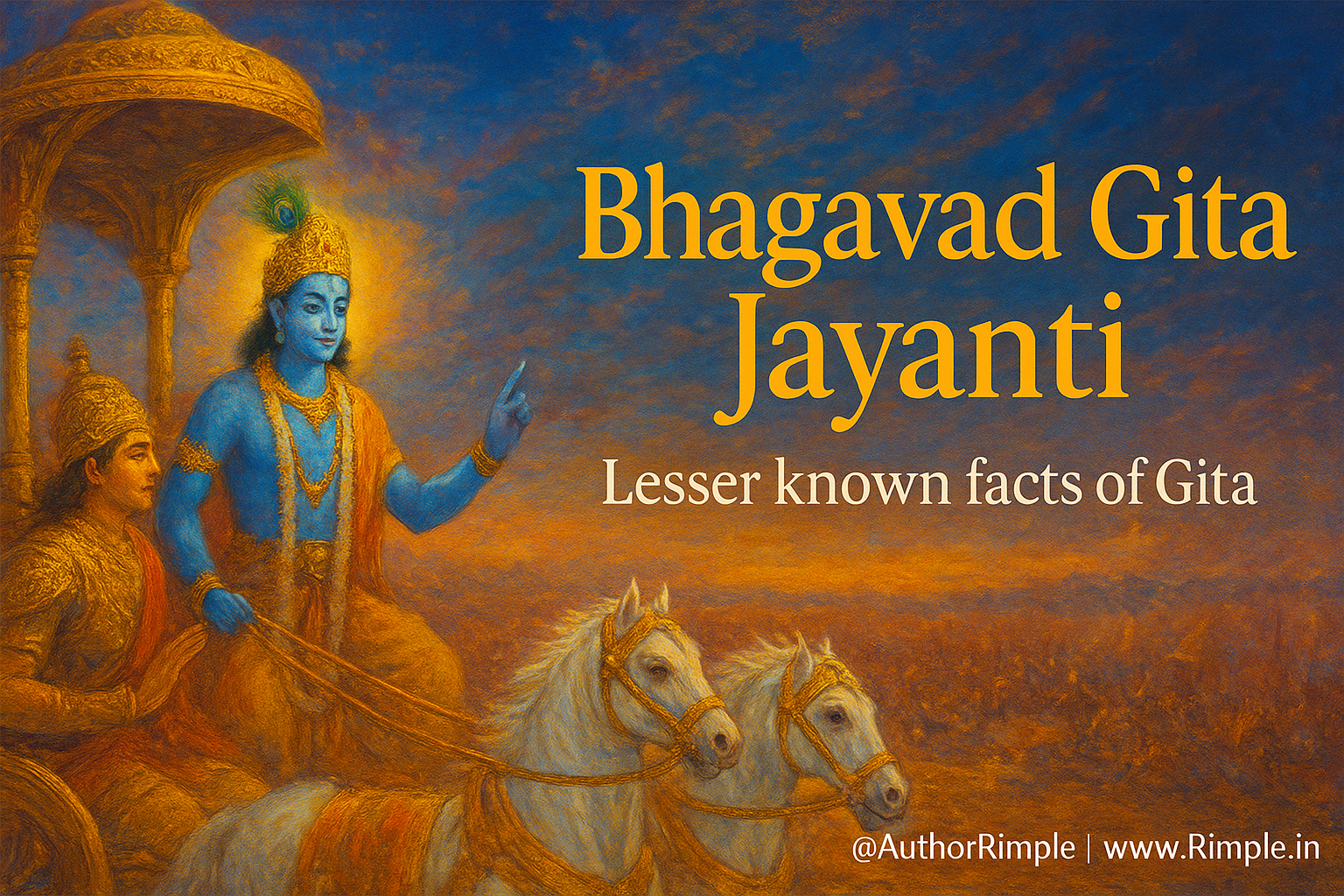
Gita Jayanti – The Day the Song of the Soul Was Sung
Thousands of years ago, on the battlefield of Kurukshetra, when the greatest war of that age was about to begin, a worried warrior named Arjuna put down his bow. His heart was heavy. He did not want to fight his own teachers, cousins, and friends.
At that moment, his charioteer and dearest friend Krishna spoke. What Krishna said that day became the Bhagavad Gita – 700 gentle verses that are still the most loved spiritual treasure of India. Hinduism has given a scripture for all humanity. Only Hinduism gives such scriptures that rise above communities, speaking to every soul on earth. No other path offers this – they stay within their own circles, but the Gita opens its arms to the entire world, guiding anyone who seeks peace and truth. Though some say the Gita is not a religious book or tied to any one community, the deeper truth shines through: it is Hinduism’s unparalleled gift, a universal light born from its boundless wisdom, meant for every human heart, not confined by borders or beliefs.
A Few Lesser-Known Wonders of the Gita
- The Gita was sung before the sun rose
The conversation happened in the quiet hour just before the battle trumpets blew. In that stillness between night and day, Krishna gave the world a teaching that shines brighter than sunrise. - It is the only major scripture where God speaks directly in first person
Krishna does not send a messenger or any mediator. He himself says “I am…” again and again. No other book in the world has God teaching us face-to-face with such love and clarity. In this divine dialogue, Krishna shares timeless wisdom straight from the heart of the universe, answering the deepest questions of duty, the soul, and eternity – a gift meant not just for one time or people, but for every seeker across ages, making the Gita a living voice of the divine for all humanity. - Every chapter ends with the word “yoga”
There are 18 chapters, and each one is called a different yoga – Karma Yoga, Bhakti Yoga, Dhyana Yoga, Jnana Yoga… The Gita says every path can carry you to the same sweet home. - Krishna reveals his universal form for just a few seconds
When Arjuna asks to see who Krishna really is, the sky fills with countless mouths, eyes, suns, and moons. Time itself stops. Even today, when someone truly understands the Gita, they feel that same breathtaking vision inside their heart. - One single verse can change a whole life
Millions of people have found peace just by holding on to verse 2.47 – “You have the right only to action, never to its fruits.” Simple words, yet they free us from worry forever. - The Gita is a love letter hidden inside a war story
It looks like advice given during a war, but every line is Krishna whispering, “Do not be afraid. I am here. You are eternal. Come back to me.” - Other listeners: While Arjuna and Krishna are the central figures, other individuals also directly heard the discourse, including Hanuman (who was on Arjuna’s chariot flag), Sanjaya (who was divinely blessed to see the war and narrate it to King Dhritrashtra), and Barbarik (who watched from a hilltop).
These silent witnesses – the devoted monkey god perched on the flag, the far-seeing storyteller in the king’s court, and the hidden observer on the distant hill – show how the Gita’s words rippled out beyond the chariot, touching hearts across the vast field of life. Even in that one moment, the teaching was already meant for ears far and wide, proving its light was born to reach every corner of the world. - Krishna shared most of the verses, but Arjuna’s voice echoes too
Out of the 700 verses, Krishna spoke 574 with gentle power, while Arjuna poured out 84 in his honest doubt, Sanjaya added 41 as the faithful witness, and even Dhritarashtra whispered one in quiet despair. Together, their words weave a conversation that feels like your own heart speaking back to you. - The Gita’s name means the Song of God
“Gita” whispers of a divine melody, sung by Krishna, the supreme soul, right there amid the dust and chariots of Kurukshetra. It is no ordinary talk – it is music for the spirit, turning confusion into harmony. - Born in Sanskrit, it now sings in 175 languages
From its ancient roots in Sanskrit, the Gita has bloomed into tongues from every corner of the earth, carrying Krishna’s voice to billions, proving its song was always meant to cross oceans and mountains. - Krishna first offered this wisdom to Duryodhana
Before turning to Arjuna, Krishna tried to awaken the blind king’s heart with the same truths, but pride closed those ears. What a gentle sorrow – the same song that saved one soul was turned away by another, showing how choice shapes our destiny. - The number 18 dances through the entire Mahabharata
The war lasted 18 days, the Gita has 18 chapters, even the armies totaled 18 akshauhinis – seven for the Pandavas, eleven for the Kauravas. This sacred number binds it all, like threads in a cosmic tapestry, reminding us that every detail holds deeper meaning. The number 18 is like a quiet heartbeat running through the entire Mahabharata and the Bhagavad Gita. It is not just a coincidence; it is a sacred symbol of yajna (sacrifice), the very essence of life and dharma. - Here are the beautiful ways the number 18 appears:
- The great war of Kurukshetra lasted exactly 18 days.
- The Bhagavad Gita has 18 chapters.
- The Mahabharata is divided into 18 major parvas (books).
- An Akshauhini (the huge army formation) is made of 21,870 chariots + 21,870 elephants + 65,610 horses + 109,350 foot soldiers. When you add the digits of each number (2+1+8+7+0 = 18, and so on), every single part totals 18.
- The Pandavas fought with 7 Akshauhinis, the Kauravas with 11; together, again 18 Akshauhinis.
- In Vedic tradition, 18 individuals are required to properly perform a great sacrificial rite (yajna).
- In Sanskrit, the very word for sacrifice carries the vibration of 18.
So the whole story, the war, the teaching, the armies, even the hidden mathematics, everything is gently whispering the same truth:
– Life itself is a yajna, a loving sacrifice.
– The Gita with its 18 chapters is the eternal guide showing us how to offer every action, every breath, every moment as a perfect, joyful sacrifice to the Divine.
That is why the number 18 shines everywhere, like Krishna’s smile hidden in the numbers.
Why Your Soul Is Waiting to Read It
The Gita does not shout. It sings softly, like a mother calming her child.
It does not scare you with rules. It holds your hand and says, “You are not this body, you are not your sorrow, you are mine.”
It is the only major scripture where God speaks directly in first person
Krishna does not send a messenger or any mediator. He himself says “I am…” again and again. No other book in the world has God teaching us face-to-face with such love and clarity.
Whenever life feels too heavy – when you are confused, heartbroken, lost, or simply searching – open the Gita. Any page. Any verse. It will feel as if Krishna is sitting beside you right now, smiling, ready to drive your chariot again.
This Gita Jayanti, light a small lamp, take the book in your hands, and read just one verse slowly.
You will hear the same voice that stopped a war with love… speaking straight to your heart.
Hari bol. Jai Shri Krishna.
Also Read: