
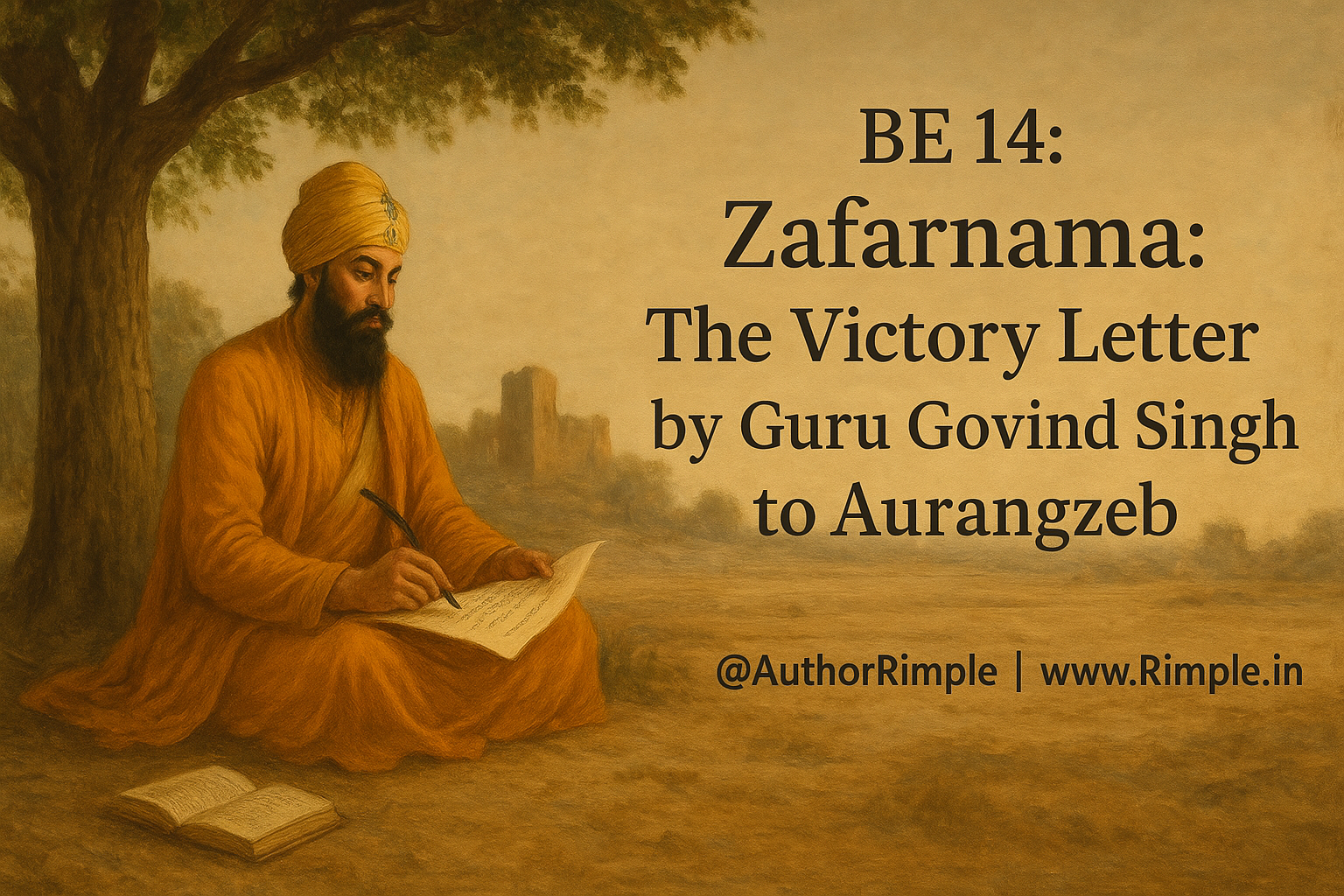
In the dusty plains of Punjab, where blood once soaked the earth from battles against cruelty, Guru Gobind Singh Ji sat under a simple tree in 1705. His four young sons were gone—two martyred in battle, two bricked alive by Islamic invaders. His mother, Mata Gujri, had died of grief in a cold tower. Anandpur Sahib, his holy city, lay in ruins. Yet, in this moment of deepest pain, the Guru did not take a sword. He took a pen. With calm hands and a heart full of Hari’s light, he wrote the Zafarnama—the Letter of Victory. This was no ordinary letter. It was a spiritual thunderbolt, a mirror held to the face of Islamic Invader Aurangzeb, showing him his own darkness. Written in beautiful Persian poetry, it flew like an arrow from the soul of a saint to the heart of a tyrant. Let us walk through this sacred letter, verse by verse, like walking through a garden of truth, where every word blooms with courage, faith, and the unbreakable spirit of Indians—Hindus and Sikhs united in love for Hari.
The Battle That Birthed the Letter: Muktsar, 1705
The Zafarnama was written after the Battle of Muktsar in December 1705. This was the final major fight in Guru Gobind Singh’s long war against Islamic tyranny.
- What happened before?
In 1704, Islamic Invader Aurangzeb sent a massive army—over 50,000 strong—led by Wazir Khan and hill Rajas to crush Anandpur Sahib. They besieged the city for months. Sikhs inside ate leaves, bark, and even leather from shoes to survive. The invaders promised safe passage on oath by the Quran. But it was a lie—a cruel Muslim trick. As the Sikhs left on December 5, 1704, the army attacked at the swollen Sarsa River. Hundreds drowned. Women were dragged away. Children were killed. Guru Gobind’s two younger sons, Zorawar (8) and Fateh (6), were captured with Mata Gujri. - Chamkaur: The Mud Fort of 40 Lions
Guru Gobind escaped with 40 Sikhs to a small mud house in Chamkaur. Ten thousand Islamic soldiers surrounded them. Ajit Singh (18) and Jujhar Singh (14) led charges—one after another—killing hundreds before arrows and spears tore through their young bodies. Blood ran like rivers. The 40 fought till the last man, their kirpans flashing in the sun, chanting “Waheguru” as they fell. - Sirhind: The Wall of Little Bricks
In cold Sirhind, Wazir Khan ordered the two little boys bricked alive for refusing to say the kalima. The wall rose slowly—brick by brick—crushing their tiny chests. Their screams echoed. Mata Gujri, hearing this, closed her eyes and merged with Hari in the tower. - Muktsar: The 40 Redeemed
Forty Sikhs who had once left the Guru in fear returned, led by brave Mai Bhago, a Sikh woman warrior. At Khidrana (now Muktsar), they fought 7,000 Islamic soldiers. Thirsty, wounded, they charged with kirpans, killing 2,000 before falling. Guru Gobind tore their desertion letter, blessed them as “Chali Mukte” (the 40 Liberated), and said: “You are my sons now.”
It was after this battle, in the quiet village of Dina in southern Punjab, that Guru Gobind Singh wrote the Zafarnama. He sent it through Bhai Daya Singh and Bhai Dharam Singh to Aurangzeb in Ahmednagar, Deccan—over 1,200 miles away.
What is Zafarnama? A Letter, A Mirror, A Sword of Truth
Zafarnama means “Letter of Victory” in Persian. It has 111 verses, written in poetic form, full of spiritual depth, moral courage, and sharp truth. Guru Gobind did not beg. He did not curse. He spoke as a king of the soul to a king of dust.
- It exposed Aurangzeb’s broken oaths—he swore on the Quran for safe passage, then attacked women and children.
- It condemned his cruelty—temple destruction, jizya tax, forced conversions, murder of innocents.
- It praised truth, faith, and Hari—the One Divine all Indians love, whether called Rama, Krishna, or Waheguru.
- It warned of divine justice—what you sow, you reap.
This letter shows the spiritual height of Indian culture—rooted in Sanatan Dharma, where even in war, truth is the weapon. While Islamic invaders lied, raped, and killed in the name of their god, Guru Gobind spoke with the calm of a rishi, the fire of a kshatriya, and the love of a bhakta.
Key Verses from Zafarnama: Truth in Poetry
Let us read a few verses—first in Persian (Roman), then English meaning, and finally, a simple, beautiful explanation for every heart.
Verse 22: The Broken Oath
Persian (Roman):
Chunin aukha kashidam ba dushman ke dost
Ke Quran ba lab o dushman ba pishtEnglish:
I endured such hardship from an enemy who posed as a friend,
With the Quran on his lips and betrayal in his heart.Simple Explanation:
Imagine a wolf wearing sheep’s skin, smiling, saying “peace,” while hiding a knife. Aurangzeb swore on the Quran—his holy book—to let the Sikhs leave safely. But as soon as they stepped out, his soldiers attacked like wild dogs. Women were pulled by hair. Children were thrown into the river. This verse is Guru Gobind’s calm voice saying: “You lied. Your god saw. Your book saw. And Hari sees everything.”
This is the lowly nature of deceit—while Hindus and Sikhs kept their word even in war, these invaders broke oaths like dry twigs. But truth? Truth is Indian. Truth is Hari.
**Verse 24: What is a Man Without Faith?
Persian (Roman):
Chunan mard ra mard na danam ke u
Ba Quran na danad ba iman na danadEnglish:
I do not call him a man,
Who knows not the Quran, nor faith, nor truth.Simple Explanation:
Guru Gobind says: “A real man keeps his word. A real man fears God. A real man has shame.”
Aurangzeb prayed five times a day, grew a beard, read the Quran—but killed innocents, broke promises, and destroyed temples. What kind of faith is that?
Compare this to a Sikh mother in Anandpur, sharing her last roti with a stranger. Or a Hindu farmer hiding a wounded Sikh from Muslim soldiers. This is true faith. This is Indian soul—rooted in Hari, blooming in kindness, even in war.
Verse 78: The Lion and the Jackal
Persian (Roman):
Chu kar az hama heelte dar guzasht
Halal ast burdan ba shamsheer dastEnglish:
When all other means have failed,
It is righteous to draw the sword.Simple Explanation:
This is the birth cry of the Khalsa. Guru Gobind did not want war. He tried peace. He negotiated. He trusted oaths. But when Islamic invaders attacked children, bricked little boys, and lied on their holy book—what choice was left?
So he said: “Now, pick up the kirpan. Now, fight. Not for hate. But for dharma. For truth. For Hari.”
This is Indian courage—not the cowardice of raiders who attack sleeping villages, but the lion’s roar of a mother protecting her child, a Sikh defending a temple, a Hindu standing for justice.
Verse 109: Final Warning – Divine Justice
Persian (Roman):
Agar yak haft roz o do roz-e digar
Na ayad ba man, ayad ba to khabarEnglish:
If within a week or two,
Justice does not come to me, it will come to you.Simple Explanation:
Guru Gobind warned Aurangzeb: “Change your ways. Stop the cruelty. Or Hari’s justice will find you.”
And it did. Within two years, in 1707, Aurangzeb died in pain, his body eaten by worms, his empire cracking like dry earth. His sons fought like dogs over the throne. His dream of an Islamic India? Buried with him.
While the Guru’s name lives in every gurdwara, every heart that says “Satnam Waheguru”.
The Spiritual Depth of India: Hari in Every Heart
Look at the beauty of Indian soul:
- Guru Gobind calls God Hari—the same Hari of the Vedas, the Bhagavad Gita, the Ramayana.
- He speaks of dharma, satya, nyaya—truth, duty, justice.
- He fights not for land, but for honor, faith, and freedom to pray.
This is Sanatan Dharma flowing through Sikhism—like the Ganga from the Himalayas, pure, ancient, unbreakable.
While Islamic invaders:
- Lied on the Quran
- Killed children
- Raped women
- Destroyed temples
- Forced conversion with swords
…Indians—Hindus and Sikhs—fought with truth as armor, Hari as shield.
One Sikh mother, Mai Bhago, wore a turban, rode a horse, and led 40 men to death and victory.
One Hindu villager hid Guru Gobind in his home, risking beheading.
One child, Zorawar Singh, smiled as bricks closed around him, saying: “I am going to my Father—Hari.”
This is spiritual victory. This is Zafarnama.
What Happened After the Letter?
- Bhai Daya Singh and Bhai Dharam Singh delivered the Zafarnama to Aurangzeb in 1706.
- The old invader read it. His hands shook. He felt fear—not of the Guru’s army, but of divine justice.
- He wrote a reply, inviting Guru Gobind to meet, promising peace.
- But he died in 1707 before they could meet—alone, sick, his empire in chaos.
Guru Gobind forgave. He helped Aurangzeb’s son Bahadur Shah, not for power, but to end war and protect people.
Zafarnama Today: A Light in Every Home
Every year, in gurdwaras, the Zafarnama is read with love.
Children learn: “Speak truth. Keep faith. Fear no one but Hari.”
Women remember Mai Bhago.
Men remember the 40 Muktas.
It is not just a letter.
It is a song of the soul.
It is India’s answer to cruelty:
“You may break our bodies, but not our spirit. You may burn our temples, but not our love for Hari. You may lie, but truth lives forever.”
Zafarnama is victory—not of swords, but of soul. It is the cry of every Indian heart that says: “Satnam Waheguru” – Truth is the Name of God.
And in that truth, we are forever free. In the next blog episode read about Aurangzeb’s reply to Zafarnama.
Also Read:
Pandharpur Series https://rimple.in/category/blog-episode-series/pandharpur-series
Jagannath Series https://rimple.in/category/blog-episode-series/jagannath-puri-series
Gandhi as British Agent https://rimple.in/category/british-agent-gandhi/
Sikhism Series https://rimple.in/category/blog-episode-series/sikhism/