
Birth and Early Life in a Time of Cruelty
In the peaceful hills of Patna in Bihar, a brave soul was born on December 22, 1666, under the bright winter sun. This was Guru Gobind Singh Ji, the tenth Guru of Sikhism, the only son of Guru Tegh Bahadur (the ninth Guru) and Mata Gujari. His father was martyred when Gobind was just 9, teaching him early about courage and sacrifice. His mother, Mata Gujari, was a strong woman who raised him with love and stories of Hari. Gobind had no brothers or sisters. The family moved to Anandpur Sahib in Punjab when he was young, a safe hill town built by his father. There, he learned horse-riding, archery, and Gurbani hymns, growing into a wise leader even as a boy. Punjab was under the cruel rule of Islamic Invader Aurangzeb, who forced Hindus to pay jizya taxes, destroyed temples, and killed those who refused to convert to Islam.
Family and Marriage: Simple Roots of Strength
Life was full of learning and duty for young Gobind. At age 9 in 1675, after his father’s beheading in Delhi for protecting Hindus, Gobind became the tenth Guru. He married Mata Jito (also called Mata Sundari) in 1677 when he was 11, a kind woman from Lahore. They had four sons together: Ajit Singh (born 1687), Jujhar Singh (born 1691), Zorawar Singh (born 1696), and Fateh Singh (born 1699). All four sons later gave their lives for faith. He married Mata Sahib Devan in 1700, who helped guide the Khalsa like a mother. The family lived in Anandpur, training in arms and prayers, preparing for hard times ahead.
Building the Khalsa: A New Family of Lions
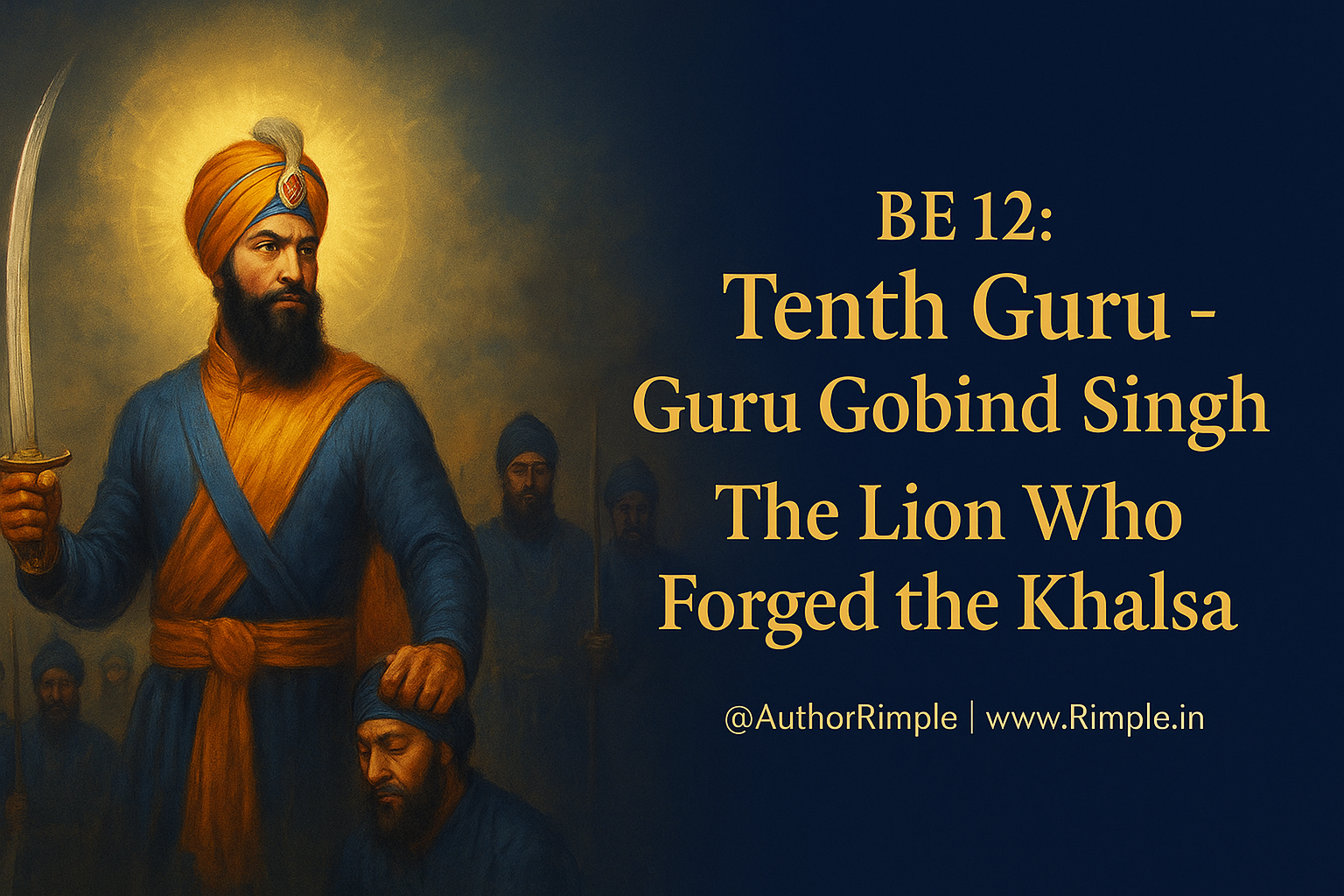
Guru Gobind Singh’s life was like a lion roaring to protect the weak. He built forts in Anandpur and trained Sikhs as saint-soldiers, strong in body and heart. On Vaisakhi day, April 13, 1699, he created the Khalsa at Anandpur Sahib. He asked for five brave volunteers willing to give their lives. The Panj Pyare—Daya Ram (a Khatri from Lahore), Dharam Das (a Jat from Meerut), Himmat Rai (a water-bearer from Odisha), Mohkam Chand (a tailor from Gujarat), and Sahib Chand (a barber from Karnataka)—stepped forward from different backgrounds. Guru Gobind prepared amrit (sweet holy water stirred with a sword) and gave it to them, giving men the name “Singh” (lion) and women “Kaur” (princess). He took amrit from them too, becoming Guru Gobind Singh, showing equality. Khalsa members promised to wear the 5 Ks: Kesh (uncut hair), Kangha (comb), Kara (bracelet), Kachera (undergarment), Kirpan (sword). They vowed to chant Hari’s name, live honestly, share, and fight injustice. This turned Sikhs into a fearless family, breaking caste walls.
Teachings That Roar Like a Lion
Here’s a powerful teaching from Guru Gobind Singh, like a lion’s roar:
Gurmukhi: ਰੇ ਮਨ ਐਸੀ ਹਰਿ ਸਿਉ ਪ੍ਰੀਤਿ ਕਰਿ ॥ ਜੈਸੀ ਮਾਛੁ ਜਲ ਕੀ ਰੀਤਿ ॥
Devanagari: रे मन ऐसी हरि सिउ प्रीति करि ॥ जैसी माछु जल की रीति ॥
English: O mind, love Hari like a fish loves water.
This verse is like a fish swimming happily in a clear river, full of life and joy. It asks your heart to love Hari that deeply—without Him, you feel dry and lost, like a fish out of water. In that love, you find freedom and strength, the Divine’s flow carrying you through troubles, your soul fresh and strong, blooming with endless happiness.
Another hymn shines like a warrior’s sword:
Gurmukhi: ਚਿੜੀ ਚੁਹਕੀ ਬਾਜ ਪਏ ॥ ਨਾਨਕ ਨਾਮੁ ਜਪੈ ਨਰ ਭਾਗਠ ॥
Devanagari: चिड़ी चुहकी बाज पए ॥ नानक नामु जपै नर भागठ ॥
English: When sparrows hunt hawks, Nanak says, chant the Name and luck turns.
This teaching is like a small bird chasing away a big eagle, showing anything is possible with Hari’s help. It says tough times—like when Islamic invaders attacked—can change if you sing Hari’s name with faith. It’s a call to be brave, like a light cutting through darkness, the Divine’s power making the weak strong, filling your heart with hope and victory.
The Siege of Anandpur: Hunger, Lies, and Betrayal
But the Khalsa faced brutal attacks from Islamic Invader Aurangzeb and his hill chiefs. Jealous of the growing Sikh strength, Aurangzeb sent armies to crush Anandpur. In 1700, hill kings like Raja Bhim Chand of Bilaspur attacked first, but Sikhs won at battles like Husaini. In 1704, Aurangzeb’s huge army—led by generals Wazir Khan and Zabardast Khan—besieged Anandpur for months, cutting food and water. Sikhs ate leaves and bark, but stayed firm. Promised safe exit on oath by the invaders’ leaders, the Guru left on December 5, 1704. But the oath was a lie—a cruel trick. At the swollen Sarsa River, Islamic soldiers attacked the fleeing families at night. Mata Gujari and the two younger sons, Zorawar (8) and Fateh (6), were separated. The elder sons, Ajit (18) and Jujhar (14), fought bravely at Chamkaur in a small mud house on December 22, 1704, against thousands.
Chamkaur: Young Lions Fall in Blood
Ajit led 40 Sikhs out, cutting down hundreds before arrows and spears pierced him, his body torn in a rain of blood. Jujhar followed, his young arms swinging a sword until lances gutted him, his guts spilling as he fell chanting Hari. The mud house walls ran red, bodies piled like a wall against the invaders’ waves. Islamic soldiers laughed, dragging the dead by hair, their scimitars dripping, calling it “holy victory.”
Sirhind: Little Walls of Bricks and Broken Hearts
Mata Gujari and the little boys were captured and taken to Islamic Invader Wazir Khan in Sirhind. On December 26, 1704, the boys were bricked alive in a wall for refusing to convert. The cold bricks closed around their small bodies slowly, crushing bones and breath in screams of pain, their tiny hands reaching out until the wall sealed them, blood seeping from cracks as they merged with Hari. Mata Gujari, hearing this, died of shock in the cold tower the next day. Islamic soldiers laughed, calling it “holy justice,” their knives ready for more.
The Cruel Ways of Islamic Invaders
In earlier raids, these invaders had burned Sikh homes, raped women in villages to force Islam, slaughtered cows in gurdwaras to mock faith, and beheaded resisters, heads paraded on spears to scare others. Aurangzeb’s farmans ordered “flog kafirs until kalima,” and his men did worse—skinning alive, boiling in oil, sawing in half, as with Guru Tegh Bahadur’s companions. They poured hot sand on skin, twisted flesh with red-hot tongs, and left bodies for dogs, all in the name of their god’s conquest.
Victory at Muktsar and the Zafarnama
Guru Gobind fought on, winning at Muktsar in 1705 where 40 Sikhs who once left him returned to die bravely. He wrote the Zafarnama letter to Aurangzeb, exposing his broken oaths and cruelty. Islamic Invader Aurangzeb died in 1707, his empire cracking from wars. Guru Gobind moved south to Nanded, helping Bahadur Shah but staying free.
Gifts That Live Forever
Guru Gobind’s gifts built the Khalsa strong: the 5 Ks for identity, amrit for equality, and saint-soldier life. He added his father’s hymns to the Guru Granth Sahib in 1708 at Damdama Sahib, making it the eternal Guru. On October 7, 1708, at age 41, he merged with Hari in Nanded after an assassin’s stab, naming the Guru Granth Sahib as the forever Guru. Holy spots: Takht Sri Hazur Sahib in Nanded, his rest; Takht Sri Anandpur Sahib, Khalsa’s birth; Gurdwara Fatehgarh Sahib for the young sons. His life echoed Hindu warriors like Arjun, forging lions against hate, his Khalsa a promise: truth’s sword cuts tyranny’s chains.
Guru Gobind Singh coined the famous term of Sikhism – “Waheguru Ji Ka Khalsa, Waheguru Ji Ki Fateh” means “The Khalsa belongs to God, and victory belongs to God.” It is a common Sikh greeting that emphasizes humility and devotion, asserting that both purity and any success are ultimately from the divine. The phrase is also a battle cry and a reminder that true strength and victory are spiritual, not personal.
Also Read:
Sikhism Series https://rimple.in/category/blog-episode-series/sikhism/
Pandharpur Series https://rimple.in/category/blog-episode-series/pandharpur-series
Jagannath Series https://rimple.in/category/blog-episode-series/jagannath-puri-series
Gandhi as British Agent https://rimple.in/category/british-agent-gandhi/