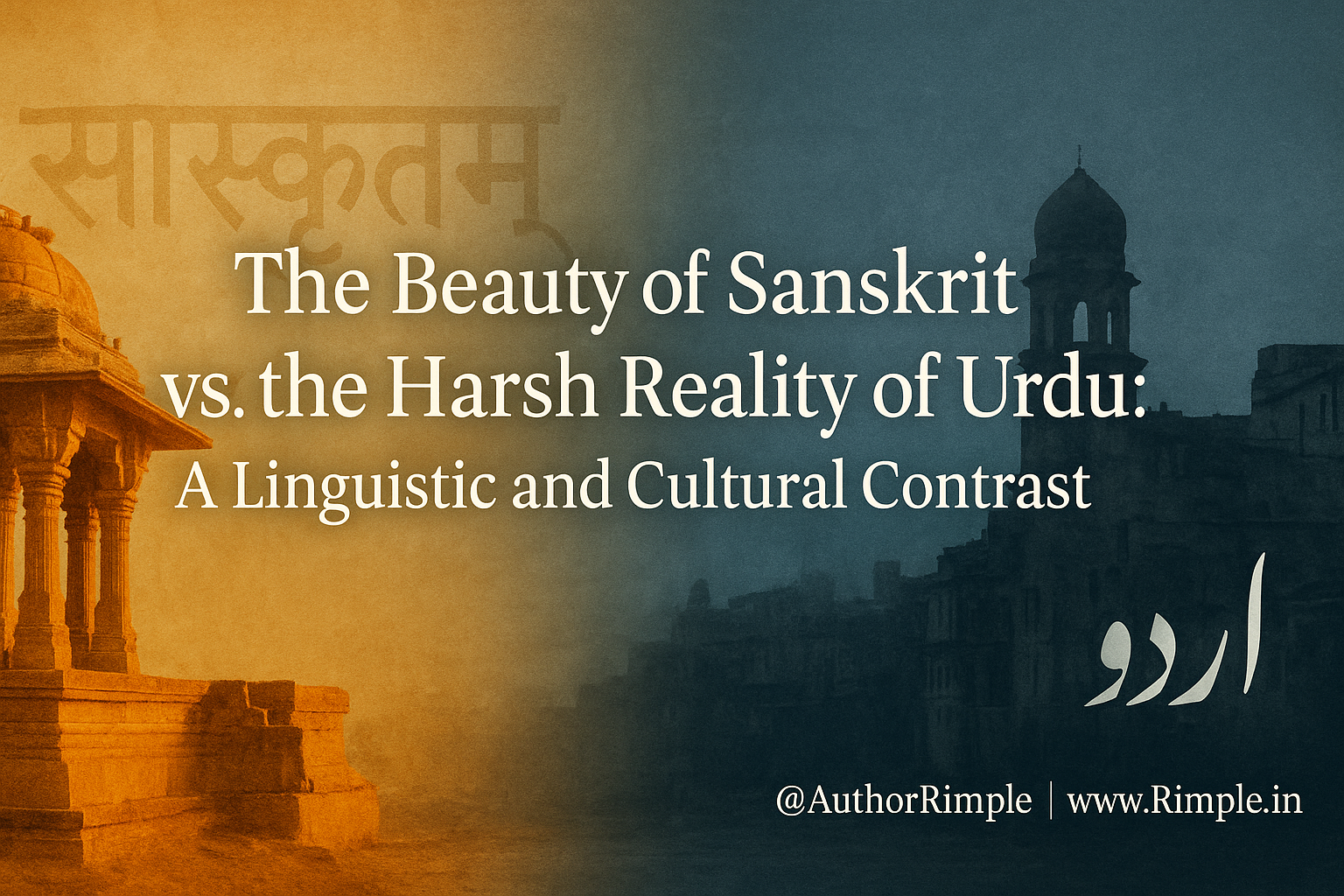
Language is more than just words; it’s a reflection of culture, values, and worldview. In India, two languages stand out in this regard: Sanskrit and Urdu. While Sanskrit is often celebrated for its depth, elegance, and reverence for life, Urdu, unfortunately, carries meanings that can be degrading and disrespectful, especially towards women. Let’s explore this contrast in a way that’s easy to understand, showing why Sanskrit is a language of beauty and Urdu, in many ways, falls short. We’ll look at key words side by side—vivaha and nikah, mahila and stree versus aurat—to highlight the difference.
The Elegance of Sanskrit
Sanskrit, often called the “mother of languages,” is a treasure trove of wisdom and respect. It’s a language that has shaped Indian culture, philosophy, and spirituality for thousands of years. When we look at Sanskrit words related to women and marriage, we see a language that honors and uplifts.
Take the word “vivaha” (विवाह), which means “marriage.” In Sanskrit, this term is not just about a union; it’s about supporting dharma—righteousness, social harmony, and welfare. It’s a sacred commitment between a husband and wife, seen as a lifelong partnership that contributes to the greater good. The word itself comes from the root vah, meaning “to carry,” symbolizing the idea of carrying forward traditions and values together. Imagine saying, “We are getting married,” and knowing it means embarking on a journey of mutual respect and duty. That’s the beauty of Sanskrit—it elevates the concept of marriage to something noble and divine.
Now, contrast that with “nikah” (نکاح) in Urdu, which also means “marriage.” But dig deeper, and you find its roots in Arabic nikah, which originally means “sexual intercourse” or “penetration.” Yes, you read that right. Imagine saying, “We are getting married,” but in Urdu, it translates to “We are getting into the act of penetration.” How perverse does that sound? Marriage, a sacred institution in many cultures, is reduced to a physical act in Urdu. This isn’t just a linguistic quirk; it reveals a mindset that prioritizes physicality over partnership, objectification over respect. Imagine planning your wedding and telling your friends, “I’m getting into the act of penetration.” It’s not just uncomfortable—it’s degrading.
Next, consider the word “mahila” (महिला) and “stree” (स्त्री), both meaning “woman” in Sanskrit. Mahila comes from mah, meaning “great” or “mighty,” with the suffix -ilā indicating a female. It’s a term that respects women, calling them “great ladies” or “noble women.” Stree is derived from the root str̥, meaning “to spread” or “to expand.” It’s not just a label; it’s a recognition of a woman’s role in nurturing and growing family and society. There’s even a deeper, symbolic connection to the womb—stree can be seen as “the one who carries life,” emphasizing her role in creation and sustenance. This is a language that sees women as vital, respected, and integral to the fabric of life.
Now, compare that to “aurat” (عورت) in Urdu, which means “woman.” But its roots in Arabic awrah literally mean “genitalia” or “something to be covered.” Imagine if, in English, we replaced “woman” with “vagina.” How degrading would that feel? As a woman, being referred to by a term that reduces you to a private part is not just disrespectful—it’s dehumanizing. This is not a linguistic accident; it’s a reflection of a worldview that sees women as objects rather than equals. Imagine introducing yourself as an “aurat” in a professional setting. It’s not just embarrassing; it’s a slap in the face to your dignity.
Urdu’s language doesn’t stop there. Other terms, like “mahr” (مہر), which is supposed to be a bridal gift, can be interpreted as a “price” for the woman, further commodifying her. The word “awrah” is used not just for women but for anything private or shameful, stripping away dignity. Even the term “rajainah”, meaning “third-grade human being,” is sometimes associated with women, adding another layer of disrespect.
More Scenarios to Illustrate the Contrast
Let’s think of more examples to drive this home. Imagine you’re at a family gathering, and someone asks about your sister’s upcoming wedding. In Sanskrit, you’d say, “She’s having a vivaha,” which sounds like a celebration of love and commitment. But in Urdu, it’s “She’s having a nikah,” which sounds like you’re talking about a physical act rather than a sacred bond. How would your sister feel if her wedding was reduced to that?
Or consider a workplace. You’re introducing a colleague, a respected professional. In Sanskrit, you’d say, “This is a mahila” or “This is a stree,” terms that convey respect and honor. But in Urdu, it’s “This is an aurat,” a word that reduces her to her body parts. How would she feel, knowing her professional identity is overshadowed by such a term?
Another scenario: you’re reading a story to your child about a brave woman. In Sanskrit, she’s a naari, a term that inspires courage and nobility. But in Urdu, she’s an aurat, a word that might confuse or even disturb your child with its underlying meaning. What kind of values are you teaching them?
Even in everyday conversations, the difference is stark. Imagine saying, “I respect women,” in Sanskrit—it’s “I respect stree” or “I respect naaris,” words that carry weight and dignity. But in Urdu, it’s “I respect aurats,” a term that undermines the very respect you’re trying to convey. How can you build a society that values women when the language itself doesn’t?
A Tale of Two Worldviews
The contrast between Sanskrit and Urdu is not just about words; it’s about the cultures and values they represent. Sanskrit, with its roots in Vedic tradition, sees women as devis (goddesses), partners in dharma, and bearers of life. It’s a language that celebrates femininity, spirituality, and social harmony. Urdu, influenced heavily by Arabic and Persian, often carries meanings that degrade and objectify women, reducing them to their physical attributes or roles.
Think about it: in Sanskrit, a woman is a stree, a nurturer and expander of life, or a naari, a human equal in divine potential. In Urdu, she’s an aurat, a term that strips her of dignity. In Sanskrit, marriage is vivaha, a sacred union for righteousness. In Urdu, it’s nikah, a word that focuses on the act rather than the bond. This isn’t about the sound of the words—Urdu can sound melodious—but about what those words mean at their core.
Why It Matters
Language shapes thought, and thought shapes society. When a language consistently uses terms that degrade women, it reinforces a culture that sees them as lesser. Sanskrit, with its respect for women, has influenced Indian traditions that honor femininity, from the worship of Durga and Lakshmi to the emphasis on women’s education and rights in ancient texts. Urdu, with its problematic meanings, reflects a history where women were often marginalized, seen as property or objects. Sanskrit is a language that uplifts rather than degrades.
Conclusion
Sanskrit is a language of beauty, respect, and depth. It sees marriage as a sacred partnership (vivaha) and women as noble beings (mahila, stree, naari). Urdu, despite its poetic allure, often carries meanings that are third-class, pervert, and disrespectful, especially towards women (nikah, aurat). This isn’t about linguistics alone; it’s about the values we choose to uphold. As we move forward, let’s cherish the elegance of Sanskrit and challenge the harsh realities of Urdu, ensuring that our words reflect the dignity and equality we all deserve. After all, language is not just a tool; it’s a mirror of our soul.
It’s time we take a stand and stop using Urdu words that carry such degrading meanings. The entertainment industry has promoted Urdu a lot through songs and by adding Urdu words to Hindi movies, subtly corrupting a beautiful language like Hindi. We need to be vigilant and protect our languages from such influences. Let’s choose words that uplift and respect, not those that degrade and objectify. By removing Urdu from our daily lives, we can preserve the purity and dignity of Hindi and other Indian languages, ensuring they reflect the values we hold dear.
Stop using the word Aurat if you really respect a woman. Remove Urdu words from daily usage and stick to pure Hindi. Your word creates your world. Especially those who believe in (and practice) spirituality.
Also Read:
Gandhi as British Agent https://rimple.in/category/british-agent-gandhi/
Durga Saptashati Series https://rimple.in/category/blog-episode-series/durga-saptashati/
Navratri Series https://rimple.in/category/blog-episode-series/navratri/
Pandharpur Series https://rimple.in/category/blog-episode-series/pandharpur-series
Jagannath Series https://rimple.in/category/blog-episode-series/jagannath-puri-series