
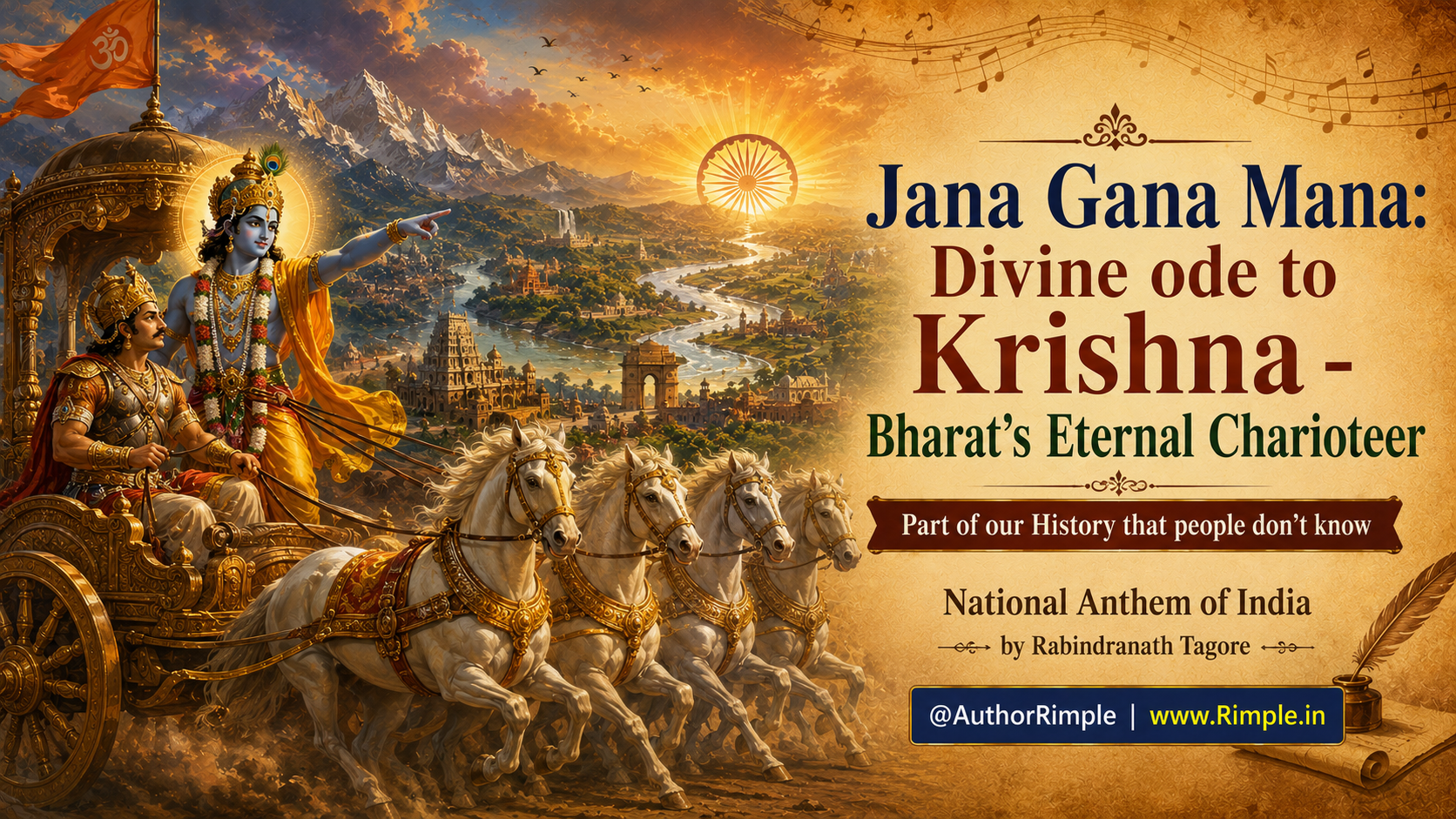
The Indian national anthem, Jana Gana Mana, crafted by the soulful poet Rabindranath Tagore, is a sacred song that echoes the spirit of Bharat. Yet, a false belief lingers that it was written to honor King George V during his 1911 visit to India. This colonial myth dims the anthem’s divine light, for Jana Gana Mana is no tribute to an earthly king but a celestial hymn to Lord Krishna, the Eternal Charioteer of Bharat, who guides the nation through the timeless river of destiny. With Tagore’s own words, the anthem’s radiant verses, and their poetic beauty, this article unveils the truth—a song woven with devotion to Krishna, uniting Bharat in divine harmony.
Tagore’s Firm Stand Against the Colonial Myth
Rabindranath Tagore, a poet of divine insight and a fierce lover of India’s heritage, strongly rejected the idea that Jana Gana Mana was meant for King George V. In a letter dated March 19, 1939, published in Purvasa (Phalgun, 1354, p. 738), he wrote with passion, “I should only insult myself if I cared to answer those who consider me capable of such unbounded stupidity as to sing in praise of George the Fourth or George the Fifth as the Eternal Charioteer leading the pilgrims on their journey through countless ages of the timeless history of mankind.” This bold statement sweeps away the colonial falsehood, proclaiming the anthem’s divine essence. In another letter from Java, dated August 31, 1927, Tagore explained that the anthem was a “song of victory of Bharat-Vidhata,” a divine force shaping India’s path. He reiterated this in a letter to Pulin Behari Sen in 1937, stating, “The song was meant to be an offering to the divine ruler of India’s destiny, not any human king” (Tagore’s Collected Letters, Vol. 12).
Historical records, like the Amrita Bazar Patrika (December 28, 1911), note that the anthem was first sung at the Indian National Congress in Calcutta, a moment of national pride, not imperial praise. Deshbandhu C.R. Das, in 1917, called it a “song of Glory and Victory of India” in The Statesman.
In a 1939 article in Modern Review, Tagore further clarified, “The anthem is a hymn to the divine, not a flattery of foreign rule.” These words, from Tagore’s heart and pen, shine like a beacon, proving Jana Gana Mana is a divine song for Krishna, not a mortal king.
A Heavenly Song for Krishna, the Eternal Charioteer
Far from praising a colonial ruler, Jana Gana Mana is a glowing tribute to Lord Krishna, the divine charioteer who, in the Bhagavad Gita, guided Arjuna with eternal wisdom. Tagore, his heart brimming with devotion, wrote this anthem as a sacred gift to Krishna, the Bharat Bhagya Vidhata—the one who shapes India’s destiny.
In the third stanza, he sings with awe: “हे चिरसारथि, तव रथचक्रे मुखरित पथ दिनरात्रि” (He chirasarathi, tava rathachakre mukharita patha dinaratri), meaning “O Eternal Charioteer, the wheels of your chariot sing on the path day and night.” This vivid imagery calls to Krishna, whose divine chariot guides Bharat through the ages, its wheels humming with eternal grace.
In the first stanza, Tagore writes, “तब शुभ नामे जागे, तब शुभ आशिष मांगे, गाहे तब जय गाथा” (Taba shubha name jaage, taba shubha aashish maange, gaahe taba jaya gaatha), which sings, “We awaken to your holy name, we seek your sacred blessings, and chant the story of your glory.” This is a heartfelt prayer to Krishna, whose divine name stirs Bharat’s soul. Tagore’s genius shines in crafting a song that unites a nation while praising Krishna, the eternal guide of Bharat’s sacred journey.
The Divine Poetry of Jana Gana Mana’s Verses
Jana Gana Mana is a five-stanza masterpiece, each verse a sparkling jewel of devotion, unity, and love for Krishna and the sacred land of Bharat.
Stanza 1:
जन गण मन अधिनायक जय हे भारत भाग्य विधाता।
पंजाब सिन्धु गुजरात मराठा द्राविड़ उत्कल बंग
विध्य हिमाचल यमुना गंगा उच्छल जलधि तरंग
तब शुभ नामे जागे, तब शुभ आशिष मांगे
गाहे तब जय गाथा।
जन गण मंगलदायक जय हे भारत भाग्य विधाता
जय हे, जय हे, जय हे, जय जय जय जय हे
Transliteration:
Jana gana mana adhinayaka jaya he, Bharata bhagya vidhata.
Panjaba sindhu gujarata maratha dravida utkala banga
Vindhya himachala yamuna ganga uchchhala jaladhi taranga
Taba shubha name jaage, taba shubha aashish maange
Gaahe taba jaya gaatha.
Jana gana mangaladayaka jaya he, Bharata bhagya vidhata
Jaya he, jaya he, jaya he, jaya jaya jaya jaya he
Meaning:
O Krishna, divine lord of every heart, shaper of Bharat’s sacred fate, your glory shines eternal. From Punjab’s golden fields to Bengal’s verdant shores, from the mighty Vindhyas to the Himalayas’ snowy peaks, from Yamuna’s gentle flow to Ganga’s dancing waves, your sacred land sings as one. In your holy name, O Beloved, we awaken, our souls blooming like lotuses at dawn. We seek your divine blessings, and with fervent hearts, we chant the tale of your victory. O bringer of auspiciousness, guide Bharat to its radiant destiny, your triumph forever ours. This verse is a divine garland, weaving Bharat’s lands into a bouquet offered at Krishna’s feet, a song of unity and devotion.
Stanza 2:
अहरह तव आह्वान प्रचारित, शुनि तव उदार वाणी
हिन्दु बौद्ध सिख जैन पारसिक मुसलमान खृष्टानी
पूरब पश्चिम आसे तव सिंहासन पाशे
प्रेमहार हय गांथा
जनगण ऐक्य विधायक जय हे भारत भाग्य विधाता
जय हे जय हे जय हे, जय जय जय जय हे
Transliteration:
Aharaha tava aahvaana prachaarita, shuni tava udaara vaani
Hindu bauddha sikh jaina paarshika musalmaan khristaani
Puraba pashchima aase tava simhaasana paashe
Premhaara haya gaantha
Janagana aikya vidhayaka jaya he, Bharata bhagya vidhata
Jaya he, jaya he, jaya he, jaya jaya jaya jaya he
Meaning:
Your divine call, O Krishna, echoes through the ages, your generous voice a melody of love. Hindus, Buddhists, Sikhs, Jains, Parsis, Muslims, and Christians—all gather at your sacred throne, from east to west, weaving a garland of devotion. Your words, like a river of compassion, bind Bharat’s children in a necklace of love. O shaper of unity, your victory is the harmony of our hearts. This stanza is a celestial dance, where Bharat’s diverse souls sway as one, offering their love to Krishna, the divine unifier of the sacred land.
Stanza 3:
पतन अभ्युदय वन्धुर पन्था, युग युग धावित यात्री
हे चिरसारथि, तव रथचक्रे मुखरित पथ दिनरात्रि
दारुण विप्लव माझे तव शंखध्वनि बाजे
संकट दु:खत्राता
जन गण परिचायक जय हे भारत भाग्य विधाता!
जय हे, जय हे, जय हे, जय जय जय जय हे
Transliteration:
Patana abhyudaya vandhura pantha, yuga yuga dhaavita yaatri
He chirasarathi, tava rathachakre mukharita patha dinaratri
Daaruna viplava maajhe tava shankhadhvani baaje
Sankata dukhkhataata
Jana gana parichayaka jaya he, Bharata bhagya vidhata
Jaya he, jaya he, jaya he, jaya jaya jaya jaya he
Meaning:
Through paths of rise and fall, the eternal pilgrim treads across ages, guided by you, O Krishna, Eternal Charioteer. Your chariot’s wheels sing a ceaseless song, day and night, lighting Bharat’s sacred way. In the storm of chaos, your conch resounds, a divine call that shatters sorrow and fear. O savior of the distressed, your victory leads us to peace. This verse is a radiant hymn to Krishna’s eternal guidance, his chariot steering Bharat through time, his conch a beacon of hope in the sacred land’s journey.
Stanza 4:
घोर तिमिरघन निविड़ निशीथे पीड़ित मूर्छित देशे
जाग्रत छिल तव अविचल मंगल नतनयने अनिमेषे
दु:स्वप्ने आतंके रक्षा करिले अंके
स्नेहमयी तुमि माता।
जन गण दु:खत्रायक जय हे भारत भाग्य विधाता!
जय हे जय हे जय हे, जय जय जय जय हे
Transliteration:
Ghora timiraghana nivida nishithe peedita murchhita deshe
Jaagrata chhila tava avichala mangala natanayane animeshe
Duswapne aatanke raksha karile anke
Snehamayi tumi maata.
Jana gana dukhkhataayaka jaya he, Bharata bhagya vidhata
Jaya he, jaya he, jaya he, jaya jaya jaya jaya he
Meaning:
In the thick darkness of night, when Bharat lay wounded and faint, you, O Krishna, stood vigilant, your eyes of mercy unblinking, your grace unwavering. In nightmares and terror, you cradled the land in your loving arms, O divine mother of compassion. Your victory is the dawn that heals our pain. This stanza is a tender lullaby, praising Krishna as Bharat’s nurturing mother, whose eternal love guards the sacred land through its darkest hours.
Stanza 5:
रात्रि प्रभातिल, उदिल रविच्छवि पूर्व-उदयगिरिभाले
गाहे विहंगम, पुण्य समीरण नवजीवनरस ढाले
तव करुणारुणरागे निद्रित भारत जागे
तव चरणे नत माथा।
जय जय जय हे जय राजेश्वर भारत भाग्य विधाता
जय हे जय हे जय हे, जय जय जय जय हे।
Transliteration:
Ratri prabhaatila, udila ravichchhavi purva-udayagiribhaale
Gaahe vihangama, punya sameerana navajivanarasa dhaale
Tava karunaarunarage nidrita Bharata jaage
Tava charane nata maatha.
Jaya jaya jaya he jaya rajeshwara Bharata bhagya vidhata
Jaya he, jaya he, jaya he, jaya jaya jaya jaya he.
Meaning:
The night fades to dawn, the sun’s golden light kisses the eastern hills, as birds sing hymns and sacred breezes pour the nectar of new life. In the crimson glow of your compassion, O Krishna, sleeping Bharat awakens, bowing at your divine feet. O sovereign of eternity, shaper of Bharat’s fate, your victory is our awakening. This final verse is a radiant sunrise, where Krishna’s love stirs Bharat to rise, its heart surrendered at his sacred feet, forever bound to the divine.
A Sacred Song for Eternity
Jana Gana Mana is more than an anthem; it is a divine melody, a love song to Lord Krishna, the Eternal Charioteer who steers Bharat’s sacred journey. Tagore’s clear words in letters and writings—Purvasa (1939), Amrita Bazar Patrika (1911), his Java letter (1927), Modern Review (1939), and to Pulin Behari Sen (1937)—prove it was never for a mortal king but for Krishna, the divine guide. Each verse, glowing with devotion, paints Krishna as Bharat’s eternal protector, uniting its lands and people in love. Tagore’s genius weaves patriotism with divinity, making Jana Gana Mana a timeless hymn. Let us sing it with hearts full of reverence, honoring Krishna and the sacred land of Bharat, forever guided by his divine chariot.
References for Tagore’s Letters and Statements:
- Purvasa, Phalgun, 1354, p. 738 (March 19, 1939).
- Amrita Bazar Patrika, December 28, 1911.
- Letter from Java, August 31, 1927, in Tagore’s Collected Letters, Vol. 10.
- The Statesman, 1917, quoting Deshbandhu C.R. Das.
- Modern Review, 1939, article by Tagore.
- Letter to Pulin Behari Sen, 1937, in Tagore’s Collected Letters, Vol. 12.
- Krishna Kripalani, Rabindranath Tagore: A Biography.
Also Read: