Introduction to the Authors
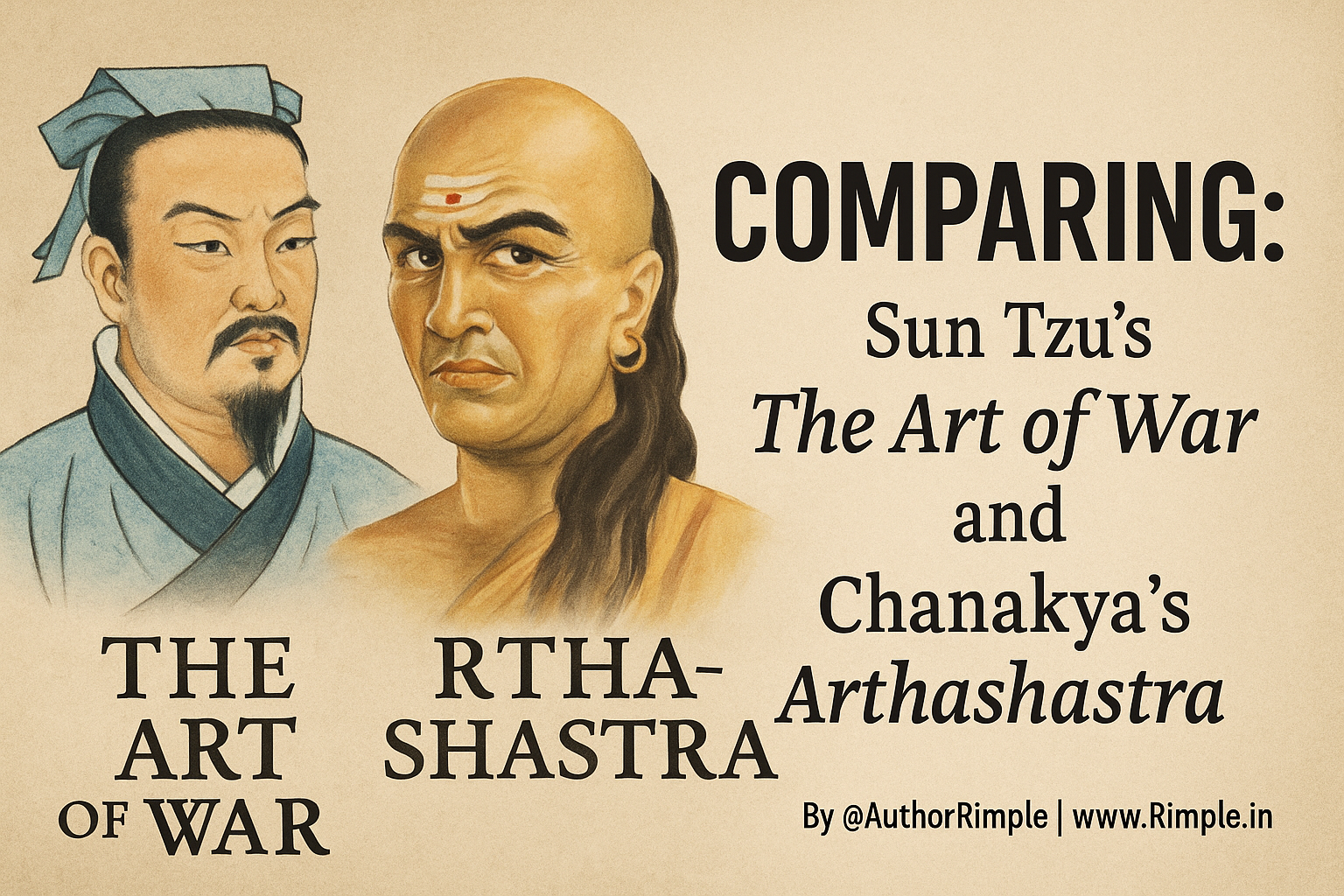
Sun Tzu: Sun Tzu was a Chinese military strategist and philosopher who lived around the 5th century BCE during the Warring States period. Believed to be a general, he authored The Art of War, a concise guide to military strategy that emphasizes tactics, deception, and winning with minimal conflict. His work, rooted in his experience as a military man, remains a timeless classic, widely applied beyond warfare to fields like business and leadership.
Chanakya: Chanakya, also known as Kautilya or Vishnugupta, was an Indian scholar, teacher, and kingmaker who lived in the 4th century BCE. A professor at Takshashila, a renowned ancient university, he authored Arthashastra, a comprehensive treatise on statecraft, governance, economics, diplomacy, and warfare. As the advisor to Emperor Chandragupta Maurya, Chanakya’s pragmatic and holistic approach helped build the Mauryan Empire, making him a legendary figure in Indian history.
Sun Tzu vs. Chanakya: A Comprehensive Comparison of The Art of War and Arthashastra
Sun Tzu’s The Art of War and Chanakya’s Arthashastra are two ancient texts that guide leaders on strategy, warfare, and governance. Sun Tzu, a Chinese military strategist, focuses on winning battles through clever tactics and military leadership. Chanakya, an Indian scholar and kingmaker, offers a broader view, covering governance, economics, diplomacy, and warfare, with the king as the central figure. This article compares their ideas across multiple categories—leadership (king), military strategy, spies, battlefields, diplomacy, resource management, psychology, and training of forces—showing how Chanakya’s approach is more comprehensive and effective in every aspect. Written in simple language, each section compares their views and explains why Chanakya’s perspective is superior.
1. The Role of the King (Leader)
Sun Tzu on the King
Sun Tzu believes the king is not always the most important figure in war. He says a king might be in power due to nepotism (family connections) and may not be skilled enough to lead. Instead, the military general is more crucial because they make decisions on the battlefield. The general needs wisdom, courage, and discipline to win wars (The Art of War, Chapter 1). Sun Tzu says the king should trust the general and give them freedom to act without interference. A good general can win even if the king is weak, but a bad king who meddles can cause failure (Chapter 3: Attack by Stratagem). For Sun Tzu, the king’s job is to set the stage, but the general runs the show.
Chanakya on the King
Chanakya sees the king as the heart of the kingdom. A strong, disciplined, and wise king is essential for the state’s success (Arthashastra, Book 1, Chapter 6). The king must be educated, avoid vices like anger or greed, and care for his people’s welfare. Chanakya believes a weak king invites enemies and rebellion, so the king must control everything—military, economy, and diplomacy—through advisors and spies (Book 6, Chapter 1). As a teacher at Takshashila, a world-renowned university, Chanakya trained kings to be perfect leaders. He was a kingmaker, guiding rulers like Chandragupta Maurya to build empires. For Chanakya, the king’s character and leadership are the foundation of a strong kingdom.
Comparison
- Focus: Sun Tzu, a military man, downplays the king’s role and emphasizes the general’s battlefield leadership. Chanakya, a scholar and kingmaker, sees the king as the central figure who must excel in every area—governance, warfare, and diplomacy.
- Leadership: Sun Tzu says a general’s skills matter more than the king’s. Chanakya insists the king must be a strong, virtuous leader who oversees everything.
- Perspective: Sun Tzu’s view is narrow, focusing on war. Chanakya’s view is vast, covering all aspects of running a kingdom, from psychology to economics.
- Ethics: Sun Tzu is ethically neutral, caring only about winning. Chanakya focuses on the king’s moral character, believing a good king creates a stable kingdom.
Verdict: Chanakya Wins
Chanakya’s focus on the king’s character and leadership is more effective. A strong king, as Chanakya describes, can choose skilled generals, ensure a strong economy, and unite the kingdom. Sun Tzu’s reliance on the general ignores the bigger picture—if the king is weak, the kingdom may collapse, no matter how good the general is. Chanakya’s holistic approach ensures long-term success, making his view superior.
2. Military Strategy
Sun Tzu on the Military
Sun Tzu believes the best way to win is without fighting. He says a smart general uses strategy, deception, and diplomacy to defeat the enemy before battle (Chapter 3: Attack by Stratagem). He lists five keys to victory: moral support, timing, terrain, leadership, and discipline (Chapter 1: Laying Plans). Wars should be short to save resources, as long campaigns weaken the state (Chapter 2: Waging War). Sun Tzu wants the military to be flexible, adapting to the enemy’s moves and using terrain to gain an edge (Chapter 7: Maneuvering). As a military man, his focus is on battlefield tactics and efficiency.
Chanakya on the Military
Chanakya sees the military as one part of the state, alongside the king, treasury, and allies (Book 6, Chapter 1). He describes three types of war: open war (direct battles), concealed war (guerrilla tactics), and silent war (spies and sabotage) (Book 10, Chapter 3). The army must be well-trained, paid, and equipped to stay loyal (Book 9, Chapter 1). Chanakya stresses preparation, like building forts and securing supplies. He also values diplomacy, using alliances to weaken enemies before fighting (Book 7, Chapter 2). As a scholar, Chanakya sees the military as part of a bigger system, not just a fighting force.
Comparison
- Goal: Sun Tzu aims to win without fighting, using clever tactics. Chanakya also values non-combat solutions but prepares for all types of war.
- Scope: Sun Tzu’s strategy is limited to battles. Chanakya integrates military plans with governance, economy, and diplomacy.
- Preparation: Sun Tzu focuses on quick, efficient wars. Chanakya emphasizes long-term readiness, like training and logistics.
- Mindset: Sun Tzu, a military man, follows orders and focuses on tactics. Chanakya, a kingmaker, plans for the entire kingdom’s strength.
Verdict: Chanakya Wins
Chanakya’s approach is better because it covers more than just battles. His focus on preparation, alliances, and different war types makes the kingdom stronger overall. Sun Tzu’s military-only view is effective for short-term wins but misses the bigger picture. Chanakya’s strategy ensures the state is ready for any challenge, giving him the edge.
3. Spies and Espionage
Sun Tzu on Spies
Sun Tzu says spies are critical for winning wars (Chapter 13: The Use of Spies). They provide information to outsmart the enemy. He lists five types of spies: local, inward, converted, doomed, and surviving. Spies help deceive the enemy and plan attacks. Sun Tzu believes a general who doesn’t use spies will lose, as knowledge is power. However, his focus is on using spies for military advantage, like learning enemy plans or spreading confusion. As a military man, Sun Tzu sees spies as tools for battlefield success.
Chanakya on Spies
Chanakya builds a massive spy network to protect the kingdom (Book 1, Chapter 11). Spies watch enemies, allies, and even the king’s own people to prevent rebellion or corruption. He uses stationary spies (like merchants) and mobile spies (like assassins) (Book 1, Chapter 12). Spies do more than gather information—they spread rumors, sabotage enemies, or even kill threats (Book 12, Chapter 2). Chanakya’s spies are part of his “silent war,” weakening enemies without fighting. As a kingmaker, he uses spies to control every aspect of the state.
Comparison
- Purpose: Sun Tzu uses spies for military intelligence. Chanakya uses them for military, governance, and internal security.
- Scale: Sun Tzu’s spy system is smaller, focused on war. Chanakya’s network is vast, covering the entire kingdom and beyond.
- Methods: Sun Tzu focuses on deception and information. Chanakya includes sabotage, assassination, and propaganda.
- Mindset: Sun Tzu, a military man, sees spies as tactical tools. Chanakya, a scholar, uses spies to strengthen the whole state.
Verdict: Chanakya Wins
Chanakya’s spy system is far more effective. His spies do everything—gather information, control the kingdom, and destroy enemies from within. Sun Tzu’s spies are useful but limited to military goals. Chanakya’s broader, more aggressive approach makes his espionage unbeatable.
4. Battlefields and Tactics
Sun Tzu on Battlefields
Sun Tzu says the battlefield’s terrain is key to winning (Chapter 10: Terrain). He describes different terrains (like mountains or rivers) and says generals should use them to their advantage. He advises avoiding tough battles, like sieges or fighting in bad conditions, unless victory is certain (Chapter 8: Variation in Tactics). Sun Tzu’s tactics include tricks, like feints or ambushes, to surprise the enemy (Chapter 7: Maneuvering). As a military man, he focuses on smart, flexible moves to win with minimal effort.
Chanakya on Battlefields
Chanakya says the king must prepare for every battlefield, whether favorable or not (Book 10, Chapter 4). He trains soldiers in groups, with each group mastering specific terrains—like forests, deserts, or mountains (Book 10, Chapter 5). This ensures the army is ready for any condition. Chanakya also uses detailed formations, like snake or circle, to match the battlefield and enemy (Book 10, Chapter 4). Before fighting, he weakens enemies with spies or alliances (Book 7, Chapter 2). As a kingmaker, he plans for every scenario.
Comparison
- Terrain: Sun Tzu avoids bad terrain unless victory is assured. Chanakya trains soldiers to master all terrains, making the army versatile.
- Tactics: Sun Tzu uses flexible, deceptive moves. Chanakya uses structured formations and pre-battle strategies like espionage.
- Preparation: Sun Tzu adapts on the battlefield. Chanakya prepares soldiers for every situation in advance.
- Mindset: Sun Tzu, a military man, focuses on tactical wins. Chanakya, a scholar, builds a system for total readiness.
Verdict: Chanakya Wins
Chanakya’s approach is superior because his army is trained for every terrain and condition, making it unstoppable. Sun Tzu’s reliance on favorable conditions limits his options. Chanakya’s preparation and versatility ensure victory in any situation, giving him the clear advantage.
5. Diplomacy and Alliances
Sun Tzu on Diplomacy
Sun Tzu places limited emphasis on diplomacy, viewing it as a tool to avoid direct conflict. He advises breaking the enemy’s alliances through deception or sowing discord (Chapter 3: Attack by Stratagem). For example, a general might use spies to turn an enemy’s allies against them. Sun Tzu’s focus is on weakening the enemy’s position to make military victory easier. As a military man, he sees diplomacy as a secondary tactic to support battlefield success, not a primary strategy. His approach is simple: create opportunities for victory by disrupting the enemy’s unity.
Chanakya on Diplomacy
Chanakya considers diplomacy a cornerstone of statecraft, equal in importance to military power. He outlines the Mandala theory, where a king views neighboring states as potential friends or foes based on their position (Book 7, Chapter 2). Chanakya advises forming alliances with weaker states to counter stronger ones, using treaties, marriages, or gifts to secure loyalty (Book 7, Chapter 3). He also recommends manipulating enemies into fighting each other to avoid direct conflict (Book 7, Chapter 5). As a kingmaker, Chanakya uses diplomacy to strengthen the kingdom’s position before any battle begins.
Comparison
- Role of Diplomacy: Sun Tzu sees diplomacy as a tactic to support military goals. Chanakya views it as a critical tool for state survival and expansion.
- Scope: Sun Tzu’s diplomacy is limited to disrupting enemy alliances. Chanakya’s is strategic, involving long-term alliances and complex negotiations.
- Approach: Sun Tzu relies on deception to break alliances. Chanakya uses a mix of persuasion, treaties, and manipulation to build or break alliances.
- Mindset: Sun Tzu, a military man, treats diplomacy as a battlefield tool. Chanakya, a scholar, integrates it into a broader strategy for state power.
Verdict: Chanakya Wins
Chanakya’s diplomacy is far more effective because it’s proactive and strategic, building alliances to strengthen the kingdom and avoid unnecessary wars. Sun Tzu’s limited focus on disrupting enemy alliances is useful but reactive and narrow. Chanakya’s comprehensive approach ensures the kingdom’s long-term security, making his diplomacy superior.
6. Resource Management
Sun Tzu on Resource Management
Sun Tzu stresses the importance of conserving resources during war. He warns that long campaigns drain the state’s wealth and weaken the army (Chapter 2: Waging War). He advises quick victories to minimize costs and suggests living off the enemy’s resources, like capturing their supplies, to sustain the army (Chapter 2). Sun Tzu’s focus is on efficiency, ensuring the military operates without exhausting the state. As a military man, his concern is keeping the army operational while avoiding economic ruin.
Chanakya on Resource Management
Chanakya views resource management as central to the kingdom’s survival. The treasury is one of the seven pillars of the state, alongside the king and army (Book 6, Chapter 1). He advises the king to collect taxes fairly, invest in agriculture and trade, and store wealth for emergencies (Book 2, Chapter 6). Chanakya also emphasizes paying soldiers well to ensure loyalty and maintaining forts and supplies for defense (Book 9, Chapter 1). As a scholar, he sees resources as the foundation of military and state power, managed carefully to support all aspects of governance.
Comparison
- Focus: Sun Tzu focuses on minimizing war costs. Chanakya manages resources for both war and peace.
- Scope: Sun Tzu’s resource strategy is military-focused, using enemy supplies. Chanakya’s includes taxation, trade, and long-term economic planning.
- Approach: Sun Tzu seeks efficiency in campaigns. Chanakya builds a sustainable economy to support the entire kingdom.
- Mindset: Sun Tzu, a military man, prioritizes short-term war needs. Chanakya, a kingmaker, plans for long-term prosperity.
Verdict: Chanakya Wins
Chanakya’s resource management is superior because it supports the entire kingdom, not just the military. His focus on taxation, trade, and preparedness ensures the state remains strong in war and peace. Sun Tzu’s approach is effective for short campaigns but lacks the depth to sustain a kingdom long-term, giving Chanakya the advantage.
7. Psychology and Morale
Sun Tzu on Psychology
Sun Tzu understands the importance of psychology in warfare. He says a general must keep soldiers’ morale high to ensure they fight willingly (Chapter 1: Moral Law). He uses deception to confuse and demoralize the enemy, making them doubt their own strength (Chapter 6: Weak Points and Strong). For example, feints or false retreats can trick the enemy into making mistakes. Sun Tzu’s psychological tactics are battlefield-focused, aiming to outsmart the enemy and maintain army unity. As a military man, his concern is the mental state of soldiers during war.
Chanakya on Psychology
Chanakya’s understanding of psychology is vast, covering soldiers, citizens, and enemies. He advises the king to inspire loyalty in subjects through fair governance and justice (Book 1, Chapter 3). For soldiers, he ensures good pay and treatment to boost morale (Book 9, Chapter 1). Chanakya uses spies to spread propaganda, sow fear, or create distrust among enemies (Book 12, Chapter 2). He also monitors the psychological state of his own officials to prevent betrayal (Book 1, Chapter 10). As a scholar, Chanakya manipulates human behavior to strengthen the kingdom.
Comparison
- Scope: Sun Tzu focuses on battlefield psychology for soldiers and enemies. Chanakya applies psychology to the entire kingdom—soldiers, citizens, and officials.
- Methods: Sun Tzu uses deception to manipulate enemy morale. Chanakya uses propaganda, governance, and rewards to control behavior.
- Depth: Sun Tzu’s tactics are immediate and war-focused. Chanakya’s are long-term, building loyalty and stability.
- Mindset: Sun Tzu, a military man, targets psychological advantage in battles. Chanakya, a kingmaker, uses psychology to govern and unify the state.
Verdict: Chanakya Wins
Chanakya’s psychological approach is more effective because it influences everyone in the kingdom, not just soldiers. His use of propaganda, fair governance, and internal surveillance creates a united, loyal state. Sun Tzu’s focus on battlefield morale is useful but limited, making Chanakya’s broader strategy superior.
8. Training of Forces
Sun Tzu on Training
Sun Tzu emphasizes discipline in training, as a well-organized army is essential for victory (Chapter 1: Method and Discipline). He advises generals to train soldiers to follow orders and act as a unified force (Chapter 7: Maneuvering). However, he doesn’t provide detailed training methods, focusing instead on how discipline translates to battlefield success. Sun Tzu expects soldiers to adapt to the general’s tactics, like feints or ambushes, through clear communication and trust. As a military man, his training focus is on immediate battlefield readiness.
Chanakya on Training
Chanakya provides detailed guidelines for training soldiers to be versatile and prepared for any situation (Book 9, Chapter 1). He divides the army into specialized groups, each trained for specific terrains (e.g., forests, deserts) or roles (e.g., infantry, cavalry, elephants) (Book 10, Chapter 5). Training includes physical fitness, weapon mastery, and loyalty to the king. Chanakya also ensures soldiers are well-paid and motivated to maintain discipline (Book 9, Chapter 2). As a scholar, he builds a systematic training program to create a strong, adaptable army.
Comparison
- Detail: Sun Tzu emphasizes discipline but offers little detail on training methods. Chanakya provides specific, systematic training plans.
- Versatility: Sun Tzu trains for battlefield unity. Chanakya trains for diverse terrains and roles, making the army more flexible.
- Motivation: Sun Tzu relies on the general’s leadership for morale. Chanakya uses pay and treatment to ensure loyalty.
- Mindset: Sun Tzu, a military man, focuses on training for immediate battles. Chanakya, a kingmaker, builds a long-term, versatile force.
Verdict: Chanakya Wins
Chanakya’s training approach is better because it creates a highly adaptable, motivated, and specialized army. His detailed system prepares soldiers for any scenario, unlike Sun Tzu’s general focus on discipline. Chanakya’s comprehensive training ensures the army is ready for all challenges, giving him the edge.
9. Broader Philosophy
Sun Tzu’s Philosophy
Sun Tzu’s main idea is to win wars with minimal fighting (Chapter 3: Attack by Stratagem). He compares war to water, flowing and adapting to the situation (Chapter 6: Weak Points and Strong). Wars should be quick to save resources (Chapter 2: Waging War). As a military man, Sun Tzu is ethically neutral—he cares about effectiveness, not morality. His ideas are simple and can apply to war, business, or life, but they focus only on military strategy.
Chanakya’s Philosophy
Chanakya’s goal is a strong, prosperous kingdom (Arthashastra, Book 6, Chapter 1). He covers everything—governance, economics, diplomacy, and warfare. As a teacher at Takshashila, he understood psychology, politics, and strategy. Chanakya is pragmatic, using any means, like assassination, to protect the state (Book 12, Chapter 2). He focuses on the king’s character, believing a good leader creates a stable kingdom. As a kingmaker, he builds systems for long-term success.
Comparison
- Focus: Sun Tzu’s philosophy is about winning battles. Chanakya’s is about building a powerful kingdom.
- Scope: Sun Tzu’s ideas are narrow, military-focused. Chanakya’s are vast, covering all aspects of statecraft.
- Ethics: Sun Tzu is neutral, focusing on results. Chanakya emphasizes the king’s moral character for stability.
- Role: Sun Tzu, a military man, follows orders. Chanakya, a kingmaker, creates rulers and empires.
Verdict: Chanakya Wins
Chanakya’s philosophy is better because it covers every part of running a kingdom, not just war. His focus on the king’s character, governance, and long-term planning ensures lasting success. Sun Tzu’s military-only view is effective but limited. Chanakya’s comprehensive approach makes him the winner.
Key Similarities
- Both value strategy, preparation, and knowledge to succeed.
- Spies are crucial for both to outsmart enemies.
- Good leadership (general for Sun Tzu, king for Chanakya) is essential.
- Both warn against long wars that drain resources.
- Deception is a key tactic for both.
Key Differences
- Scope: Sun Tzu focuses on military tactics; Chanakya covers governance, economics, diplomacy, and more.
- Leadership: Sun Tzu prioritizes the general; Chanakya emphasizes the king.
- Ethics: Sun Tzu is neutral; Chanakya stresses the king’s moral character.
- Approach: Sun Tzu is a military man following orders; Chanakya is a kingmaker building empires.
- Preparation: Sun Tzu adapts to situations; Chanakya prepares for every scenario.
Final Conclusion
Across all categories—leadership, military strategy, spies, battlefields, diplomacy, resource management, psychology, training, and philosophy—Chanakya’s Arthashastra surpasses Sun Tzu’s The Art of War. Sun Tzu, as a military man, offers clever tactics for winning battles, but his focus is narrow and limited to warfare. Chanakya, a scholar and kingmaker, provides a complete guide to running a kingdom, integrating governance, economics, diplomacy, and warfare. His emphasis on a strong king, versatile training, extensive spy networks, and proactive diplomacy ensures the kingdom’s success in every situation. From mastering all terrains to building a sustainable economy, Chanakya’s strategies are more practical, comprehensive, and effective. For readers seeking a winning approach, Chanakya’s wisdom is the clear choice in every case.
Also Read Blog Series
Some topics cannot be covered in 1 article. Read them in Blog Episodes. Below are some amazing Blog Series to read. Click on the link to read…
Pandharpur Series https://rimple.in/category/blog-episode-series/pandharpur-series
Kamakhya Series https://rimple.in/category/blog-episode-series/kamakhya-series
Jagannath Series https://rimple.in/category/blog-episode-series/jagannath-puri-series
Russia-Ukraine War Series https://rimple.in/category/blog-episode-series/russia-ukraine-war/
Alternative in the menu, go to Blog Series.
Also Read Articles: