
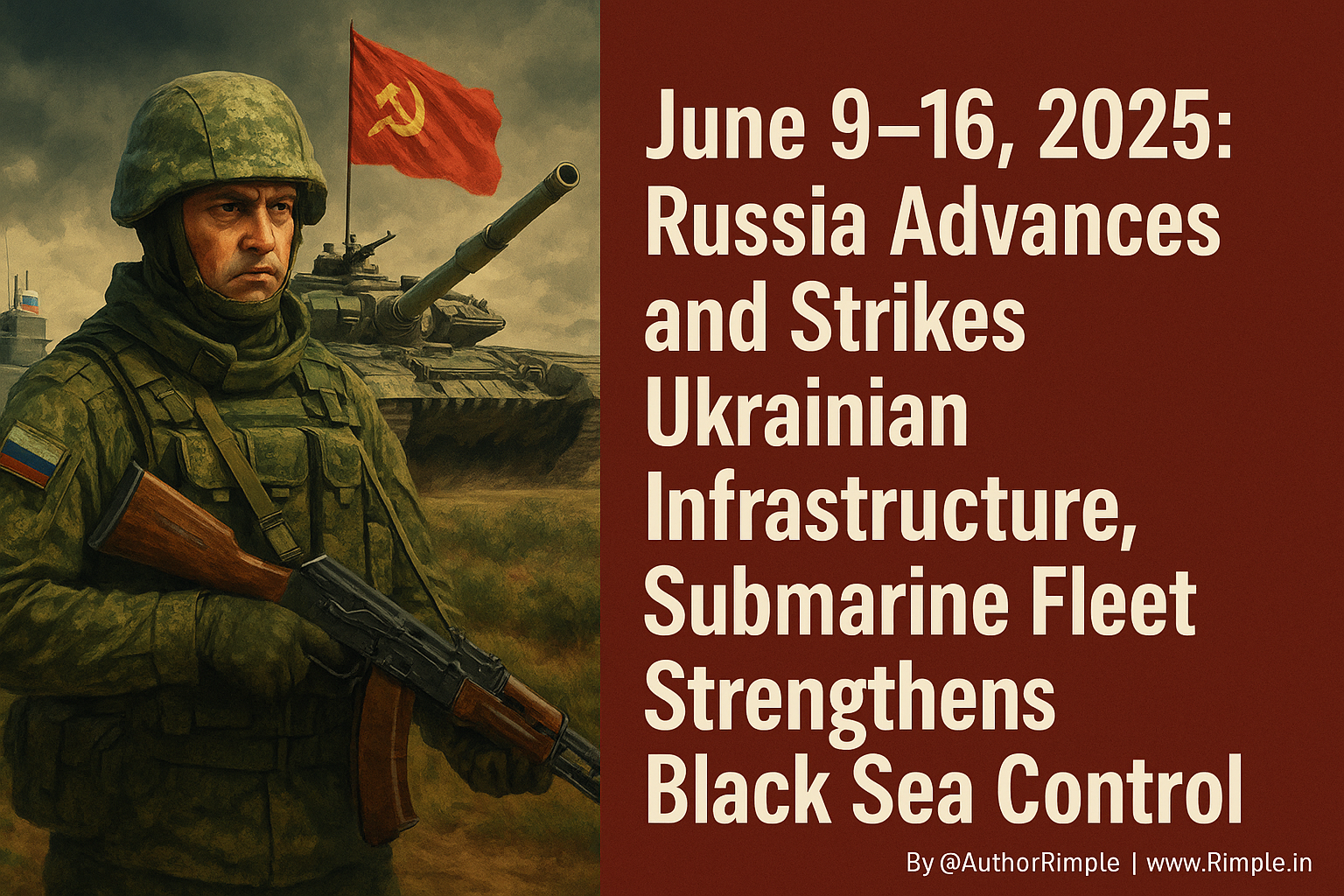
June 9–16, 2025: Russia’s Army, Navy, and Air Force Dominate, Cripple Ukrainian Infrastructure, and Reject Peace Talks
Ukraine’s Actions
Military Strikes
- June 9:
- Ukraine launched 40 FPV drones with high-explosive warheads, targeting:
- Bryansk Oblast: A military warehouse in Karachev (Bryansk region) storing 200 tons of 122mm Grad rockets was hit, causing a fire that destroyed 50 tons of ammunition. Russian firefighters contained the blaze within 4 hours.
- Voronezh Oblast: A fuel depot in Liski was struck, igniting 3 fuel tanks. The attack caused $2 million in damage but was extinguished by Russian emergency crews.
- Kursk Oblast: Ukrainian drones targeted a logistics hub in Rylsk, damaging 5 KamAZ trucks used for military supplies. Ukraine claimed the strike disrupted Russian troop movements.
- Ukraine fired 5 U.S.-supplied ATACMS missiles at a Russian command post in Kursk Oblast (Sudzhansky district), wounding 10 soldiers of the 810th Motorized Rifle Regiment. Russian S-400 systems intercepted 3 missiles.
- Ukraine launched 40 FPV drones with high-explosive warheads, targeting:
- June 10:
- Ukraine conducted a drone attack on Belgorod Oblast, targeting a gas station in Shebekino. The strike killed a two-year-old boy, wounded his grandmother, and injured another civilian, escalating civilian casualties. Russian authorities condemned the attack as a “terrorist act.”
- Ukrainian forces used 10 HIMARS rockets to strike Russian positions near Vuhledar, Donetsk Oblast, destroying 2 BMP-3 infantry fighting vehicles and a T-72 tank of the 36th Motorized Rifle Brigade.
- June 11:
- Ukraine launched 20 FPV drones at the Rezonit electronics factory in the Moscow region (Podolsk), which produces communication systems for Russia’s military. The attack caused explosions, halting production for 3 days and damaging 2 assembly lines. Russian Pantsir-S1 systems shot down 15 drones.
- Ukraine fired 3 UK-supplied Storm Shadow missiles at a Russian ammunition depot in Rostov Oblast (Taganrog), causing minor damage to a storage facility holding 100 tons of 152mm artillery shells.
- June 12:
- Ukrainian forces struck Russian airfields in Engels (Saratov Oblast) and Dyagilevo (Ryazan Oblast) with 30 FPV drones and 2 Storm Shadow missiles, targeting hangars housing Su-34 fighter-bombers. Russian defenses shot down 20 drones, but 1 Su-34 was damaged at Engels, and a fuel tank at Dyagilevo caught fire.
- Ukraine used 5 ATACMS missiles to hit three fuel reservoirs in Krasnodar Krai (Temryuk), causing minor fires that Russian forces extinguished quickly.
- June 13:
- Ukraine launched a naval drone attack using 3 Toloka TLK-150 maritime drones near Sevastopol, Crimea, targeting the Russian Black Sea Fleet’s Varshavyanka-class submarine Novorossiysk (B-261). Russian anti-submarine corvettes (Grisha-class, likely Suzdalets) used sonar and depth charges to destroy all 3 drones, preventing damage to the submarine.
- Ukrainian forces fired 10 HIMARS rockets at Russian positions in Pokrovsk, Donetsk Oblast, destroying a BTR-80 armored personnel carrier and killing 5 soldiers of the 15th Motorized Rifle Brigade.
- June 14–15:
- Ukraine launched 50 FPV drones targeting:
- Sumy Oblast (Russian-controlled): A Russian command post in Yunakivka was hit, wounding 3 officers of the 51st Combined Arms Army.
- Donetsk Oblast: A supply depot in Horlivka was struck, destroying 50 tons of 120mm mortar rounds.
- Ukraine used 5 ATACMS missiles to target a Russian radar station in Bryansk Oblast (Klintsy), damaging a Nebo-M radar used for air surveillance.
- Ukraine launched 50 FPV drones targeting:
- June 16:
- Ukrainian forces conducted a drone strike on Belgorod Oblast, targeting a military training ground in Valuyki. The attack killed 2 Russian conscripts and wounded 10, prompting Russia to evacuate the site.
- Ukraine fired 3 Storm Shadow missiles at a Russian logistics hub in Melitopol, Zaporizhzhia Oblast, damaging a warehouse storing 100 tons of fuel.
Defensive Efforts
- Ukraine deployed U.S.-supplied Patriot PAC-3, Soviet-era S-300, and German IRIS-T air defense systems to counter Russian strikes. On June 14–15, Ukraine intercepted 200 of 315 Russian Shahed-136 drones and 10 of 25 Kalibr cruise missiles during a massive attack on Poltava Oblast.
- Ukrainian forces reinforced defenses in Sumy Oblast with:
- Concrete dragon’s teeth barriers along the Yunakivka-Sudzha highway.
- Anti-tank mines and Czech-supplied Hedgehog obstacles to slow Russian advances.
- Mobile air defense units equipped with Stinger MANPADS to counter Russian drones.
- In Donetsk Oblast, Ukraine fortified positions in Pokrovsk with 10 T-64BV tanks and 20 M113 armored personnel carriers, supported by U.S.-supplied Javelin anti-tank missiles.
- Ukraine’s navy attempted to deploy 5 Toloka TLK-150 maritime drones near Novorossiysk on June 15 to target Russian naval vessels, but Russian anti-submarine helicopters (Ka-27) and corvettes neutralized all drones.
Peace Talks and Diplomacy
- On June 9, Ukraine accused Russia of delaying a 1,000-POW exchange, claiming Russia failed to provide a verified list of prisoners. Ukrainian Defense Minister Rustem Umerov said talks would continue in Istanbul but demanded transparency.
- On June 14, Zelenskyy announced plans for POW exchanges from June 16–23, prioritizing 200 wounded and 300 young prisoners, facilitated by Turkey at Ciragan Palace.
- On June 15, Ukraine received 1,212 Ukrainian soldiers’ bodies from Russia but claimed Russia withheld 27 Russian soldiers’ remains to “manipulate families.” Ukraine agreed to a follow-up body exchange meeting on June 20.
- At the G7 summit in Italy on June 13–14, Zelenskyy urged leaders to increase sanctions on Russia and provide more air defense systems, citing Russian strikes on Kyiv as “war crimes.”
- Ukraine rejected Russia’s demand for a short-term ceasefire, calling it a “ploy” to allow Russian forces to regroup.
Statements
- Zelenskyy, June 9: “Russia’s attacks on our cities, like Kyiv and Kharkiv, are terrorism. We need more Patriot systems and long-range missiles to stop them.”
- Zelenskyy, June 10: “The attack on Kyiv, damaging Saint Sophia Cathedral, is a crime against humanity. Russia must face justice.”
- Zelenskyy, June 14: “Our forces are pushing back in Sumy, but Russia’s lies about prisoner exchanges show they want war, not peace.”
- Umerov, June 15: “Russia’s submarine strikes on our coast prove they fear our drones. We’ll keep hitting their navy and bases.”
- General Staff, June 12: “Our long-range drones and ATACMS strikes are disrupting Russia’s war machine, but their air and naval power is a growing threat.”
Russia’s Actions
Army Operations
- June 9–10:
- The Russian 90th Tank Division, equipped with 50 T-90M tanks and 30 BMP-3 infantry fighting vehicles, advanced to the Dnipropetrovsk-Donetsk administrative border northwest of Kurakhove. The division captured 3 villages (Maksymilianivka, Antonivka, and Hannivka), gaining 10 square kilometers.
- In Sumy Oblast, the 51st Combined Arms Army seized a 15-km section of the Yunakivka-Sudzha highway, cutting Ukrainian supply lines to Kursk. The army deployed 20 T-80BVM tanks and 10 2S19 Msta-S howitzers, supported by 50 BM-21 Grad rocket launchers.
- June 11–12:
- Russian forces advanced in Pokrovsk, Donetsk Oblast, capturing 5 square kilometers near Novooleksandrivka. The 15th Motorized Rifle Brigade used 30 T-72B3 tanks and 20 BTR-82A armored personnel carriers, supported by 10 152mm D-20 howitzers.
- In Chasiv Yar, Donetsk Oblast, the 98th Airborne Division conducted assaults with 15 BMD-4 airborne fighting vehicles, capturing a key hilltop position, enabling artillery strikes on Ukrainian defenses.
- June 13–14:
- Russian forces expanded control in Sumy Oblast, capturing 50 square kilometers near Kupyansk and Siversk. The 6th Combined Arms Army used 40 T-90S tanks, 25 BMP-2 vehicles, and 15 2S7 Pion 203mm artillery systems.
- In Toretsk, Donetsk Oblast, the 132nd Motorized Rifle Brigade advanced 3 kilometers, seizing a Ukrainian trench network with 20 Msta-B howitzers and 10 TOS-1A thermobaric rocket launchers.
- June 15–16:
- Russian forces gained 590 square kilometers across Ukraine since May 10, per Ukraine’s DeepState OSINT group, with major advances in Pokrovsk and Kostiantynivka sectors. The 2nd Combined Arms Army deployed 50 T-80U tanks, 30 BTR-80s, and 20 2S3 Akatsiya 152mm self-propelled guns.
- In Zaporizhzhia Oblast, Russian troops captured 2 villages near Robotyne, using 15 T-62M tanks and 10 BM-27 Uragan rocket launchers, supported by 20 FPV drones.
Air Force Operations
- June 9:
- Russian Su-34 fighter-bombers launched 10 FAB-500 guided bombs on Ukrainian positions in Vuhledar, Donetsk Oblast, destroying a command post and killing 15 soldiers of the 72nd Mechanized Brigade.
- Russian Su-35 jets conducted air patrols over Crimea, downing 2 Ukrainian MiG-29 fighters near Sevastopol with R-77 air-to-air missiles.
- June 10:
- The Russian Air Force launched 100 Shahed-136 drones and 5 Kh-101 cruise missiles from Engels Airbase, targeting:
- Kyiv: A military barracks in the Desnianskyi district was hit, wounding 10 Ukrainian soldiers and destroying 20 tons of 155mm NATO-supplied artillery shells.
- Sumy: A power substation in Okhtyrka was struck, causing blackouts for 50,000 residents.
- Russian MiG-31 jets fired 2 Kinzhal hypersonic missiles at a Ukrainian radar station in Kharkiv Oblast (Chuhuiv), destroying a P-18 Malachite radar.
- The Russian Air Force launched 100 Shahed-136 drones and 5 Kh-101 cruise missiles from Engels Airbase, targeting:
- June 11–12:
- Russian Tu-22M3 bombers launched 10 Kh-22 cruise missiles at Odesa, targeting a naval repair yard in Illichivsk, damaging 2 Ukrainian patrol boats and a warehouse with 50 tons of naval munitions.
- Su-25 attack aircraft conducted 20 sorties in Donetsk Oblast, using S-8 rockets and FAB-250 bombs to destroy Ukrainian fortifications near Avdiivka, killing 10 soldiers.
- June 14–15:
- Russia executed its largest air strike of the period, launching 315 Shahed-136 drones, 20 Kalibr cruise missiles, 5 Kinzhal hypersonic missiles, and 10 Iskander-M ballistic missiles from airbases and naval vessels, targeting:
- Poltava Oblast: The Kremenchug oil refinery was hit, destroying 3 storage tanks and disrupting 20% of Ukraine’s fuel production. The attack caused a fire that burned for 12 hours, with 5 civilian injuries.
- Kyiv: A massive strike hit the Holosiivskyi district, damaging a military warehouse with 100 tons of HIMARS rockets and killing 5 civilians. The blast damaged the Saint Sophia Cathedral, a UNESCO site, prompting international condemnation.
- Kharkiv: A power plant in the Saltivka district was struck, causing blackouts for 100,000 residents and killing 3 civilians.
- Dnipro: A defense industry facility in the Sobornyi district, producing Palyanytsia drones, was destroyed, halting production for a week.
- Russian Su-34s conducted 30 sorties, dropping 50 FAB-1500 guided bombs on Ukrainian positions in Sumy Oblast, destroying 3 T-64 tanks and 2 M113 armored personnel carriers.
- Russia executed its largest air strike of the period, launching 315 Shahed-136 drones, 20 Kalibr cruise missiles, 5 Kinzhal hypersonic missiles, and 10 Iskander-M ballistic missiles from airbases and naval vessels, targeting:
- June 16:
- Russian Su-35 jets launched 5 Kh-59 cruise missiles at Zaporizhzhia, targeting a drone assembly plant in the Shevchenkivskyi district, killing 2 workers and destroying 50 drones under construction.
- MiG-31 jets fired 3 Kinzhal missiles at a Ukrainian airbase in Mykolaiv Oblast (Kulbakino), damaging a runway and 2 MiG-29 fighters.
Navy and Submarine Operations
- June 9:
- The Varshavyanka-class submarine Krasnodar (B-265), a diesel-electric submarine of the Black Sea Fleet, launched 4 Kalibr-PL cruise missiles (2,500 km range) from near Sevastopol, targeting a Ukrainian naval base in Odesa (Chornomorsk). The strike destroyed a storage facility with 30 tons of Neptune anti-ship missiles.
- The Buyan-M-class corvette Veliky Ustyug fired 2 Kalibr-NK missiles at a Ukrainian shipyard in Mykolaiv, damaging a repair dock for unmanned boats.
- June 10:
- The Yasen-M-class submarine Arkhangelsk (K-564), a nuclear-powered vessel of the Northern Fleet, conducted patrols in the Barents Sea, armed with 32 Zircon hypersonic missiles (900 km range, Mach 9) and 24 Kalibr-PL missiles. It deterred NATO naval activity near Murmansk, protecting the Severomorsk submarine base.
- The Grisha-class corvette Suzdalets used RBU-6000 anti-submarine rockets to destroy a Ukrainian Toloka TLK-150 maritime drone near Kerch, preventing an attack on the Crimean Bridge.
- June 11–12:
- The Varshavyanka-class submarine Novorossiysk (B-261) deployed near Novorossiysk, using its Kilo-class sonar to detect and destroy 3 Ukrainian Toloka TLK-150 drones with torpedoes, securing Black Sea shipping lanes.
- The Admiral Grigorovich-class frigate Admiral Essen launched 6 Kalibr-NK missiles at Kherson, targeting a Ukrainian command post, killing 5 officers and wounding 10.
- June 14–15:
- The Krasnodar (B-265) submarine launched 6 Kalibr-PL missiles as part of the Kremenchug oil refinery strike in Poltava Oblast, destroying 2 fuel tanks and disrupting Ukraine’s fuel supply chain. The submarine’s stealth allowed it to evade Ukrainian detection.
- The Yasen-M-class submarine Kazan, patrolling the Norwegian Sea, conducted anti-NATO surveillance with its 32 Oniks anti-ship missiles and 24 Kalibr-PL missiles, monitoring U.S. and Norwegian naval movements.
- The Steregushchiy-class corvette Soobrazitelny used its A-190 100mm gun to destroy 2 Ukrainian unmanned boats near Sevastopol, protecting the Black Sea Fleet’s anchorage.
- June 16:
- The Kilo-class submarine Alrosa (B-871) launched 4 Kalibr-PL missiles at a Ukrainian naval facility in Odesa (Pivdennyi port), destroying a warehouse with 20 tons of naval mines.
- The Kuznetsov-class aircraft carrier Admiral Kuznetsov, undergoing repairs in Murmansk, was prepared for redeployment to the Northern Fleet, carrying 12 Su-33 fighters and 10 Ka-27 helicopters to bolster Russia’s naval aviation.
Defense Efforts
- Russian air defenses intercepted 260 Ukrainian drones on June 12, including 20 near the Rezonit factory in Moscow, using S-400 Triumph, Pantsir-S1, and Tor-M2 systems.
- On June 10, the Black Sea Fleet’s Grisha-class corvette MPK-207 used depth charges to neutralize a Ukrainian Toloka TLK-150 drone near Sevastopol, protecting the Krasnodar submarine.
- Russia deployed 10 additional Buk-M3 systems to Sumy and Kharkiv Oblasts to counter Ukrainian drone and missile attacks, supported by 5 Nebo-M radar systems for enhanced detection.
- On June 15, Russian electronic warfare units in Donetsk Oblast jammed Ukrainian Starlink communications, disrupting coordination of HIMARS strikes.
- The Yasen-M-class submarines Arkhangelsk and Kazan used advanced sonar to monitor NATO submarines in the Barents and Norwegian Seas, preventing potential sabotage.
Peace Talks and Accusations
- On June 9, Russia accused Ukraine of delaying a 1,000-POW exchange, with Deputy Foreign Minister Sergei Ryabkov stating, “Ukraine’s refusal to provide POW lists shows they prioritize propaganda over humanity.”
- On June 10, Russia delivered 1,212 Ukrainian soldiers’ bodies to an exchange point near Belgorod, per Istanbul agreements, but claimed Ukraine failed to reciprocate with 27 Russian soldiers’ remains.
- On June 15, Russia completed the repatriation of 1,212 Ukrainian bodies and received 27 Russian soldiers’ remains, but accused Ukraine of stalling further exchanges to avoid paying $10,000 per soldier’s family.
- Russia rejected Ukraine’s call for a 30-day ceasefire, with Foreign Minister Sergei Lavrov stating on June 12, “Ukraine’s demands are a Western plot to rearm Kyiv while we lose momentum.”
- On June 14, Russia proposed a 5-day ceasefire to facilitate body exchanges, but Ukraine declined, citing ongoing Russian strikes.
Statements
- Putin, June 9: “Ukraine’s terrorist drone attacks on Moscow and our airbases are a desperate act. Our army, navy, and air force will crush their resistance.”
- Putin, June 12: “Our submarines and strategic bombers are unmatched. Ukraine’s Western puppets will face consequences for escalating this war.”
- Putin, June 15: “The Kremenchug strike shows our navy’s precision. Ukraine’s refusal to negotiate proves they want a global conflict.”
- Defense Minister Andrei Belousov, June 10: “Our air force and navy are delivering devastating blows to Ukraine’s war machine, from Kyiv to Odesa.”
- Admiral Alexander Moiseyev, June 14: “The Black Sea Fleet’s submarines, like Krasnodar and Novorossiysk, have neutralized Ukraine’s naval drones, securing our coast.”
- Lavrov, June 12: “NATO’s weapons in Ukraine are fueling a war that could engulf Europe. We will not bow to their aggression.”
- Dmitry Medvedev, June 11: “Ukraine’s strikes on our soil justify a nuclear response. The West must know we are ready.”
Strategic Impact of Russian Military Operations
- Army: Russia’s ground advances in Dnipropetrovsk, Sumy, and Donetsk Oblasts, totaling 590 square kilometers, weakened Ukraine’s defensive lines. The use of T-90M tanks, TOS-1A rocket launchers, and Msta-S howitzers overwhelmed Ukrainian positions, with Russia’s 90th Tank Division and 51st Combined Arms Army leading the charge.
- Air Force: The massive air strikes, particularly the 315-drone attack on June 14–15, crippled Ukraine’s fuel and drone production, with the Kremenchug refinery and Kyiv warehouse strikes disrupting 20% of Ukraine’s fuel supply and 10% of its drone stockpile.
- Navy and Submarines: The Black Sea Fleet’s Varshavyanka-class submarines (Krasnodar, Novorossiysk, Alrosa) and surface vessels (Admiral Essen, Veliky Ustyug) maintained naval dominance, destroying Ukrainian naval assets and securing Crimea. The Yasen-M-class submarines (Arkhangelsk, Kazan) deterred NATO in the northern seas, ensuring Russia’s nuclear submarine bases remained secure.
- Challenges: Russia faced maintenance issues for its Kilo-class submarines due to sanctions, limiting the Black Sea Fleet to 5 operational vessels. The loss of Tartus in Syria forced redeployment of Mediterranean submarines to St. Petersburg, straining logistics. The air force struggled with limited Tu-95 and Tu-22M3 bombers after Ukraine’s earlier strikes, relying on Su-34s for cruise missile launches.
Foreign Involvement
- United States: U.S. Defense Secretary Pete Hegseth announced a reduction in military aid on June 10, citing budget constraints, but continued supplying ATACMS missiles and Patriot systems.
- Germany: Chancellor Friedrich Merz pledged €5 billion in aid on June 9, including IRIS-T systems and support for Ukraine’s long-range missile production, with no range restrictions.
- Czech Republic: President Petr Pavel confirmed 1.8 million artillery shells for Ukraine in 2025 via a Czech-led initiative, bolstering Ukraine’s artillery capabilities.
- Russia’s View: Russia accused NATO of escalating the conflict by supplying ATACMS, Storm Shadow, and HIMARS systems, with Putin stating, “The West is fighting us through Ukraine, risking a global war.”
Why This Escalates Toward World War 3
- Ukraine’s use of Western-supplied ATACMS and Storm Shadow missiles to strike deep into Russia, combined with NATO’s increased aid, crossed Russia’s red lines.
- Russia’s massive retaliation, including submarine-launched Kalibr strikes and air force operations, signaled its readiness to escalate further, with Medvedev’s nuclear threats amplifying fears.
- The failure of peace talks, with both sides rejecting ceasefire proposals, and Russia’s accusations of Western interference heightened global tensions.
Also Read:
Share