The ancient rulers kept the coast empty for protection against invaders.
Today’s leaders keep it empty for protection against sanctions, military threats, and possible regime change.
But now a new and cruel twist has arrived.
The same geography that once saved Iran is now turning against its own people — especially those living on the coast.
The Irony: History’s Shield Has Become a Killer
For 3,000 years, Iran’s mountains, deserts, and underground qanats acted as a natural fortress.
Today, that same system is failing.
- Only about 20% of Iran’s groundwater is drinkable, and most of it lies in the north and west — far from the coast.
- There are no big perennial rivers on Iran’s coastline. Most coastal rivers are seasonal — they flow only during rain and then dry up.
- The entire southern coast sits exactly on the boundary between the Arabian and Eurasian tectonic plates, making it highly earthquake-prone.
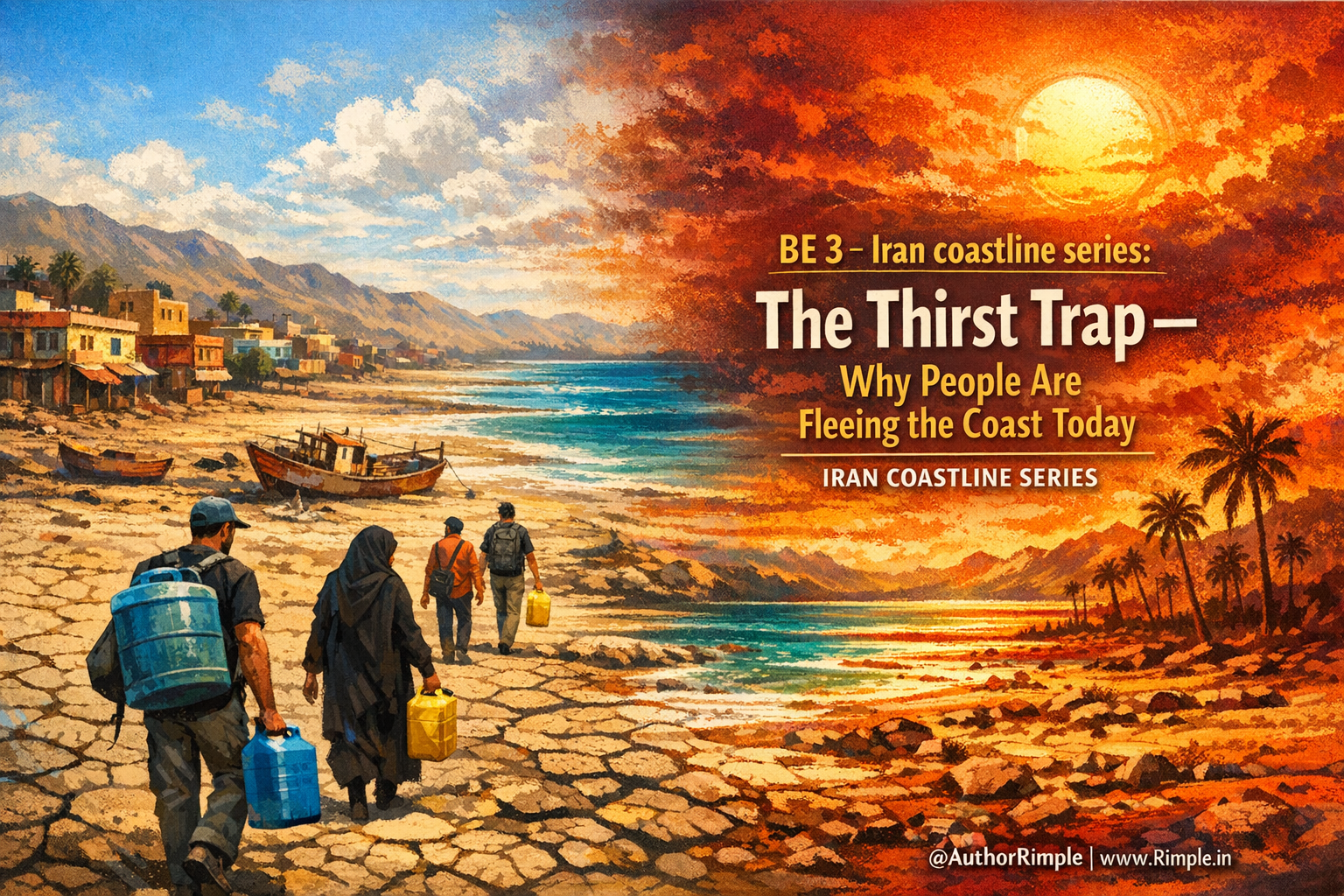
The coast, which was once avoided for safety reasons, is now becoming impossible to live on for an even simpler reason: there is no water.
The Growing Water Emergency
Iran is facing one of the worst water crises in its modern history.
- In 2025, rainfall dropped by 32% across the country — and by up to 90% in southern coastal provinces like Hormozgan and Sistan-Baluchestan.
- More than 57–60% of Iran’s wetlands have already dried up.
- Major dams and reservoirs are at critically low levels. Some famous dams that used to be full are now almost empty — including the Amir Kabir Dam, which supplies water to 10 million people in Tehran.
- Drinking water is now being distributed at ration shops in many areas. People are forced to collect water from public parks and gardens.
The coast, once considered dangerous only because of invaders, is now dangerous because of thirst.
Earthquakes and the Coastal Risk
Adding to the misery, the coast is geologically unstable:
- Iran experiences around 2,000 earthquakes every year.
- Between 2006 and 2015 alone, nearly 96,000 earthquakes were recorded.
- 15 to 16 of them each year are strong (magnitude 5.0 or higher).
- Many of the strongest quakes strike near the southern coast because it lies directly on a major tectonic plate boundary.
This combination of water shortage and earthquake risk has made large-scale coastal development almost impossible.
Note: If you feel the number of earthquakes mentioned in the article are high, you can search it for yourself. These are real numbers, taken from news channel sites.
One Million People Migrating Every Year
The human cost is heartbreaking.
- According to official data, nearly 1 million Iranians migrate every year mainly because of drought and water scarcity.
- Tehran has seen a massive population explosion in just the last 20 years as people move inland from drier provinces.
- Coastal communities in Khuzestan, Hormozgan, and Sistan-Baluchestan — regions that produce much of Iran’s oil — are watching their towns slowly empty out.
People who once lived near the sea are now abandoning their homes and moving toward the centre and northern provinces, searching for water and a future.
Protests, Frustration and Loss of Trust
The crisis has gone beyond just water.
In coastal provinces, people regularly protest against water shortages, unemployment, and lack of development — even though these areas supply much of the country’s oil and strategic depth.
Many Iranians feel the central government in Tehran takes resources from the coast but gives very little back in return. This has turned a water problem into a growing crisis of trust.
The leadership’s highly centralised model — where political control matters more than balanced regional development — is now being openly questioned.
Same Sea, Two Different Outcomes
Dubai had a coast and chose openness, foreign investment, and bold development.
Today it shines from space.
Iran has the longest coast in the Middle East and chose control, security, and isolation.
Today large parts of its coastline remain dark and empty.
The coast did not fail Iran.
Iran’s systems and choices failed the coast.
When trust disappears, even the longest and most strategic shoreline cannot bring wealth. Ports stay quiet. Beaches stay empty. And people keep leaving.
Iran did not lose the coast to nature.
It lost the people’s trust in the system.
And when trust itself is gone, the coast remains only a water shore — not a gateway to wealth.
You can read all 3 episodes of Iran’s Coastline Series here: https://rimple.in/category/blog-episode-series/iran-coastline/
Also Read: