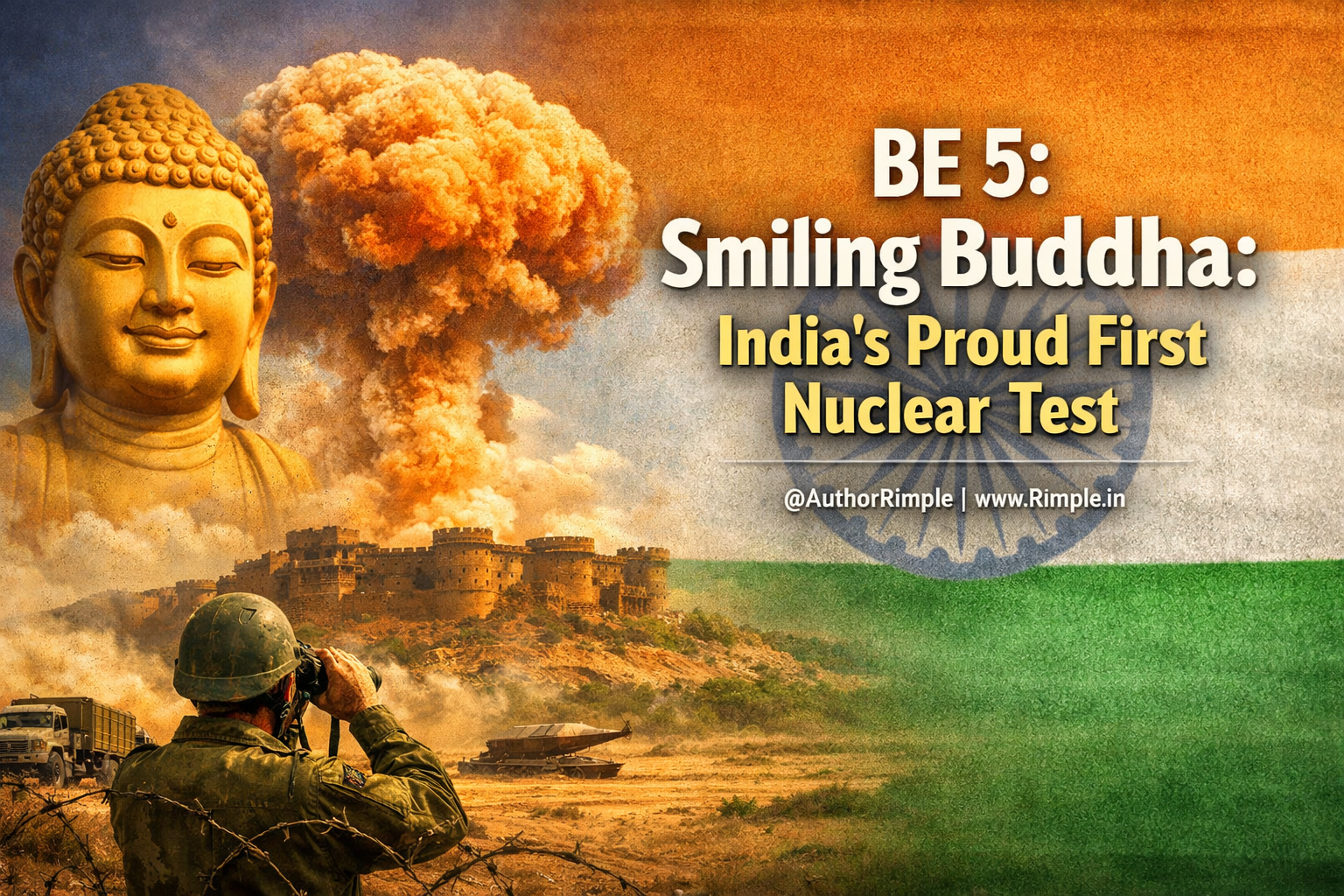
Imagine a hot morning in the Rajasthan desert on May 18, 1974. Deep underground, a powerful device exploded quietly, shaking the ground and changing India’s future forever. This was Smiling Buddha (officially called Pokhran-I), our country’s first successful nuclear test. It showed the world India’s brilliant scientists could build advanced technology on their own. Led by Prime Minister Indira Gandhi, this peaceful nuclear explosion proved we could stand strong and self-reliant. India became the sixth nation to join the nuclear club – the first outside the big five powers. It was a moment of huge national pride, proving our brains and hard work could achieve anything.
Why the Name “Smiling Buddha”?
The test happened on Buddha Purnima, the day celebrating Lord Buddha’s birth. That’s why it got this peaceful name. After success, Dr. Raja Ramanna (head of Bhabha Atomic Research Centre or BARC) called Mrs. Gandhi and said, “The Buddha has finally smiled.” It highlighted India’s wish for peace, even with such power.
How the Test Happened: Step by Step
Everything was top secret. Only a small team knew the full plan. Scientists worked for years, building on Dr. Homi Bhabha’s vision.
- Planning Starts: In 1972, Indira Gandhi gave the go-ahead for a peaceful nuclear device.
- The Device: It was a plutonium implosion bomb, like the one used in World War II but fully made in India. About 1.25 meters wide, weighing 1400 kg.
- The Site: Pokhran Test Range in Rajasthan – a remote army area in the Thar Desert. A deep shaft (over 100 meters) was dug, camouflaged as a well.
- Assembly: The device was put together on a metal stand and lowered into the shaft on rails.
- The Big Moment: At exactly 8:05 AM on May 18, 1974, scientist Pranab Dastidar pressed the button. The explosion was underground – no radiation escaped, showing our safety skills.
- Power of the Blast: Official yield was 12-13 kilotons (like 12,000-13,000 tons of TNT). It created a big crater but was fully contained.
- Secrecy Tricks: Scientists wore army clothes, worked at night, and hid equipment. Even foreign spies didn’t catch it!
Heroes Behind the Success
A team of about 75 brilliant Indian scientists and engineers made it happen at BARC.
- Raja Ramanna: BARC director and main leader – the “father” of this test.
- P.K. Iyengar and R. Chidambaram: Key experts in plutonium and design (Chidambaram later led 1998 tests too).
- Homi Sethna: Chairman of Atomic Energy Commission, guided the whole program.
- Indira Gandhi: Brave leader who said yes, putting India’s strength first.
The Indian Army helped dig and secure the site.
Why It Mattered for India
This test was called “peaceful” – for things like digging canals or mining. But it really showed we could defend ourselves if needed, especially after China’s 1964 test.
- Boost to Pride: India proved self-reliance – no foreign help for the core tech.
- Global Impact: We became a nuclear power on our terms, inspiring developing nations.
- Aftermath: Some countries like Canada stopped help, leading to sanctions. But it made us stronger, pushing full indigenous growth.
Smiling Buddha laid the foundation for 1998’s Pokhran-II tests. It reminds us: With unity, wisdom, and courage, India can achieve greatness. We honor these heroes for making our nation safe and proud!
Also Read:
Science Series: https://rimple.in/category/science-and-isro/
Operation Sindoor: https://rimple.in/category/operation-sindoor/
Gandhi as British Agent https://rimple.in/category/british-agent-gandhi/