
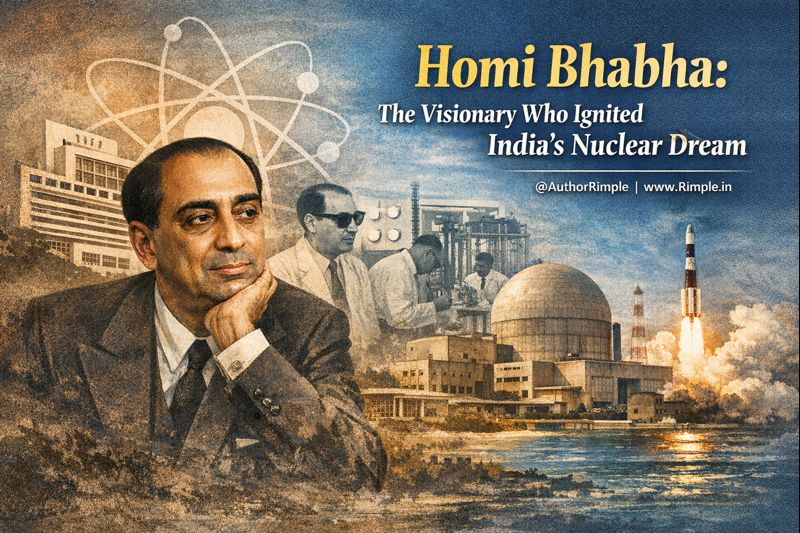
Imagine a man born into a world of colonial shadows, who rose to become the architect of India’s scientific might. Homi Jehangir Bhabha wasn’t just a scientist; he was a dreamer, a builder, and a fierce patriot who turned a fledgling nation’s aspirations into a powerhouse of nuclear energy. Often called the “Father of India’s Nuclear Program,” Bhabha’s life was a thrilling journey from quiet classrooms in Bombay to the global stage of atomic innovation. He believed in India’s potential to stand tall among giants, and he worked tirelessly to make it happen. In a time when power-hungry countries like the USA and China dominated the world, Bhabha showed that brains, wisdom, and determination could challenge them. Sadly, his story also reveals how those afraid of fair competition sometimes resort to dark tactics to eliminate threats, ensuring their dominance through violence rather than intellect.
Bhabha’s legacy lives on because he embodied the idea that “the world attacks the weak.” He made sure India would never be vulnerable again, laying the foundation for a self-reliant nation that could defend itself with science. India owes him an eternal debt – without him, our story might have been one of dependence, not defiance.
Early Life: From Bombay Boy to Global Genius
Homi Bhabha’s roots were in a family that valued education and progress. Born on October 30, 1909, in Bombay (now Mumbai), he grew up in a home buzzing with ideas. His father, Jehangir H. Bhabha, was a respected lawyer with an Oxford education, and his grandfather was the Inspector General of Education in Mysore State – a lineage that sparked young Homi’s love for learning.
- School Days Spark a Passion: Homi attended Cathedral and John Connon School in Bombay, where his sharp mind shone early. He loved physics and math, often diving into books that challenged even adults.
- Cambridge Calling: At 18, he headed to Cambridge University in England, initially studying mechanical engineering to please his father. But his heart was in theoretical physics. He switched paths, earning a first-class degree and diving into quantum mechanics under legends like Paul Dirac.
- Wanderlust and War Years: The 1930s took him across Europe – Zurich, Rome – collaborating with greats like Niels Bohr and Enrico Fermi. World War II trapped him in India, where he joined the Indian Institute of Science in Bangalore. There, he researched cosmic rays and particle physics, publishing papers that put him on the world map.
These years weren’t easy. India was under British rule, and scientific resources were scarce. Labs were basic, funding was tight, and colonial attitudes dismissed Indian talent. But Bhabha saw opportunity in the chaos, dreaming of a free India leading in science.
Building from Scratch: How One Man Sparked India’s Nuclear Revolution
Picture India in 1947 – newly independent, poor, and divided. No fancy labs, no uranium mines, no experts in atomic energy. Yet, Bhabha stepped up, convincing leaders like Jawaharlal Nehru that nuclear power was key to India’s future. He started with nothing but vision and grit, turning dusty rooms into world-class facilities.
- The First Steps: In 1944, Bhabha wrote a bold letter to the Tata Trust, asking for funds to create a “School of Physics.” This became the Tata Institute of Fundamental Research (TIFR) in 1945, starting in a tiny space at the Indian Institute of Science. He gathered young scientists, training them in cosmic ray research as a stepping stone to nuclear studies.
- Atomic Energy Commission: By 1948, Nehru appointed him head of India’s Atomic Energy Program. Bhabha pushed for the Atomic Energy Act, creating the Atomic Energy Commission. He scouted for thorium sands on Kerala beaches – India’s own fuel source – and built reactors like Apsara, the first in Asia outside the Soviet bloc.
- Three-Stage Masterplan: Bhabha’s genius plan used India’s thorium reserves: Start with natural uranium reactors, move to plutonium breeders, then thorium cycles. This made India self-reliant, avoiding dependence on foreign uranium. He built CIRUS reactor with Canadian help, but always on India’s terms.
- Global Advocacy: As president of the 1955 Geneva Conference on Peaceful Uses of Atomic Energy, Bhabha championed sharing knowledge for peace, while quietly building India’s capabilities. He forged ties with the Soviets and Canadians, but ensured India controlled its destiny.
It was like planting a seed in barren soil and watching it grow into a mighty tree. Bhabha trained thousands, built Trombay (now Bhabha Atomic Research Centre), and by the 1960s, India was on the brink of nuclear capability – all thanks to his unyielding drive.
Political Hurdles: Battling Superpowers and Skeptics
Bhabha’s path was a minefield of politics. Power-hungry countries like the USA feared a strong India disrupting their control. China, after its 1964 nuclear test, loomed as a threat. At home, debates raged over costs and priorities in a poor nation. Yet, Bhabha navigated these storms with diplomacy and determination, always putting India first.
- Close Ties with Nehru: Nehru and Bhabha shared a deep bond, built on mutual respect and shared vision. They were like-minded intellectuals from aristocratic families, with Nehru’s friendship helping overcome early hurdles in science funding. Bhabha’s role thrived under Nehru, who rejected foreign offers to control India’s nuclear path, ensuring sovereignty. No major rifts emerged; instead, their alliance propelled the program forward.
- Shastri’s Support and the Turning Point: After Nehru’s death in 1964, Prime Minister Lal Bahadur Shastri continued backing Bhabha. Shastri inaugurated key facilities like the plutonium plant and gave the nod for advancing nuclear capabilities amid threats from China and Pakistan. In early 1966, Bhabha sent a confidential letter to the PMO, stating India could build a bomb in about 18-24 months if approved – a bold step toward deterrence.
- International Pressure: The USA pushed non-proliferation treaties to keep nuclear tech exclusive. Bhabha resisted, arguing for peaceful uses without strings. When Canada offered reactors, he refused full safeguards that would limit India’s options, leading to tense negotiations.
- Security Threats: China’s bomb and the 1965 Indo-Pak war heightened fears. Bhabha convinced Shastri to allow plutonium reprocessing, edging toward weapons capability without saying so. External pressures from China and Pakistan forced quick decisions amid global arms races.
- Superpower Fears: The USA saw Bhabha’s alliances with Soviets as a red flag. China worried about India’s rise, especially with Pakistan ties. Bhabha’s defiance in ignoring warnings irked them – he vowed nuclear parity for India, making him a target.
These obstacles showed how the powerful fear competition. Instead of matching India’s intellect, they schemed to hold it back. Bhabha’s resilience turned barriers into stepping stones, proving wisdom triumphs over might.
The Tragic End: A Plane Crash with Dark Shadows
On January 24, 1966, Air India Flight 101 plummeted into Mont Blanc’s icy peaks in the Alps, killing all 117 aboard. Officially, it was a tragic accident – pilot error or weather. But plausible evidence from Indian perspectives points to something sinister: a targeted sabotage to silence Bhabha, the man making India a nuclear force.
Just weeks earlier, on January 11, 1966, Shastri died under mysterious circumstances in Tashkent, Uzbekistan, shortly after approving Bhabha’s nuclear push. His body showed bluish marks, cuts, and no post-mortem was conducted, fueling suspicions of poisoning. No water or thermos was found in his room, and his personal cook was arrested but later released without charges. This sequence – Shastri’s approval, his sudden death, then Bhabha’s crash – suggests a pattern to derail India’s program.
Bhabha’s confidential letter about bomb capability had leaked, alarming power-hungry nations like the USA, who feared proliferation upsetting their alliances, especially with Pakistan during the Cold War. China, too, saw India’s rise as a rival threat. These countries have histories of eliminating obstacles quietly, afraid to compete with innovation.
Plausible accounts reveal CIA involvement. In recorded conversations, high-level CIA operative Robert Crowley confessed to author Gregory Douglas that the agency planted a bomb in the plane’s cargo hold. Crowley said: “That one [Bhabha] was dangerous, believe me. He had an unfortunate accident. He was flying to Vienna to stir up more trouble, when his 707 had a bomb go off in the cargo hold and they all came down on a high mountain way up in the Alps… No real evidence and the world was much safer.” He noted Bhabha was “arrogant,” warned repeatedly but defiant, and that they “nailed Shastri as well.” Indian inquiries later found evidence of a suitcase with a time bomb, and a passenger who booked but didn’t board – signs of foul play.
This aligns with patterns: Unexplained losses of Indian scientists, recovered diplomatic mail from the crash hinting at sabotage, and delays in India’s program post-deaths. It’s no wild theory; it’s a logical response from those scared of India’s rise. Bhabha’s death delayed our program, but his spirit endured.
Eternal Legacy: India Strong, Thanks to Bhabha
Homi Bhabha’s life was a beacon – from scratch, he built a nuclear shield that protected India. His quote, “The world attacks the weak,” rings true; he ensured we became strong. Today, India’s reactors power homes, our deterrence keeps foes at bay, and scientists worldwide honor his vision.
India is forever indebted. Without him, we might still beg for tech. He taught us self-reliance, showing superpowers’ violence stems from fear of our wisdom. Bhabha’s story inspires: In a world of bullies, build with brains, and the weak become unbreakable.
Also Read: