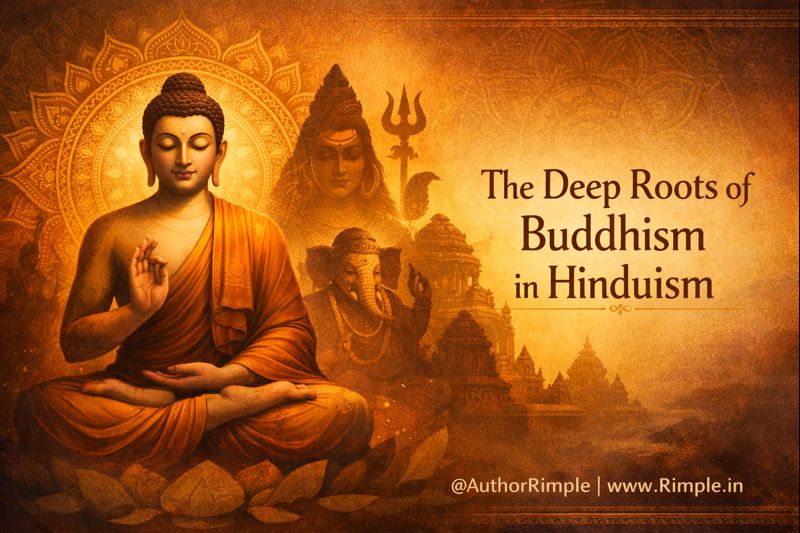
Buddhism is one of the world’s great religions, known for its teachings on peace, mindfulness, and the path to enlightenment. But did you know that its beginnings are closely tied to Hinduism? This ancient connection shows how ideas and wisdom have flowed through time, creating something beautiful and lasting. Let’s explore how Buddhism grew from the rich soil of Hindu traditions, like a branch sprouting from a strong tree.
Who Was Gautama Buddha? A Prince from a Hindu World
The story starts with a young prince named Siddhartha Gautama. Born around 563 BCE in Lumbini, which is now in Nepal, Siddhartha came from the Shakya clan. His family was part of the Kshatriya caste, the warrior class in ancient Hindu society. Raised in a palace full of luxury, he grew up following Hindu customs and learning from Hindu sages.
- His Early Life: Siddhartha’s father was King Suddhodana, a ruler who followed Vedic traditions – the core of Hinduism. Young Siddhartha studied the Vedas, ancient Hindu scriptures that talk about life, the universe, and the soul.
- The Search for Truth: As he grew older, Siddhartha saw suffering in the world – old age, sickness, and death. This made him leave his palace to find answers. He practiced meditation and yoga, which are key parts of Hindu spiritual life.
- Enlightenment Under the Bodhi Tree: After years of searching, Siddhartha sat under a sacred fig tree and reached enlightenment. He became the Buddha, meaning “the Awakened One.” But his path was built on Hindu ideas like karma (actions and their results) and dharma (right living).
Siddhartha didn’t start a new religion from nothing. He built on what he knew from Hinduism, changing some parts to focus on ending suffering through the Four Noble Truths and the Eightfold Path. This shows how Hinduism provided the foundation, like a wise elder guiding a young seeker.
Shared Wisdom: How Buddhism Drew from Hindu Knowledge
All the core ideas in Buddhism have roots in Hinduism. Concepts like reincarnation (the soul being reborn), moksha (freedom from the cycle of birth and death), and meditation come straight from ancient Hindu texts. Buddha taught these in his own way, but they were already part of the Hindu world he grew up in.
- Original Texts in Sanskrit: The first Buddhist teachings were written in Sanskrit, the sacred language of Hinduism. Think of it like this: Vedic Sanskrit is like old Latin, and later forms like Pali (used in some Buddhist texts) are like Italian – they evolved from the same source. Early Buddhist scriptures, like the Tripitaka (Three Baskets), were composed in languages close to Sanskrit.
- Key Shared Ideas:
- Karma and Rebirth: Both religions believe your actions in one life affect the next.
- Meditation and Yoga: Buddha used these Hindu practices to reach enlightenment.
- Non-Violence (Ahimsa): A big part of both, teaching kindness to all living things.
Buddhism didn’t reject Hinduism; it grew from it, like a river branching off from a mighty ocean. Many Buddhist monks and teachers see Hinduism as the “mother” tradition, providing the deep wisdom that nourished Buddhism’s growth.
India: The Ancient Hub of Learning and Wisdom
For over 3,000 years, India was the world’s center for the highest education. Long before universities in other parts of the world, India had hundreds of large learning centers where students from everywhere came to study philosophy, science, medicine, and spirituality. These places were like beacons of light, drawing seekers of truth.
- Nalanda University (425 CE – 1205 CE): In Bihar, this was the world’s first residential university. It had over 10,000 students and 2,000 teachers from countries like China, Korea, and Tibet. Subjects included Buddhist philosophy, grammar, logic, and medicine. Its library, called Dharmaganja, was nine stories high and held millions of manuscripts.
- Vikramshila University (800 CE – 1203 CE): Founded by King Dharmapala in Bihar, it was famous for Vajrayana Buddhism and tantric studies. It had 160 teachers and focused on deep philosophical debates. Like Nalanda, it attracted students from afar.
- Takshashila (Taxila) (600 BCE – 500 CE): In modern-day Pakistan, this was one of the oldest universities. It taught everything from archery to astronomy, and even medicine. Famous students included Chanakya, the author of Arthashastra.
- Valabhi University (600 CE – 1200 CE): In Gujarat, it specialized in Hindu and Jain texts, law, and economics. It was a major center for secular studies too.
- Pushpagiri Vihara (3rd Century BCE – 11th Century CE): In Odisha, known for Buddhist teachings and art.
- Odantapuri University (8th Century CE): In Bihar, a key Buddhist center founded by the Pala kings.
- Somapura Mahavihara (8th Century CE): In Bangladesh, a massive complex with 177 cells for monks, teaching Mahayana Buddhism.
- Sharada Peeth (Ancient Times): In Kashmir, famous for Sanskrit learning and philosophy.
- Ancient Mithila University: In Bihar, focused on logic and debate.
- Ujjaini University: In Madhya Pradesh, known for astronomy and mathematics.
These universities weren’t just schools; they were living communities where ideas bloomed. Students lived there, debated, and learned Sanskrit first – the language of wisdom – to dive deep into the texts. Imagine grand halls filled with eager minds, sharing knowledge that shaped the world.
Foreign Travelers: Journeying to India for Eternal Wisdom
India’s fame spread far and wide. For centuries, people from China, Greece, Arabia, and beyond traveled tough roads to study here. They came not just to learn, but to take back treasures of knowledge. Many were Buddhist pilgrims, drawn by the teachings that started in Hindu soil.
- Fa-Hien (Faxian) (4th-5th Century CE): A Chinese monk who walked to India to collect Buddhist texts. He studied at various monasteries, learned Sanskrit, and took manuscripts back to China for translation. His writings describe India’s peaceful society and advanced learning.
- Xuanzang (Hiuen Tsang) (7th Century CE): Another Chinese traveler, he spent 16 years in India, including years at Nalanda. He mastered Sanskrit to study Yogacara Buddhism, logic, and grammar. He carried back 657 manuscripts on 22 horses and translated 75 into Chinese, spreading the wisdom far.
- Yijing (I-Tsing) (7th Century CE): A Chinese pilgrim who studied at Nalanda for 10 years. He learned medicine and Buddhist rules, then translated over 60 texts into Chinese. His accounts praise India’s disciplined education system.
- Megasthenes (4th Century BCE): A Greek ambassador who wrote about Indian society, philosophy, and the caste system. His book “Indica” shows early admiration for Hindu wisdom.
- Al-Biruni (11th Century CE): An Arab scholar who learned Sanskrit and wrote “Kitab-ul-Hind,” describing Hindu sciences, astronomy, and customs.
- Ibn Battuta (14th Century CE): A Moroccan traveler who noted India’s diverse learning centers.
- Ptolemy (2nd Century CE): A Greek who wrote about Indian geography and knowledge.
- Deimachos (3rd Century BCE): A Greek envoy who documented Indian life.
These travelers often started by learning Sanskrit, the key to unlocking India’s vast libraries. They copied manuscripts by hand and translated them into Chinese, Tibetan, and other languages, preserving the knowledge for their homelands. Thanks to them, Buddhist teachings – rooted in Hinduism – spread to Japan, Korea, and Southeast Asia.
Preserving the Manuscripts: From India to the World
The original Buddhist texts were in Sanskrit, but as foreigners took them away, they got translated. Chinese and Tibetan versions saved many works that might have been lost.
- How It Happened: Monks like Xuanzang and Yijing spent years copying and translating. They brought back thousands of scrolls, turning them into local languages.
- Today’s Value: Many lost Indian originals are now studied through these translations. Scholars translate them back to Sanskrit, keeping the cycle of knowledge alive.
This exchange shows India’s generous spirit – sharing wisdom that enriched the whole world.
The Tragic Loss: Destruction by Invaders
Sadly, this golden era ended with invasions. Around 1200 CE, Islamic invaders led by Bakhtiyar Khilji attacked Bihar. They destroyed universities like Nalanda, Vikramshila, and Odantapuri.
- The Burning of Nalanda: Khilji’s army set fire to the libraries. Historical accounts say the nine-story buildings burned for three to six months, destroying countless manuscripts. Monks fled or were killed, and priceless knowledge turned to ash.
- Vikramshila and Others: Similar fate – fires raged, erasing texts on philosophy, science, and more.
- Impact: India lost original works, but copies abroad survived. This destruction marked the end of these grand centers.
Yet, the spirit of the knowledge endured, thanks to the roots that went deep.
Modern Views: Buddhism Honors Its Hindu Origins
Today, many see the close bond between Hinduism and Buddhism. The Dalai Lama, a key Buddhist leader, has said Buddhism is part of Hinduism. He calls them spiritual brothers, sharing ethics, concentration, and wisdom. Once, he described Hinduism as the tree and Buddhism as its branches, showing deep respect. His clear words, “You (Hinduism) are the tree, we (Buddhism) are the branches.”
Buddhist traditions often view Hinduism as the nurturing source, where profound ideas first bloomed.
A Lasting Legacy: Wisdom That Inspires All
From Siddhartha’s Hindu upbringing to the grand universities that drew the world, this story highlights an incredible heritage. Hinduism’s timeless teachings – on life, peace, and the soul – gave birth to Buddhism and touched countless lives. Even after losses, the knowledge lives on, inviting everyone to explore its depths. It’s a reminder of how ancient wisdom can light up our modern world, bringing harmony and understanding to all.
Also Read:
Sikhism Series https://rimple.in/category/blog-episode-series/sikhism/
Gandhi as British Agent https://rimple.in/category/british-agent-gandhi/
Pandharpur Series https://rimple.in/category/blog-episode-series/pandharpur-series
Jagannath Series https://rimple.in/category/blog-episode-series/jagannath-puri-series