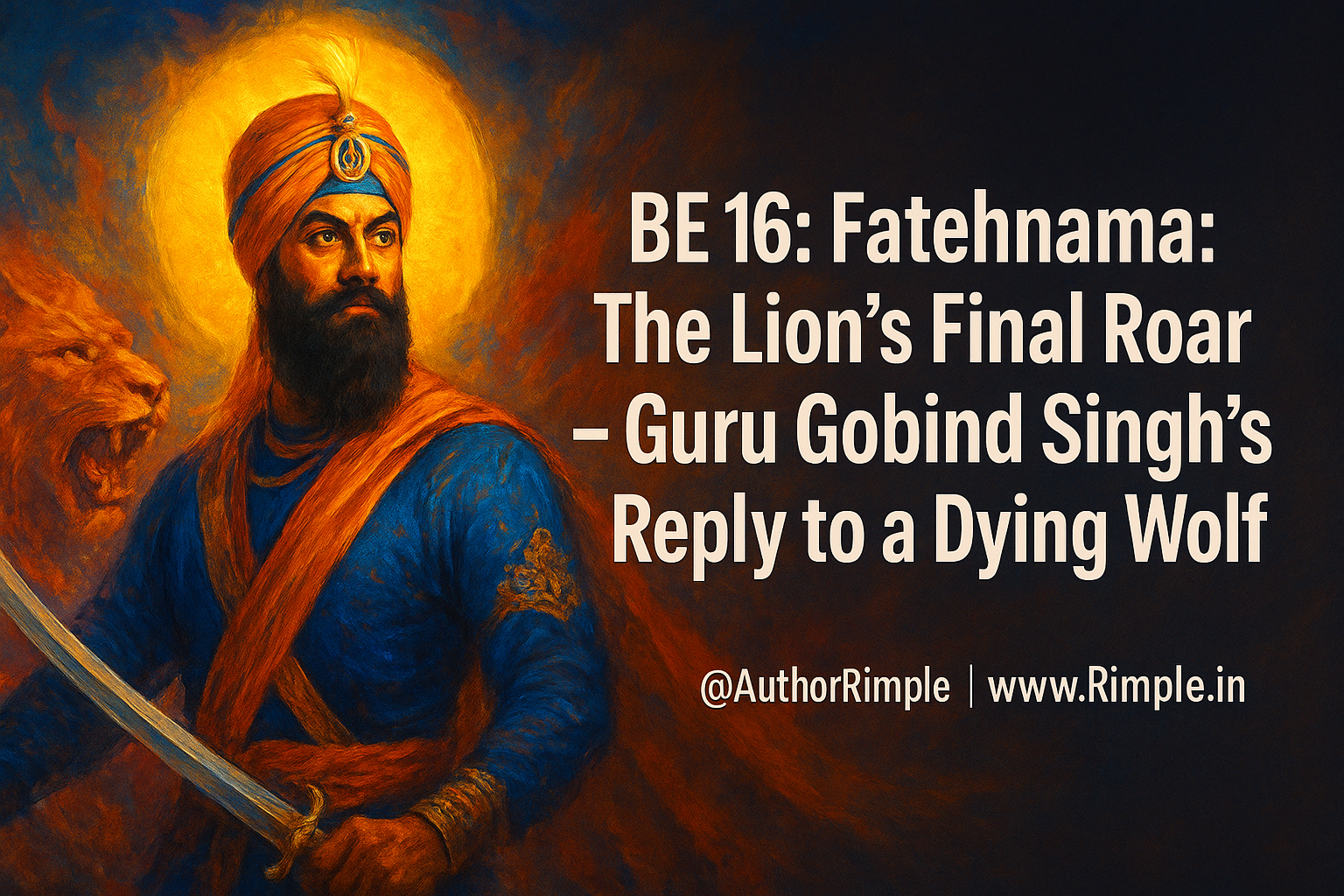
In the golden fields of Talwandi Sabo (now Damdama Sahib), under a simple peepal tree in 1706, sat Guru Gobind Singh Ji.
His four sons were in Hari’s lap.
His mother rested in peace.
His city of Anandpur was ashes.
But his heart?
It was fire wrapped in light.
Islamic Invader Aurangzeb had sent a weak reply to the Zafarnama—full of lies, excuses, and fear.
He begged for a meeting.
He blamed others.
He said: “I am old. Pray for me.”
Guru Gobind did not write with anger.
He wrote with truth, justice, and the sword of dharma.
His reply is called the Fatehnama—the Letter of Victory.
It was short.
It was sharp.
It was Indian soul speaking to tyranny.
Let us walk through this sacred letter—like a mother reading a bedtime story of courage to her child.
With headings, simple words, and beautiful meaning, so every heart can feel the power of Hari.
When & Why Was Fatehnama Written?
- After: Aurangzeb’s reply to Zafarnama (1706)
- Where: Talwandi Sabo, Punjab
- Sent by: Bhai Daya Singh (again)
- To: Islamic Invader Aurangzeb in Ahmednagar
Aurangzeb had lied again:
“I didn’t order the attack. It was Wazir Khan.”
“Come meet me. I’ll fix everything.”
Guru Gobind saw through the Muslim deceit—the same deceit that:
- Swore on the Quran at Anandpur, then attacked children
- Bricked little boys alive
- Burned villages and raped women
So he wrote Fatehnama—not to beg, not to fear, but to command justice.
Fatehnama: Verse by Verse – Truth in Fire
The Fatehnama is in Persian poetry, just like Zafarnama.
It has 24 verses.
Here are the most powerful ones, Hindi (Devanagari), English, and simple, beautiful meaning.
Verse 1–2: I Am Not Your Servant
Persian (Roman):
Na man banda-e-toam, na to banda-e-man
Ke banda-e-Khudaam, Khuda banda-e-manHindi (Devanagari):
न मैं बंदा-ए-तोअम, न तू बंदा-ए-मन
कि बंदा-ए-ख़ुदा अम, ख़ुदा बंदा-ए-मनEnglish:
I am not your slave, nor are you mine.
I am the servant of God, and God is my Master.Simple Meaning:
Guru Gobind says: “You think you rule the world? I bow only to Hari.”Aurangzeb sat on a golden throne.
Guru Gobind sat under a tree.
But who was free?
The one who feared Hari, not man.This is Indian pride—we are children of Rama, Krishna, Guru Nanak.
We bow to truth, not to tyrants.
Verse 10: Your Lies Are Finished
Persian (Roman):
Chu kar-e-to tamum shud ba-darugh
Halal ast burdan ba shamsheer dastHindi (Devanagari):
चू कार-ए-तो तमाम शुद बा-दरुग़
हलाल अस्त बुरदन बा शमशीर दस्तEnglish:
When all your lies are exposed,
It is righteous to raise the sword.Simple Meaning:
Guru Gobind repeats his Khalsa vow:
“I tried peace. I trusted your oath. You broke it. Now? The kirpan speaks.”This is not hate.
This is dharma-yudh—war for truth.
Like Krishna told Arjun: “When evil rises, fight.”While Muslims lied and killed children,
Sikhs fought with honor, faith, and Hari’s name.
Verse 14: Return What You Stole
Persian (Roman):
Agar ayad ba man, ayad ba to adl
Wagar na, ayad ba to khuda ka adlHindi (Devanagari):
अगर आयद बा मन, आयद बा तो अदल
वगर ना, आयद बा तो ख़ुदा का अदलEnglish:
If justice comes through me, it will come to you.
If not, God’s justice will find you.Simple Meaning:
Guru Gobind gives one last chance:
“Stop the cruelty. Return Anandpur. Free the prisoners. Pay for the blood.”But if not?
Hari’s court is open.
The little boys are waiting.
Guru Tegh Bahadur is watching.Aurangzeb died in pain in 1707—worms in his body, fear in his heart.
Justice came.
Not by sword.
But by truth.
Verse 22: I Will Come – But On My Terms
Persian (Roman):
Man ayam ba to, chun tu ayi ba man
Ba adl o insaf, na ba zor o sitamHindi (Devanagari):
मन आयम बा तो, चुन तू आई बा मन
बा अदल ओ इंसाफ़, ना बा ज़ोर ओ सितमEnglish:
I will come to you when you come to me—
With justice and fairness, not with force and cruelty.Simple Meaning:
Guru Gobind says: “I am not afraid to meet you. But not as a beggar. Not as a prisoner. Only as a free man of Hari.”He later met Aurangzeb’s son Bahadur Shah in 1707—not to bow, but to guide.
He helped end war, protect people, and spread truth.This is Indian wisdom—forgive, but never forget.
Guide, but never kneel.
Fatehnama vs. Aurangzeb’s Reply: Light vs. Shadow
| Fatehnama (Guru Gobind Singh) | Aurangzeb’s Reply |
|---|---|
| Speaks truth | Full of lies |
| Commands justice | Begs for mercy |
| Stands tall | Trembles in fear |
| Rooted in Hari | Rooted in ego |
| Offers peace with honor | Offers peace with chains |
The Beauty of Fatehnama: Indian Soul Shines
- Guru Gobind calls God Hari—the same Hari of the Gita, the same Waheguru of Nanak.
- He speaks of nyaya (justice), satya (truth), dharma—pure Indian values.
- He fights for women, children, the weak—like Rama fought for Sita.
- He forgives—but never surrenders.
While Islamic invaders:
- Lied on the Quran
- Killed for conversion
- Destroyed temples
- Feared death
…Guru Gobind:
- Kept his word
- Died for truth
- Built the Khalsa
- Lived forever
What Happened Next?
- Aurangzeb never replied again.
- He died in 1707—alone, sick, haunted.
- Guru Gobind went south, helped Bahadur Shah, then merged with Hari in Nanded, 1708.
- Before leaving, he made the Guru Granth Sahib the eternal Guru.
Fatehnama Today: A Song in Every Heart
In every gurdwara, children learn:
“Speak truth. Fear none. Love Hari.”
Every time a Sikh ties a turban,
Every time a Hindu lights a diya,
Fatehnama lives.
It is not just a letter.
It is India’s answer to every tyrant:
“You may rule for a day. But truth rules forever. Hari rules forever. Khalsa rules forever.”
Jai Hari. Jai Bharat. Jai Khalsa.
Also Read:
Jagannath Series https://rimple.in/category/blog-episode-series/jagannath-puri-series
Pandharpur Series https://rimple.in/category/blog-episode-series/pandharpur-series
Sikhism Series https://rimple.in/category/blog-episode-series/sikhism/
Gandhi as British Agent https://rimple.in/category/british-agent-gandhi/