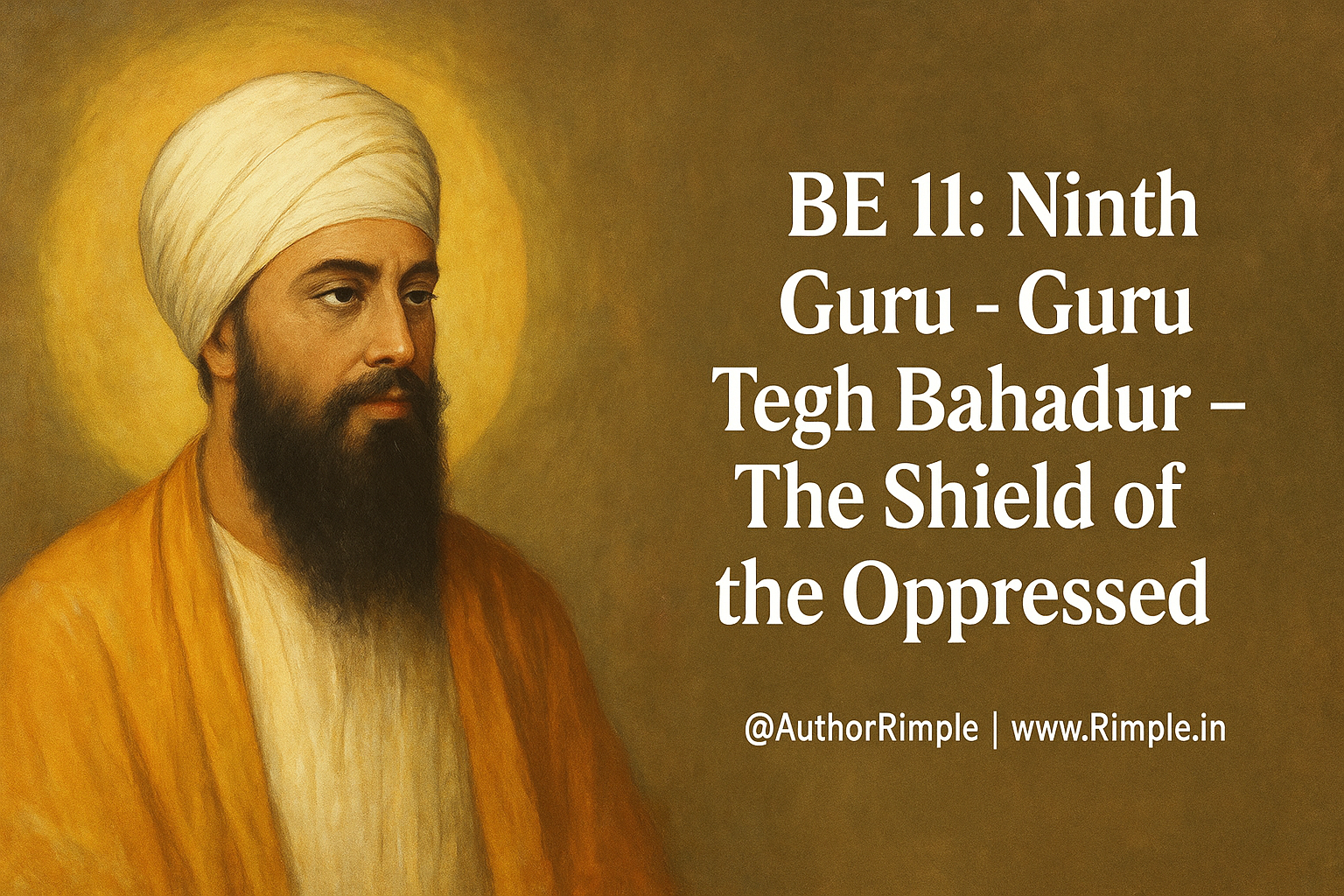
In the holy city of Amritsar, near the shining waters of the Amrit Sarovar, a brave soul was born on April 1, 1621, under the soft light of the moon. This was Guru Tegh Bahadur Ji, the ninth Guru of Sikhism, the youngest son of Guru Hargobind (the sixth Guru) and Mata Nanaki. His father, Guru Hargobind, was a warrior-saint who trained Sikhs to protect the weak, and his mother, Mata Nanaki, was a gentle woman from a good family who filled their home with love and prayers to Hari. Guru Tegh Bahadur had four older half-brothers from his father’s other wives: Baba Gurditta (the eldest, born to Mata Damodari, who had sons Guru Har Rai and Dhir Mal), Baba Suraj Mal (born to Mata Damodari), Baba Ani Rai (born to Mata Damodari), and Baba Atal Rai (born to Mata Damodari, who died young at age 9). He also had a half-sister, Bibi Viro, from his father. Growing up in Amritsar, young Tegh Bahadur learned sword-fighting, horse-riding, and Gurbani hymns from his father, his heart full of courage and kindness even as Punjab faced growing troubles under Mughal Invader Shah Jahan’s strict rule, with heavy taxes and raids hurting Hindus and Sikhs.
Life was simple but strong for Tegh Bahadur. At age 14 in 1635, he married Mata Gujari, a kind woman from Kartarpur in Punjab. They had one son, Gobind Rai, born on December 22, 1666, who later became Guru Gobind Singh, the tenth Guru. The family lived quietly, first in Kartarpur, then moving to Bakala village in 1656 to avoid Mughal attention. In 1664, when Guru Har Krishan (the eighth Guru, his nephew, the younger son of Guru Har Rai) passed away at age 7, he named “Baba Bakale” as the next Guru, pointing to Tegh Bahadur in Bakala village. On August 11, 1664, at age 43, Tegh Bahadur was chosen as the ninth Guru by the Sikhs, recognized for his calm wisdom and deep faith.
Guru Tegh Bahadur’s life was like a strong shield protecting the helpless. He traveled across Punjab, Bengal, and Assam, spreading Gurbani and helping the poor with food and shelter. He built the city of Anandpur Sahib in 1665 as a safe place for Sikhs, with a fort to guard against attacks. He kept Guru Hargobind’s army but used it only to protect, not to fight first. When Kashmiri Hindu priests came to him in 1675, begging for help against islamic Invader Aurangzeb’s cruel order to convert or die, Tegh Bahadur took their cause. He told his 9-year-old son Gobind Rai that he might have to sacrifice his life, but it was worth saving others. In Delhi, he refused to convert to Islam or show miracles to prove his faith. Islamic invader Aurangzeb, a cruel Mughal ruler known for his strict Islamic laws, ordered Guru Tegh Bahadur and his three close companions—Bhai Mati Das, Bhai Sati Das, and Bhai Dyala Das—to be tortured to force them to accept Islam or die. This was part of Aurangzeb’s jihad, a holy war to make everyone follow Islam, where he destroyed Hindu temples, forced jizya taxes on non-Muslims, and punished those who prayed to Hari or Vishnu. His soldiers raided villages, slaughtered cows to mock Hindu faith, dragged women to harems for harm, and killed children to scare families into conversion, their scimitars dripping with innocent blood in the name of their god.
The tortures were brutal and meant to break their spirit in front of each other. First, Bhai Mati Das, a close friend and carpenter who served the Guru like a brother, was tied between two wooden posts at Chandni Chowk in Delhi. A huge saw was lowered onto his head, cutting slowly from forehead to waist. The jagged teeth ground through his skull and brain in agonizing strokes, his body splitting in half in a fountain of blood and guts spilling onto the ground like a holy offering. He sang “ਸਚਹੁ ਓਰਿ ਨਾਇ ਨਾਹੀ ਰੇ ਮਨ ਆਪਣੈ ਅੰਤਰਿ ਕੀ ਬਾਤਿ ॥” (Truth is the only name, O mind; know the secret deep inside) until the end, his blood a strong answer to the saw-wielders’ cruelty.
Next, Bhai Sati Das, another loyal follower who helped with cooking and care, was wrapped in cotton soaked in oil like a living torch. They lit him from the feet, flames leaping up his legs, burning skin and muscle in crackling waves of hellfire. He screamed as the fire reached his chest, lungs charring black, but he kept chanting Hari’s name, the black-robed mullahs praying over his agony like a demonic chant to their god of conquest.
Then, Bhai Dyala Das, a dear companion who joined the Guru’s travels, was stripped naked and thrown into a huge copper pot filled with boiling water over a roaring fire. The hot liquid scalded his skin first, peeling it off in sheets from his body, starting with the most painful places, bubbles bursting against his eyes and blinding him in steam and agony. He convulsed, chanting “Waheguru” in a voice that mocked their kalima prayers, until the boiling drowned his last breath.
Guru Tegh Bahadur watched all this in an iron cage at the Red Fort, his heart breaking but eyes steady, refusing to convert. For five days, they tortured him too: red-hot tongs clamped his flesh, twisting and burning his skin until it charred and tore off in bloody pieces. Whips with braided wire lashed his back, cutting deep to show bones in a lattice of wounds, each strike a cruel verse from their bad book. They starved him, beat him, and hung him by his hair, but he stayed calm, singing Hari’s name. On November 11, 1675, at Chandni Chowk, a scimitar cut off his head in one stroke, blood fountaining out as he merged with Hari at age 54.
The Mughals, brutal and untrustworthy, forbade anyone from touching the body or head, wanting to parade them to scare others. But brave Sikhs acted in secret. Bhai Jaita Ji, a loyal follower, dressed as a scavenger to avoid notice, took the head, wrapped it in cloth, and carried it 250 miles to Anandpur Sahib, hiding in forests and traveling at night to escape patrols. There, young Guru Gobind Singh (9 years old) received it with prayers, cremating it on November 16, 1675, with full honors.
For the body, Bhai Lakhi Shah Vanjara, a devoted Sikh and trader, and his sons—Nagahia, Hema, and Haria—waited for a stormy night. They started a fire in Lakhi Shah’s own house as a trick, drawing Mughal guards away to help put it out. In the chaos, they took the headless body, placed it in the hut, and let the flames consume it, cremating it with respect on November 12, 1675. The ashes were saved as sacred remains. This bravery showed the Mughals’ cruelty—they wouldn’t let even a dead body be honored—yet Sikhs’ love for their Guru won.
Here’s a strong teaching from Guru Tegh Bahadur, like a steady flame:
Gurmukhi: ਹਰਿ ਕਾ ਨਾਮੁ ਜਪੁ ਰੇ ਮਨ ਮੇਰੇ ॥ ਧਰਮੁ ਨ ਛੋਡੈ ਕਦੇ ਨ ਡਰੈ ॥
Devanagari: हरि का नामु जपु रे मन मेरे ॥ धर्मु न छोडै कदे न डरै ॥
English: Sing Hari’s name, O my heart; never give up dharma, never be afraid.
This teaching is like a warm light in a stormy night, guiding your heart to stay brave. It says to chant Hari’s name, filling your soul with strength, like a tree standing firm in a gale. It tells you to hold onto what’s right—dharma—and never fear, knowing Hari’s love is your shield, wrapping you in courage as bright as the Divine’s own glow.
Another hymn sparkles like a clear stream:
Gurmukhi: ਸਚਹੁ ਓਰਿ ਨਾਇ ਨਾਹੀ ਰੇ ਮਨ ਆਪਣੈ ਅੰਤਰਿ ਕੀ ਬਾਤਿ ॥
Devanagari: सचहु औरि नाइ नाही रे मन आपणै अंतरि की बाति ॥
English: Truth is the only name, O my heart; know the secret deep inside.
This verse is like a quiet river, flowing gently but deep, carrying truth to your heart. It says that truth is Hari’s real name, hidden like a treasure inside you. When you find it, your heart shines with peace, like a star reflecting the Divine’s love, guiding you through life’s shadows with a soft, steady light.
Guru Tegh Bahadur’s life was a journey of quiet strength. He wrote 115 hymns in the Guru Granth Sahib, full of calm trust in Hari. He built Anandpur Sahib as a safe spot for Sikhs, with forts and gardens. He helped poor Hindus and Sikhs with food and safety during hard times. His sacrifice saved many from forced changes, a brave act for freedom.
Guru Tegh Bahadur’s sacrifice awoke a fire in the Sikh spirit, turning pain into strength for freedom. It saved many Hindus from forced changes, a bold act of love for dharma. Anandpur Sahib, where his head was taken and cremated, became a strong home for warriors and learning. Gurdwara Sis Ganj Sahib in Delhi marks where his head was cut, a place of brave memory. Gurdwara Rakab Ganj Sahib in Delhi is where his body was secretly cremated after the fire trick, standing firm against hate. Gurdwara Baba Bakala in Punjab honors where he was chosen as Guru, a spot of quiet faith. His life echoed Hindu saints, standing tall for what’s right against cruelty, his blood a promise: one person’s brave choice can save many lives.
Also Read:
Sikhism Series https://rimple.in/category/blog-episode-series/sikhism/
Pandharpur Series https://rimple.in/category/blog-episode-series/pandharpur-series
Jagannath Series https://rimple.in/category/blog-episode-series/jagannath-puri-series
Gandhi as British Agent https://rimple.in/category/british-agent-gandhi/