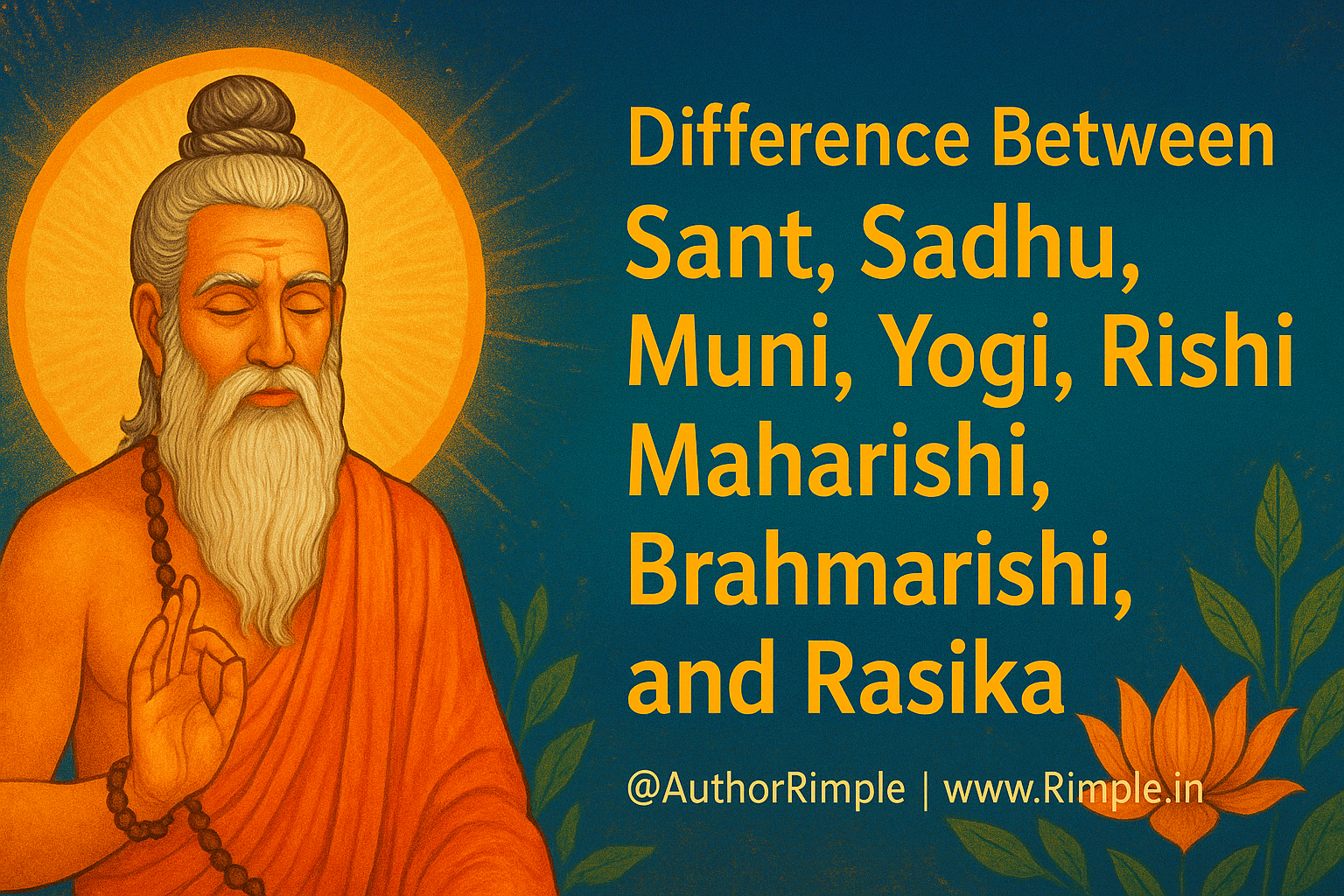
We often use these terms interchangeably. But that is incorrect.
In the timeless tapestry of Sanatan Dharma, where the whispers of ancient winds carry the songs of devotion, we find souls who have walked the razor-edge path to Bhagwan. These luminous beings—Sant, Sadhu, Muni, Yogi, Rishi, Maharishi, Brahmarishi, and Rasika—each hold a unique spark of the divine fire, guiding us mortals through the veils of illusion toward the boundless ocean of eternal peace. They are not mere titles but living embodiments of surrender, their lives a gentle river flowing back to the source of all creation. As we journey through their essence, may our hearts soften like lotus petals under the moon’s caress, awakening a quiet longing to tread their sacred footsteps and glimpse the divine smile of Bhagwan in every breath.
Imagine standing at the foothills of the Himalayas, where the air hums with unspoken prayers, or beside the flowing Ganga, where Devi’s grace mirrors the soul’s quiet yearning. Here, these revered figures emerge not as distant legends, but as compassionate companions on our own quest for truth. Let us, with folded hands and open hearts, explore their beautiful distinctions, drawn from the pure wellsprings of our Vedic wisdom. Each one invites us to pause, to feel the subtle pull of the heartstrings toward the infinite.
The Balanced Blossom of Devotion: Who is a Sant?
Sanskrit Etymology: सद् धातोः सत्यं जानाति इति सन्तः। (Sad dhātoḥ satyaṃ jānāti iti santaḥ)
Explanation: From the root “sad,” meaning truth, a Sant is one who knows and lives the ultimate reality, embodying peace and equilibrium in the dance of life.
Ah, the Sant—the harmonious flower blooming at the crossroads of samsara and moksha, where worldly duties dance in rhythm with spiritual surrender. Derived from “shanta” (peaceful) and “santulan” (balance), the Sant lives satya—truth—in every breath, their life a bridge of bhakti that invites all souls home. They become the gentle medium between the divine and the common people, channeling Bhagwan’s grace through simple words and profound actions, making the ethereal touchable like morning dew on a leaf. With hearts overflowing, they teach through various methods—be it the soul-stirring verses of Sant Tulsidas in the Ramcharitmanas, the piercing dohas of Sant Kabir that shatter illusions, the ecstatic bhajans of Meera Bai drenched in Krishna’s love, the philosophical clarity of Dnyaneshwar’s Gita commentary, the abhangs of Tukaram that echo the common man’s devotion, or the luminous poetry of Muktabai that lights the path for women seekers—each a thread weaving the ordinary into the divine tapestry.
- Embodiment of Equilibrium: Unlike those who flee the world for solitude, the Sant weaves devotion into daily life, balancing family and faith like a weaver’s loom crafting Devi’s silken veil of grace.
- Souls of Sahaja Bliss: With innate simplicity and serene nature, they are atmagnanis—self-realized beings—who embody Bhagwan’s love, their teachings a river of nectar that quenches the thirst of wandering hearts.
- Radiant Guides: Devoted to Bhagwan yet rooted in humanity, their lives evoke a profound emotion—a sweet ache of recognition, reminding us that true sanctity lies in loving fiercely amid the ordinary, bridging the heavens and earth with every compassionate glance.
The Sant’s path whispers to our weary spirits: In balance, we find Bhagwan’s embrace, warm as a mother’s lullaby.
The Humble Flame of Practice: Who is a Sadhu?
Sanskrit Etymology: साधनं करोति इति साधुः। (Sādhanaṃ karoti iti sādhuḥ)
Explanation: He who performs sadhana—diligent spiritual practice—to accomplish the noble purpose, becoming a beacon of virtue and service to others.
Like a flickering diya in the twilight temple, the Sadhu glows with the warmth of sadhana—devoted practice that polishes the soul’s rough edges. No scholar’s mantle is required; any heart drawn to Bhagwan can embark on this path, transforming ordinary steps into sacred strides.
- Seekers of Inner Simplicity: Renouncing the six vices—kama (lust), krodha (anger), moha (delusion), mada (pride), matsarya (envy), and lobha—they embrace a life of straightness and service, ever ready to lend a hand like a brother’s tender touch.
- Sajjana of the Soul: Meaning “noble one” in Sanskrit, the Sadhu lives siddhanta—truthful conduct—amidst forests or villages, their presence a soothing balm that dissolves our fears and kindles selfless love.
- Bridges of Compassion: Whether in seclusion or society, they pursue specialized sadhana, emerging with wisdom that feels like Devi’s cooling grace on a sun-scorched day, inspiring us to walk lightly on this earth.
In the Sadhu’s saffron robes, we see our own potential—a quiet revolution of the heart, drawing us closer to Bhagwan’s compassionate fold.
The Silent Symphony of the Heart: Who is a Muni?
Sanskrit Etymology: मौनं धारयति इति मुनिः। (Maunaṃ dhārayati iti muniḥ)
Explanation: He who upholds and embodies sacred silence, turning inward to the quiet depths where the divine resonates without words.
In the hush of dawn, where words dissolve into the ether, dwells the Muni—the embodiment of mauna, sacred silence. This sage vows quietude not as absence, but as the profound language of the soul, delving into the Vedas and Bhagavad Gita with a stillness that mirrors the calm depths of Devi’s meditative gaze.
- Vow of Noble Quiet: Speaking sparingly, the Muni chants mantras in the temple of their heart, their silence a shield against the world’s clamor, fostering an inner garden where devotion to Bhagwan flourishes unchecked.
- Architects of Sacred Texts: Like the wandering Narada Muni, who strums the veena of divine tales, they compose shastras and illuminate paths of dharma, their knowledge a gentle rain nourishing society’s parched fields.
- Ascetic Harmony: Sustained by one simple meal and unyielding discipline, their lives weave a tapestry of peace, stirring in us a longing to still our own restless minds and listen for Bhagwan’s whisper.
The Muni teaches us that true eloquence lies in silence, where the heart’s devotion sings the sweetest bhajans to the divine.
The Yogic River to Union: Who is a Yogi?
Sanskrit Etymology: युजिर् योगे। (Yujir yoge)
Explanation: From the root “yuj,” meaning to yoke or unite, a Yogi is the one who joins the individual soul to the supreme, flowing in harmonious oneness with the cosmic rhythm.
Flowing like the sacred Yamuna toward its divine confluence, the Yogi masters the art of yoga—the union of jivatma (individual soul) with paramatma (supreme soul). Through disciplined control of prana (life force) and senses, they dissolve the ego’s barriers, emerging as rivers of pure devotion.
- Masters of Inner Alchemy: Practicing asanas, pranayama, and dhyana, Yogis harness the body’s subtle energies, their sadhana a fiery forge where the soul gleams like gold in Devi’s eternal light.
- Conquerors of the Senses: Free from indriya nigraha (sensory bondage), they attain samadhi—blissful absorption—evoking in us a rush of awe, as if Bhagwan has unlocked the hidden chambers of our own hearts.
- Devotees of Dynamic Grace: Whether in caves or courts, like the royal Yogi King Janaka, they teach that yoga is life’s rhythm—a devotional dance that pulls us, trembling with joy, into the divine whirl.
The Yogi’s poise stirs a deep yearning within, a call to align our fragmented selves with the symphony of Bhagwan’s cosmic breath.
The Gentle Weaver of Worlds: Who is a Rishi?
Sanskrit Etymology: ऋषेर् दर्शन-ज्ञाने। (Ṛṣer darśana-jñāne)
Explanation: From the root “ṛṣ,” meaning to see or know, a Rishi is the one who beholds the profound truths of existence, piercing the veils of maya with the clarity of awakened vision.
A Rishi is the seer of the unseen, the one whose eyes pierce the veil between the seen and the divine. Born from centuries of unwavering tapasya—intense meditation and austerity—the Rishi beholds the cosmic rhythms hidden within the Vedas, those eternal hymns whispered by Bhagwan Himself. They are the architects of knowledge, not bound by worldly chains, yet often rooted in the grihastha ashram, the householder’s life, where they balance the material and the mystical.
- Vision of the Divine: Through their awakened jnana chakshu (eye of knowledge), Rishis perceive the energy pulsing behind every form, from the rustle of leaves to the vastness of stars, revealing Bhagwan’s playful leela in creation.
- Guardians of Wisdom: They compose and preserve mantras, guiding disciples toward atmajnana—self-realization—much like the Sapta Rishis (Kashyapa, Pulastya, Atri, Angira, Vashishtha, and Bhrigu), who illuminate the night sky as Bhagwan’s eternal sentinels.
- Heart of Purity: Free from the shadows of krodha (anger), lobha (greed), moha (attachment), and ahankara (ego), their lives evoke a profound peace, stirring in us a devotion that blooms like the first monsoon flower.
In their presence, the soul feels cradled, as if Bhagwan Himself has leaned in to share a secret of the universe.
The Majestic Summit of Enlightenment: Who is a Maharishi?
Sanskrit Etymology: महान् ऋषिः। (Mahān ṛṣiḥ)
Explanation: “Maha” signifying greatness combined with “Rishi,” the great seer, denoting one who has ascended to the highest realms of wisdom and divine insight.
If a Rishi is the mountain’s steady peak, the Maharishi is its snow-capped crown, touching the heavens where the air is rarefied with ultimate truth. This great sage ascends through unparalleled tapas and jnana, reaching the pinnacle where knowledge merges seamlessly with the divine will. In the ancient dawn of Bharat, Maharishis were the scientists of their times, unraveling the mysteries of the cosmos through profound insight, their discoveries in fields like Ayurveda and atomic theory echoing like sacred chants across millennia.
- Awakened Divine Sight: With their divya chakshu (divine eye) fully bloomed, Maharishis unravel the deepest mysteries of the cosmos, their insights flowing like nectar from Devi’s own ambrosial cup.
- Pioneers of Ancient Science: Visionaries such as Maharishi Charaka, revered as the father of Ayurveda, and Maharishi Kanada, who envisioned the indivisible atoms (paramanu) long before modern eyes could see them, blended empirical exploration with spiritual depth, gifting humanity healing arts and foundational physics that still whisper truths of creation.
- Exemplars of Detachment: Renouncing all moh-maya (illusions of attachment), they surrender utterly to Bhagwan, as seen in the last such soul, Swami Dayanand Saraswati, whose words still echo like temple bells, awakening generations.
- Beacons of Supreme Grace: Their param chakshu (supreme eye) grants visions of the ultimate reality, evoking in us tears of joy, a heartfelt pull toward the divine embrace that heals all hidden wounds.
To encounter a Maharishi’s legacy is to feel the soul expand, like a river finally merging with the eternal sea of Bhagwan’s love.
The Ultimate Union with the Divine: Who is a Brahmarishi?
Sanskrit Etymology: ब्रह्मा ऋषिः। (Brahma ṛṣiḥ)
Explanation: The Rishi of Brahman, one whose being is fully immersed in the supreme reality, transcending all forms to become one with the eternal essence.
At the pinnacle of spiritual ascent stands the Brahmarishi, the supreme sage whose every thought, word, and deed is a seamless flow with Brahman—the infinite, formless source of all. Far beyond the Maharishi, this rare soul has awakened the param chakshu, the ultimate eye that dissolves the illusion of separation, merging the drop of the self into the ocean of Bhagwan. Maharishi’s are scientists, still discovering the universe while Brahmarishis are the ones who have already known the universe. They embody complete liberation, living as if the world is a dream woven by Devi’s gentle hand, guiding others not through effort but through their very presence, which radiates the quiet thunder of divine oneness.
- Total Surrender to Brahman: Free from even the subtlest traces of ego or desire, the Brahmarishi exists in sahaja samadhi—natural absorption—where every breath is a silent praise to Bhagwan, evoking in us a profound stillness that feels like coming home.
- Living Scriptures: Exemplars like Vashishtha or Vishwamitra, whose lives were hymns of cosmic harmony, they inspire without preaching, their aura a soft light that awakens the dormant divinity in every heart, much like the first rays of dawn chasing away the night.
- Eternal Witnesses: In their gaze, the veils of birth and death lift, revealing Bhagwan’s playful leela in perfect clarity, stirring a deep emotion of awe and love that washes over the soul like Ganga’s sacred waters.
The Brahmarishi’s path is the final sigh of the seeker—a blissful dissolution where we too glimpse the divine mirror reflecting our own infinite self.
If Maharishis were the brilliant scientists of ancient Bharat—unraveling the secrets of the universe through deep insight, like Maharishi Charaka with healing herbs or Maharishi Kanada glimpsing the tiny building blocks of creation—then Brahmarishis were the ultimate mystics, the souls who dissolved completely into the infinite ocean of Brahman, the formless essence of Bhagwan Himself.
Picture them as the quiet emperors of enlightenment, far beyond even the greatest sages. Through endless tapasya and pure surrender, they awakened the param chakshu—the supreme eye—that sees no separation between the self and the divine. No more questions, no more seeking; just blissful oneness, like a river melting into the endless sea. Legends like Vashishtha, Vishwamitra, Bhrigu, and Dadhichi embodied this, their lives a living prayer that echoes through the Vedas, stirring our hearts with a sweet ache for that same eternal embrace.
In their presence, the world feels like a gentle dream woven by Devi’s loving hands, reminding us that true wisdom isn’t in knowing the stars, but in becoming one with the light that births them. May their grace whisper to your soul, drawing you ever closer to Bhagwan’s boundless love.
The Divine Connoisseur of Love: Who is a Rasika?
Sanskrit Etymology: रसं भुङ्क्ते इति रसिकः। (Rasaṃ bhuṅkte iti rasikaḥ)
Explanation: He who tastes and relishes the essence of rasa—the emotional flavors of divine love—becoming a joyful partaker in Bhagwan’s eternal play.
Oh, the Rasika—the exquisite taster of the divine nectar, whose heart is a goblet overflowing with the rasa of bhakti, the sweet emotional essence of Bhagwan’s leela. In the fragrant gardens of Vaishnava devotion, the Rasika savors the flavors of love’s eternal dance, from the tender shringara (romantic bliss) of Radha-Krishna to the profound karuna (compassion) that melts the soul. They are not ascetics fleeing the world but joyful participants in its divine play, their every glance a poem, every sigh a prayer.
- Tasters of Sacred Rasa: Awakened to the nine rasas—shringara, hasya, karuna, raudra, veera, bhayanaka, bibhatsa, adbhuta, and shanta—the Rasika relishes Bhagwan’s presence like a bee drunk on Devi’s blooming lotuses, finding ecstasy in the subtlest shades of devotion.
- Hearts Ablaze with Bhakti: In traditions like the Rasik Sampradaya, they embody the sakhya (friendship) and madhurya (sweetness) of divine love, as in the verses of poets like Surdas, the rasik-siroamani, whose songs still draw tears of rapture from wandering souls.
- Bridges of Emotional Grace: Living amid the world’s colors yet immersed in Bhagwan’s rasa, they invite us to sip from the same cup, evoking a shiver of joy that lingers like the afterglow of a moonlit raas, pulling our hearts into the whirl of unending love.
The Rasika’s life is a banquet of the soul, where every bite of devotion fills us with the intoxicating wine of Bhagwan’s nearness, leaving us forever changed, forever hungering for more.
A Heart’s Invitation to the Divine Journey
As the sun dips below the horizon, painting the sky in hues of saffron and rose, these sacred souls remind us that the path to Bhagwan is not a solitary climb but a chorus of lights—each distinct, yet all converging in the grand mandala of devotion. Whether through the Sant’s balanced love, the Sadhu’s humble practice, the Muni’s silent profundity, the Yogi’s unified flow, the Rishi’s visionary gaze, the Maharishi’s transcendent wisdom, the Brahmarishi’s ultimate union, or the Rasika’s rapturous tasting, they beckon us: Surrender, beloved seeker, and let your heart unfold like a thousand-petaled lotus. In their stories, we find not just knowledge, but the tender touch of the divine—a emotion so pure, it lingers like incense in the soul’s quiet temple, forever drawing us nearer to Bhagwan’s infinite grace. May their light illuminate your steps, filling each moment with the sweet nectar of eternal bhakti.
Pandharpur Series https://rimple.in/category/blog-episode-series/pandharpur-series
Jagannath Series https://rimple.in/category/blog-episode-series/jagannath-puri-series
Also Read: