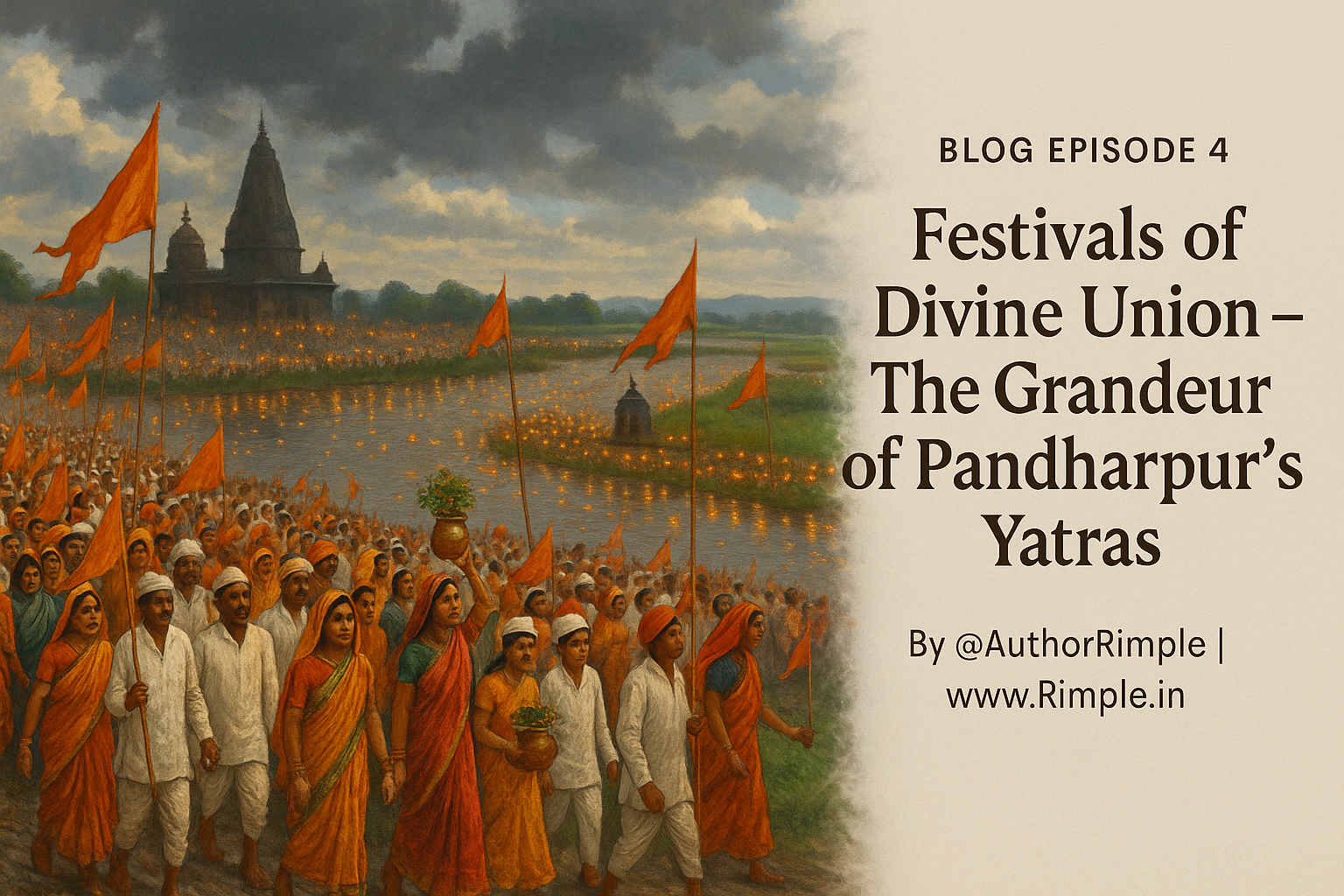
The Pandharpur Wari, a river of bhakti flowing from the sacred touch of Bhagwan Vitthal’s lotus feet, pulses with love through its rituals—kirtans under banyan trees, dips in the Chandrabhaga, and the tender moment of touching Vitthal’s feet. These daily acts of love bloom into something even grander during Pandharpur’s festivals, when lakhs of bhakts gather, their hearts singing “Vitthal Vitthal.” Imagine the scene: the Chandrabhaga River sparkles under monsoon clouds, its banks alive with the glow of countless diyas. Saffron flags dance in the breeze, their colors bright against the green fields. The air carries the sweet scent of jalebis and the rhythmic beat of mridangas, as bhakts—farmers, weavers, women, and children—walk together, their voices one in bhakti. These festivals, especially Ashadhi Ekadashi and Kartiki Ekadashi, are the Wari’s heartbeat, a divine union where Pandharpur becomes a sea of love for Bhagwan Vitthal and Devi Rukmini. Let us step into this joyous celebration, where every chant and every step is an offering of bhakti.
The grandest of all is the Ashadhi Ekadashi Wari, the world’s largest walking pilgrimage, held in the monsoon month of Ashadh (June-July). Over 7 to 10 lakh bhakts walk 250 kilometers to Pandharpur, their hearts light with love for Vitthal. The journey begins in Alandi and Dehu, where palkhis—wooden palanquins carrying the padukas of Sant Dnyaneshwar and Sant Tukaram—set out, adorned with garlands of marigolds and jasmine. Picture the scene: monsoon rains patter softly on bhakts’ faces, cooling their bare feet as they tread the muddy paths. Women in bright saris balance tulsi pots, their ankle bells jingling like temple chimes. Children run ahead, waving saffron flags, their laughter blending with the chant of “Dnyanoba Mauli Tukaram.” The air smells of wet earth and roasting corn, shared among bhakts like prasad under starlit skies. For 21 days, they walk through villages, sleeping in fields, their dreams filled with Vitthal’s smile.
When the palkhis reach Pandharpur on Ashadhi Ekadashi, the town bursts into a festival of bhakti. The Vitthal-Rukmini Mandir glows with thousands of diyas, their golden light reflecting in the Chandrabhaga’s waters. Bhakts crowd the ghats, taking a holy snan, the river’s cool touch washing away their worries. The temple’s sanctum hums with the Mahanaivedhya, a grand offering of rice, dal, and sweet puran poli, its aroma filling the air. Priests chant mantras, piling fresh roses and champa flowers at Vitthal’s feet, his dark idol shining with sandalwood paste. Devi Rukmini, draped in a green sari, seems to smile, her presence a warm embrace. Bhakts sing abhangas, their voices soaring with the beat of cymbals, their hearts dancing as they wait for Padsparshadarshan, to touch Vitthal’s lotus feet. The moment is pure magic—a farmer’s rough hand, a child’s tiny fingers, an old woman’s trembling palm—all feel Vitthal’s love, their tears sparkling like the river.
The Kartiki Ekadashi Wari, held in November, is another jewel in Pandharpur’s crown. Three to four lakh bhakts join this autumn pilgrimage, the air crisp and cool, the Chandrabhaga shimmering under a clear sky. The fields around Pandharpur glow golden with ripe crops, and bhakts walk with lighter steps, their saffron turbans bright as the setting sun. The palkhis move slowly, their silver bells tinkling, as bhakts sing bhajans under neem trees, the scent of agarbatti mingling with the sweetness of sugarcane juice shared among dindis. On Kartiki Ekadashi, the temple hosts the Palkhi Sohla, a vibrant ceremony where bhakts decorate the palanquins with rangoli—swirls of red, yellow, and white powder blooming like flowers. The river ghats buzz with bhakts offering diyas, their flames floating like stars, carrying prayers to Vitthal and Rukmini.
Two smaller yatras, Chaitri Ekadashi (March-April) and Maghi Ekadashi (January-February), draw one to two lakh bhakts, each with its own charm. In Chaitri, spring paints Pandharpur with palash flowers, their fiery red petals falling like blessings. In Maghi, the winter air is sharp, warmed by bhakts’ kirtans and the steam of hot kheer shared in dindis. Every Wednesday, Vitthal’s sacred day, holds special meaning—bhakts avoid leaving Pandharpur, staying to sing his name, their voices soft as the river’s flow. These festivals weave bhakti into every moment, from the first step of the Wari to the final aarti in the temple, where the sanctum glows with love.
A Marathi abhanga by Sant Tukaram sings of this festive joy:
Marathi Abhanga (Devanagari):
पंढरीचा सोहळा, विठ्ठलाचे दर्शन।
हृदयात रंग भरे, भक्तीचा उन्मेषण॥
Poetic Translation:
Pandharpur’s grand fest, Vitthal’s vision bright,
Fills the heart with color, bhakti’s boundless light.
Meaning: This abhanga celebrates the joyous festival (sohla) of Pandharpur, where the darshan of Bhagwan Vitthal fills bhakts’ hearts with vibrant love. It describes the awakening of bhakti, like a flower blooming in the soul, during the Wari’s festivals.
The festivals are a tapestry of sights, sounds, and scents. Imagine a bhakt, her sari damp from the river, standing in the temple’s courtyard. The air carries the jingle of her ankle bells and the sweet smell of prasad—laddoos and coconut barfi—shared among strangers who feel like family. A child waves a peacock feather fan, its colors dancing in the sunlight. An old man sways to a kirtan, his voice hoarse but full of bhakti, as mridangas thump like a heartbeat. Bhakts from villages and cities, rich and poor, walk as one, calling each other “Mauli,” their love for Vitthal erasing all differences. The Chandrabhaga reflects their diyas, each flame a prayer, each chant a step closer to moksha, the soul’s freedom promised by the Padma Purana.
These festivals are more than gatherings—they are a divine dance, where bhakts become one with Vitthal and Rukmini. Picture a woman standing before Vitthal’s idol, her hands folded, her heart whispering his name. The temple’s sanctum glows with oil lamps, their light soft on Vitthal’s smiling face. Devi Rukmini’s maternal gaze falls on her, and the bhakt feels a warmth, as if held by a mother. The Wari’s festivals are a call to every heart, inviting all to join this river of bhakti, to sing, to walk, to love.
The joy of these festivals flows from a deeper spring—the Varkari sampradaya, a path of bhakti that shapes the Wari’s soul. In the next chapter, we will explore this sacred philosophy, the teachings that guide bhakts to see Vitthal in every heart and every step.
Also Read: