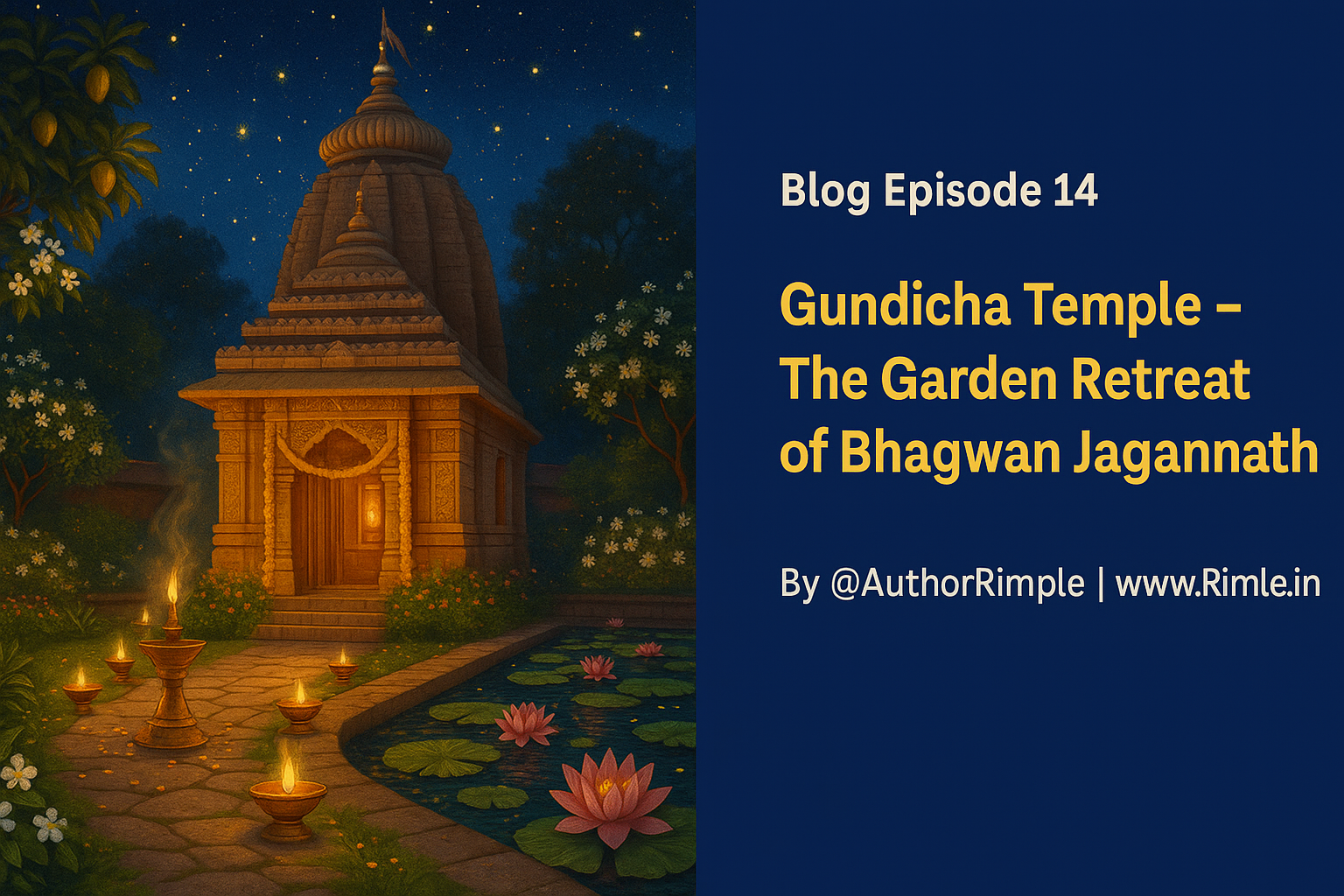
From the vibrant rituals of Ratha Yatra, where Bhagwan Jagannath, Balabhadraji, and Subhadraji roll through Puri’s Bada Danda in a divine dance of bhakti, we arrive at the serene embrace of the Gundicha Temple, the sacred “Garden House” where the deities reside for seven days. Nestled 3 kilometers from Shri Mandir, this sandstone Deula stands like a tranquil oasis, its walls glowing under torchlight, surrounded by lush gardens where mogra flowers’ sweet fragrance mingles with sandalwood incense. The soft murmur of bhakts’ prayers blends with the rustle of leaves, as the temple’s chlorite Ratnavedi platform shines, cradling Jagannathji’s divine presence. This retreat, vibrant with the colors of Hinduism—crimson silks, emerald foliage, golden lamps—offers bhakts a rare intimacy with Shri Krishna’s love, a divine homecoming that deepens bhakti in Kali Yuga.
The Serene Beauty of Gundicha Temple
The Gundicha Temple, named after Queen Gundicha, the wife of King Indradyumna, radiates a quiet sanctity, its Kalinga-style architecture a testament to Puri’s spiritual heritage. The temple’s sandstone Deula, crowned with a modest spire, rises amidst sprawling gardens, where mango trees and lotus ponds shimmer under Odisha’s starry sky. The air hums with the scent of mogra and jasmine, their white petals scattered like blessings, while sandalwood incense swirls from brass censers, wrapping bhakts in a divine embrace. The temple’s walls, carved with delicate floral motifs, glow in the flicker of oil lamps, and the chlorite Ratnavedi platform, polished to a mirror-like sheen, awaits the deities’ arrival, its cool surface radiating Shri Krishna’s warmth.
During Ratha Yatra, on June 27, 2025, Jagannathji, Balabhadraji, and Subhadraji are carried in the Pahandi procession to the Gundicha Temple after their journey on colossal chariots. The deities, adorned in crimson, white, and golden silks, are placed on the Ratnavedi, their lotus-like eyes sparkling as bhakts chant “Jai Jagannath!” The air echoes with conch shells’ deep hum and the rhythmic beat of mridangams, while emerald garlands and yellow marigolds drape the sanctum, creating a vibrant tapestry of devotion. Unlike Shri Mandir, where Daitapatis lead the worship, here Brahmin priests, their white dhotis glowing, perform rituals with Vedic precision, offering rice, dal, and kheer, their earthy aromas filling the temple with divine warmth.
Why Jagannathji Journeys to Gundicha Temple
The journey to Gundicha Temple is a divine homecoming, rooted in Pauranic lore that portrays it as the abode of Jagannathji’s aunt, a symbol of familial love and Shri Krishna’s Vrindavan leela. The Skanda Purana recounts that Jagannathji, embodying Shri Krishna, travels to Gundicha to relive His playful visits to Vrindavan, where He met Shri Radha and the gopis, their love filling the air with flute melodies. The temple represents a garden retreat, a place of intimate bhakti where Jagannathji, as the Lord of the Universe, draws closer to His bhakts, His large eyes blessing all, regardless of caste or creed. This seven-day stay, from June 27 to July 4, 2025, is believed to be a time when Jagannathji’s divine energy rejuvenates, the temple’s gardens mirroring Vrindavan’s lush serenity.
A Pauranic tale tells of Queen Gundicha, a devoted bhakt of Bhagwan Vishnu, who prayed for Jagannathji to visit her home. Moved by her bhakti, Jagannathji promised to reside in her temple annually during Ratha Yatra, the air alive with the scent of her offered lotuses. Another story narrates how Shri Krishna, in His Jagannath form, chose Gundicha as a retreat to teach humility, allowing even the humblest bhakts to approach Him in this serene abode, the temple’s quiet sanctity amplifying His mercy in Kali Yuga.
History of Gundicha Temple
The Gundicha Temple’s history is intertwined with Puri’s spiritual legacy, dating back to the time of King Indradyumna in Satya Yuga, who, according to the Purushottama Mahatmya, built it as a sacred retreat for Jagannathji. Historical records, as noted in jagannath.nic.in, suggest the current structure was constructed during the Ganga dynasty in the 12th century, alongside Shri Mandir, under King Anantavarman Chodaganga Deva. The temple’s sandstone architecture, with its simpler Deula compared to Shri Mandir’s towering spire, reflects its role as a tranquil abode, designed for intimate worship. Inscriptions on the temple’s walls, referenced in jagannathdham.com, mention renovations by subsequent rulers, ensuring its sanctity endures. The Gundicha Marjana ritual, performed on June 26, 2025, cleanses the temple with rosewater and Vedic chants, preparing it for the deities’ arrival, a tradition unbroken for centuries.
The temple’s name honors Queen Gundicha, whose bhakti is celebrated in Odia lore as the inspiration for Jagannathji’s annual visit. Unlike Shri Mandir, where Daitapatis, descendants of the Savara tribe, lead rituals, Gundicha’s worship by Brahmin priests highlights its distinct role, offering a contrast that underscores Jagannathji’s universal appeal. The temple remains largely empty outside Ratha Yatra, its gardens a silent testament to its sacred purpose, awakening only when Jagannathji’s chariot arrives, the air tingling with bhakti’s fervor.
The Spiritual Heart of Gundicha Temple
Gundicha Temple is a divine retreat where bhakts feel an intimate connection with Jagannathji, Balabhadraji, and Subhadraji. The temple’s serene gardens, the soft glow of torchlight on the Ratnavedi, and the Brahmin priests’ gentle chants create a sacred space where Shri Krishna’s love feels within reach. The vibrant colors—crimson silks, emerald leaves, golden lamps—reflect Hinduism’s unity, as Vaishnavas, tribal bhakts, and all devotees gather, their voices rising in kirtans. In Kali Yuga, Gundicha Temple teaches that Jagannathji’s mercy is accessible, His seven-day stay a divine invitation to draw closer, the air alive with mogra’s scent and the warmth of His gaze.
To capture this sacred retreat, let us turn to an Odia verse from traditional Jagannath bhakti poetry, sung in Gundicha’s tranquil gardens:
Odia Verse (Devanagari):
गुण्डिचा मन्दिर प्रेम दीपति, जगन्नाथ भक्ति हृदये जागे।
विश्वं सर्वं शान्त्या भासति, श्रीमन्दिरे दीपं प्रकाशति॥
Poetic English Translation:
Gundicha’s temple love does softly glow, Jagannath’s bhakti wakes the heart,
The world in peace and light does shine, in Shri Mandir’s sacred art.
Meaning of the Verse:
This verse celebrates Gundicha Temple as a radiant haven of love, awakening bhakti in every heart. It bathes the world in peace and light, making Shri Mandir’s legacy a beacon in Kali Yuga, guiding bhakts to Shri Krishna’s eternal embrace.
As Jagannathji, Balabhadraji, and Subhadraji rest in Gundicha’s serene embrace, under Puri’s starry sky, bhakts sing bhajans, the air alive with sandalwood and conch shells’ chime. But how does this divine cycle continue beyond Ratha Yatra? The answer lies in the vibrant festivals that sustain Jagannathji’s bhakti throughout the year, waiting to unfold in their sacred splendor.
Also Read:
Pandharpur Series https://rimple.in/category/blog-episode-series/pandharpur-series
Kamakhya Series https://rimple.in/category/blog-episode-series/kamakhya-series
Jagannath Series https://rimple.in/category/blog-episode-series/jagannath-puri-series
Russia-Ukraine War Series https://rimple.in/category/blog-episode-series/russia-ukraine-war/
Alternative in the menu, go to Blog Series.