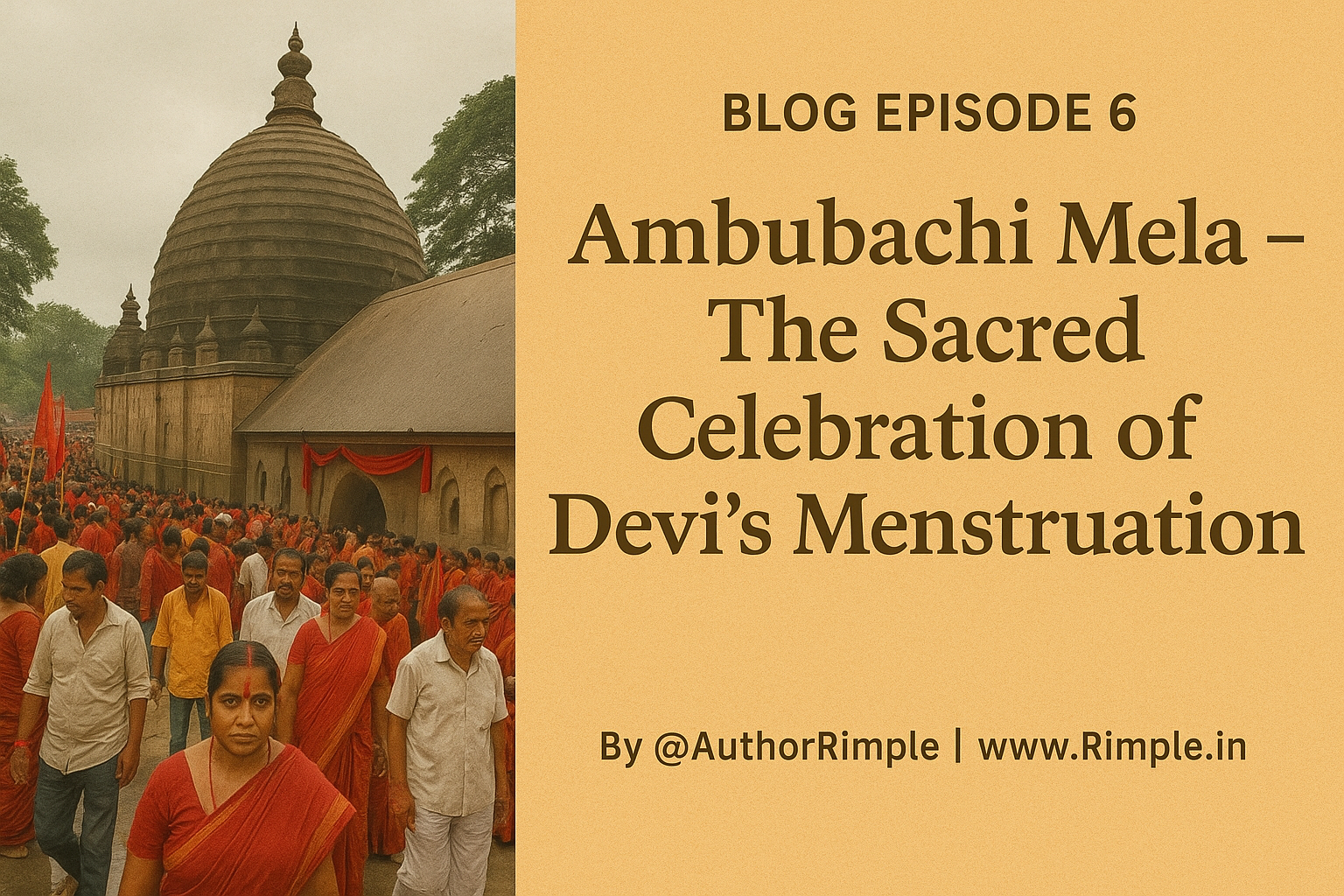
As monsoon clouds gather over Nilachal Hill, the Kamakhya Temple transforms into a vibrant tapestry of colors, sounds, and sacred energy. The air hums with the scent of wet earth and burning incense, while the Brahmaputra River below shimmers like a silver thread under the rain’s gentle touch. This is the time of Ambubachi Mela, a festival that celebrates Devi Kamakhya’s menstruation, her yoni (womb) radiating the divine cycle of creation. Step onto the hill, feel the damp stone underfoot, hear the distant chants rising like waves, and let’s immerse in this extraordinary celebration, where womanhood is revered as the heartbeat of life, and every woman feels the shakti of Devi within her.
The Divine Menstruation: A Sacred Pause
Each June, when the rains kiss Assam’s green hills, Ambubachi Mela begins, marking the sacred moment when Devi Kamakhya is believed to menstruate. For three days, the temple’s doors close, its garbhagriha—where the yoni-shaped stone resides—draped in crimson cloth, symbolizing Devi’s rest. Imagine the hill cloaked in reverence, the air heavy with the scent of sandalwood and rain-soaked flowers. No rituals are performed, no bhakts enter; the silence is profound, broken only by the soft patter of rain and the rustle of leaves. This pause honors the yoni (womb) as the source of creation, mirroring a woman’s menstrual cycle—a natural, divine rhythm. Women bhakts, standing outside, feel a deep connection, their own bodies celebrated as sacred, their cycles echoing Devi’s shakti.

The Reopening: A Burst of Bhakti
On the fourth day, as dawn paints the sky in hues of gold and pink, the temple doors swing open, and Ambubachi Mela bursts into life. Bhakts from across India flood Nilachal Hill, their voices weaving a chorus of mantras and songs. Picture the scene: vibrant sarees in reds and yellows, like flowers blooming against the green hill. Hear the rhythmic beat of dhols, the jingle of bells, and the ecstatic chants of Baul singers, their melodies soaring under the monsoon sky. Priests, clad in white, emerge from the garbhagriha, carrying angodak (sacred spring water) and angabastra (red cloth) as prasad, blessed by Devi’s menstrual shakti. Smell the jasmine and marigolds offered in heaps, their fragrance mingling with the earthy scent of rain. Bhakts receive the red cloth, holding it close, feeling Devi’s blessings flow through them.
The Red River: A Divine Mystery
During Ambubachi, a miracle unfolds along the Brahmaputra. The river’s waters, some say, turn red, a phenomenon attributed to natural minerals or Devi Kamakhya’s divine menstruation. Stand by the riverbank, see its surface ripple with crimson hues, reflecting the cloudy sky. Feel the cool mist on your face, hear the river’s gentle song blending with the chants from the hill. For bhakts, this is no mere coincidence but a sign of Devi’s shakti, her life-giving power flowing through the land. Women bhakts, gazing at the river, feel their own cycles honored, their bodies seen as sacred vessels of creation. The red cloth and water they carry home are not just prasad but talismans of Devi’s feminine energy, breaking taboos and affirming menstruation as divine.

Tantric Sadhana: Awakening the Feminine
Ambubachi Mela is a magnet for Tantric practitioners, drawn to Kamakhya’s Kulachara Tantra, where the yoni is revered as the cosmic womb. Sages and sadhus gather on Nilachal Hill, their bodies smeared with ash, meditating in makeshift shelters under the rain. Imagine a sadhu seated cross-legged, his eyes closed, chanting mantras like “Om Hreem Kamakhya Namah,” each syllable vibrating through the misty air. Smell the burning dhoop, its smoke curling upward, mingling with the scent of wet grass. Bhakts, including women, join these sadhanas, visualizing Devi’s yoni as the source of all life. A woman meditating feels her own shakti awaken, her breath syncing with the hill’s pulse. These practices celebrate the feminine as the root of existence, empowering women to see their bodies as divine.
Community and Bhakti: A Collective Embrace
Ambubachi is more than a festival; it’s a gathering of souls united in bhakti. Families, sadhus, and bhakts camp on the hill, sharing stories and songs under colorful tents. Picture a grandmother weaving tales of Devi Sati for her granddaughter, their laughter mingling with the crackle of bonfires. Taste the sweet prasad—laddoos and kheer—distributed among the crowd, its warmth a comfort in the cool rain. Women bhakts, young and old, feel a sisterhood, their hearts linked by Devi’s shakti. A young girl, holding her mother’s hand, watches the aarti, her eyes wide, sensing her own divinity. This communal spirit reflects Hinduism’s embrace of womanhood, where every woman is a spark of Devi, her life a sacred offering.
A Sanskrit Shloka: Devi’s Menstrual Shakti
Let’s pause to chant a verse from the Kalika Purana, which sings of Devi Kamakhya’s divine cycle:
कामाख्या योनिरूपेण विश्वं संनादति सदा ।
मासिकं शक्तिसंयुक्तं सर्वं मंगलदायिनी ॥
Poetic Translation:
Kamakhya’s yoni, world’s eternal song,
Resounds with life, forever vast and strong,
Her sacred cycle, shakti’s radiant flow,
Brings blessings pure, where all auspicious grow.
Meaning: This shloka praises Devi Kamakhya’s yoni form as the eternal source of creation, her menstruation a sacred cycle filled with shakti. It bestows auspiciousness on the world, affirming the divine feminine’s power to nurture and renew. The verse captures Ambubachi’s essence, where Devi’s cycle mirrors every woman’s sacred rhythm.
Womanhood’s Sacred Cycle
Ambubachi Mela is a revolutionary celebration, shattering taboos around menstruation. Unlike traditions that hide this natural cycle, Kamakhya honors it as divine, a reflection of Devi’s creative power. Imagine a woman bhakt standing in the temple courtyard, clutching the angabastra, her heart full as she feels her own body celebrated. The festival affirms that menstruation is not impurity but shakti, a sacred rhythm that mirrors the universe’s cycles. Kumaripuja’s echo lingers here, as girls and women are seen as living goddesses, their wombs a spark of Devi’s yoni. Hinduism, through Ambubachi, weaves bhakti with empowerment, inviting every woman to embrace her divinity.
As the festival fades, Nilachal Hill glows with the light of countless lamps, the Brahmaputra hums its crimson song, and the air dances with bhakti. Devi Kamakhya’s shakti lingers in every heart, every red cloth carried home. In our next article, we’ll delve into the temple’s unique worship of the yoni, the heart of its celebration of womanhood, inviting all to feel the divine feminine within.
Also Read: