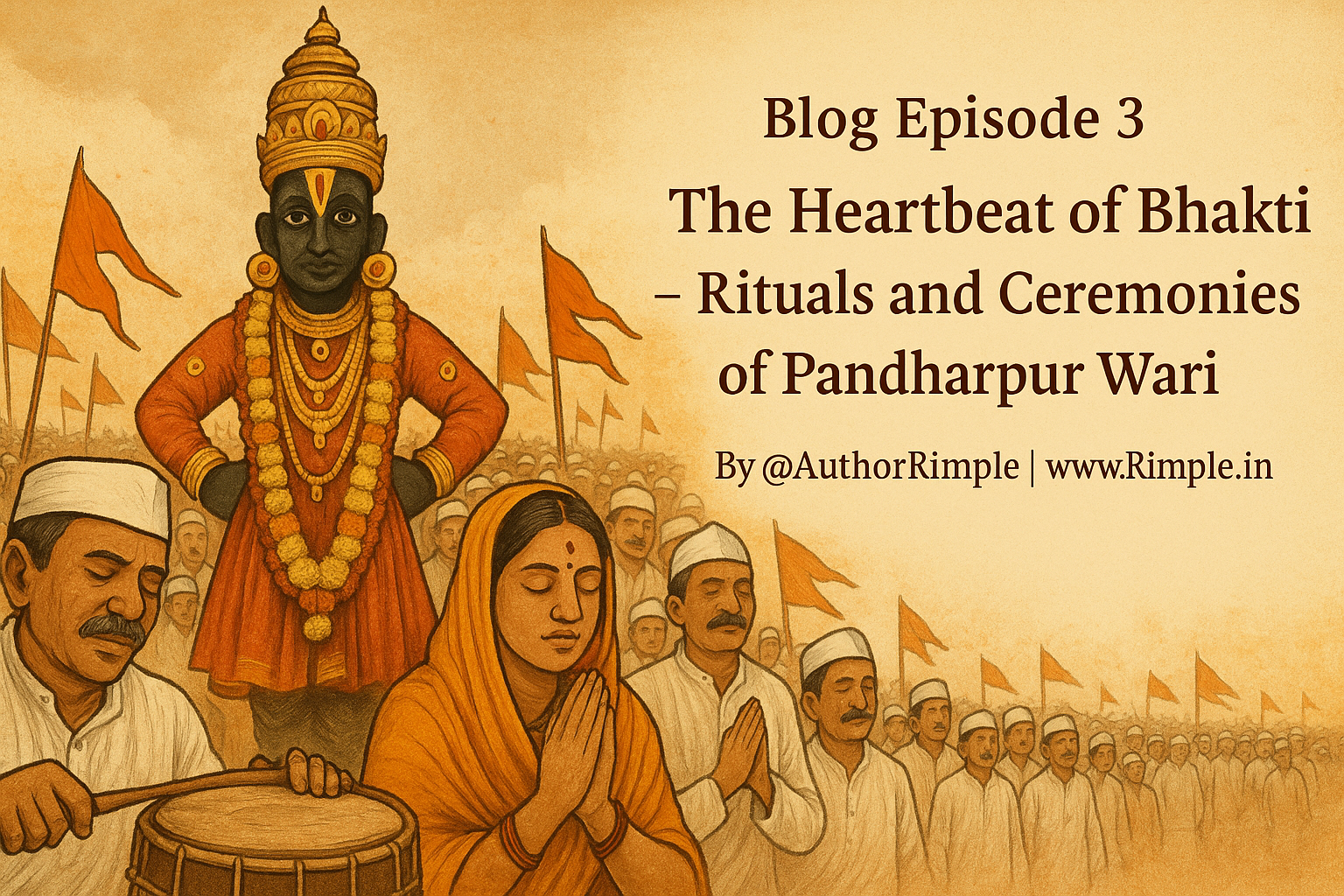
From the sacred dawn when Bhagwan Vitthal stood on a brick for Bhakt Pundalik, Pandharpur grew into a river of bhakti, swelling with love through centuries. The Pandharpur Wari, born from this divine call, became a grand journey where lakhs of bhakts walk to meet their beloved Vitthal and Devi Rukmini. Picture the scene: monsoon clouds above, the Chandrabhaga River sparkling below, and bhakts singing “Vitthal Vitthal” as they carry tulsi pots and saffron flags. The air hums with the jingle of ankle bells, and the scent of fresh prasad—sweet pedhas and warm kheer—floats through the crowd. This Wari is not just a walk; it is a heartbeat of bhakti, pulsing through sacred rituals and ceremonies that bind bhakts to Bhagwan Vitthal’s lotus feet. Let us step into these holy practices, where every chant, every step, and every offering becomes a song of love for Vitthal and Rukmini.
The Vitthal-Rukmini Mandir, Pandharpur’s glowing heart, comes alive each day with rituals that fill the air with bhakti. At dawn, the Kakda Aarti begins as priests light oil lamps, their tiny flames dancing like stars in the dim sanctum. The scent of camphor swirls, and the soft clang of cymbals joins a soulful bhajan, waking Bhagwan Vitthal with love. Bhakts stand with folded hands, their eyes fixed on Vitthal’s dark idol, his fish-shaped earrings glinting, his smile warm as a mother’s. Devi Rukmini, draped in a silken sari, glows nearby, her presence a gentle hug to every heart. The Mahapuja follows, with priests offering fresh flowers—red hibiscus and creamy jasmine—piling them at Vitthal’s feet until the sanctum smells like a garden. Bhakts sing abhangas, their voices rising like waves, their hearts melting in bhakti.
The most special ritual is the Padsparshadarshan, where bhakts touch Bhagwan Vitthal’s lotus feet. Imagine the moment: a bhakt, perhaps a farmer in a simple dhoti or a woman with a tulsi garland, steps forward. The cool stone floor of the temple feels sacred underfoot. As their fingers brush Vitthal’s feet, a wave of bhakti floods their heart, and tears spill from their eyes. The temple echoes with chants of “Hari Vitthal,” and the air feels alive, as if Vitthal himself whispers, “I am here, my child.” This touch, this connection, is Pandharpur’s gift—a moment where every bhakt feels Vitthal’s love, close and real.
A Marathi bhajan sung during these rituals captures this bhakti:
Marathi Bhajan (Devanagari):
विठ्ठलाच्या पायी, हृदय माझे रंगले।
चंद्रभागेच्या काठी, भक्तीने मी न्हाले॥
Poetic Translation:
At Vitthal’s feet, my heart is painted bright,
By Chandrabhaga’s banks, I bathe in bhakti’s light.
Meaning: This bhajan expresses the joy of a bhakt whose heart is filled with love at Bhagwan Vitthal’s feet. It celebrates the sacred act of bathing in the Chandrabhaga River, where bhakti purifies the soul, connecting the bhakt to Vitthal’s divine presence.
The Wari itself is a living ritual, a moving prayer that begins far from Pandharpur. In Alandi, bhakts gather around the palkhi of Sant Dnyaneshwar, a wooden palanquin adorned with marigold garlands and silver bells. In Dehu, they join Sant Tukaram’s palkhi, its saffron flag fluttering like a flame. These palkhis carry the padukas, sacred sandals of the saints, as bhakts walk 250 kilometers through dusty paths and green fields. The monsoon rains kiss their faces, the earth soft and cool under their bare feet. Bhakts form dindis, groups that sing abhangas, their voices blending with the beat of mridangas and the chime of kartalas. “Dnyanoba Mauli Tukaram,” they chant, the words a melody that lifts their hearts to Vitthal. Women balance tulsi pots, their saris bright as peacocks, while children run alongside, waving tiny flags, their laughter a sweet offering.
Each night, the Wari rests in villages, where bhakts share simple meals—steaming bhakri, spicy thecha, and sweet shrikhand. The air smells of woodsmoke and roasted corn, and under banyan trees, kirtans fill the night with bhakti. Bhakts call each other “Mauli,” meaning mother, their voices warm with love. Farmers, weavers, and teachers walk together, their differences forgotten, their hearts united by Vitthal’s name. The Chandrabhaga welcomes them as they near Pandharpur, its waters shimmering like a mirror of bhakti. Bhakts take a holy snan, dipping into the cool river, feeling their worries wash away. They offer tarpan, their hands cupped with water, the droplets sparkling like prayers under the sun. Some perform abhishek, pouring river water over Vitthal’s idol, its dark stone gleaming as bhakts chant his name.
One sacred ritual is the Namdev Payari, a humble step at the temple’s entrance. Before entering, bhakts touch this step, honoring Sant Namdev, whose childlike bhakti moved Vitthal to eat his prasad. Imagine a bhakt, perhaps an old woman with a trembling hand, bending to touch the step. Her fingers feel the cool stone, worn smooth by countless bhakts, and her heart whispers, “Namdev, you showed us Vitthal’s love.” The moment is quiet but powerful, like a soft breeze carrying bhakti to the soul. This ritual teaches humility, reminding bhakts that Vitthal loves all equally—whether a saint or a simple villager.
These rituals weave a tapestry of bhakti, where every act is an offering to Bhagwan Vitthal and Devi Rukmini. Picture a bhakt standing by the Chandrabhaga at dusk, a diya in her hands, its flame dancing in the river’s reflection. The air carries the scent of agarbatti and the sound of a distant bhajan. Her heart swells, feeling Vitthal’s presence in the water, the wind, the stars. The Wari’s rituals are a dance of love, where bhakts of all kinds—young and old, rich and poor—come together, their voices one, their hearts beating for Vitthal.
These sacred practices shine brightest during Pandharpur’s grand festivals, when the Wari becomes a sea of bhakti. In the next chapter, we will dive into these festivals, like Ashadhi Ekadashi, where lakhs of bhakts gather, their songs and steps lighting up Pandharpur with the joy of Vitthal’s love.
Also Read Blog Series
Some topics cannot be covered in 1 article. Read them in Blog Episodes. Below are some amazing Blog Series to read. Click on the link to read…
Pandharpur Series https://rimple.in/category/blog-episode-series/pandharpur-series
Kamakhya Series https://rimple.in/category/blog-episode-series/kamakhya-series
Jagannath Series https://rimple.in/category/blog-episode-series/jagannath-puri-series
Russia-Ukraine War Series https://rimple.in/category/blog-episode-series/russia-ukraine-war/
Alternative in the menu, go to Blog Series.
Also Read Articles: