Walk with me through the mists of time, where Nilachal Hill stands tall, its stones whispering tales of kings and bhakti. The Kamakhya Temple, a radiant jewel of Assam, glows with the energy of Devi Kamakhya, the mother whose yoni (womb) cradles creation. Picture the hill bathed in dawn’s golden light, the Brahmaputra River shimmering below, its waters carrying centuries of stories. The air smells of fresh earth and incense, and the distant hum of chants fills your heart with bhakti. Let’s unravel the historical tapestry of Kamakhya, woven with resilience and reverence for the divine feminine.
The Dawn of Kamarupa: Naraka’s Legacy
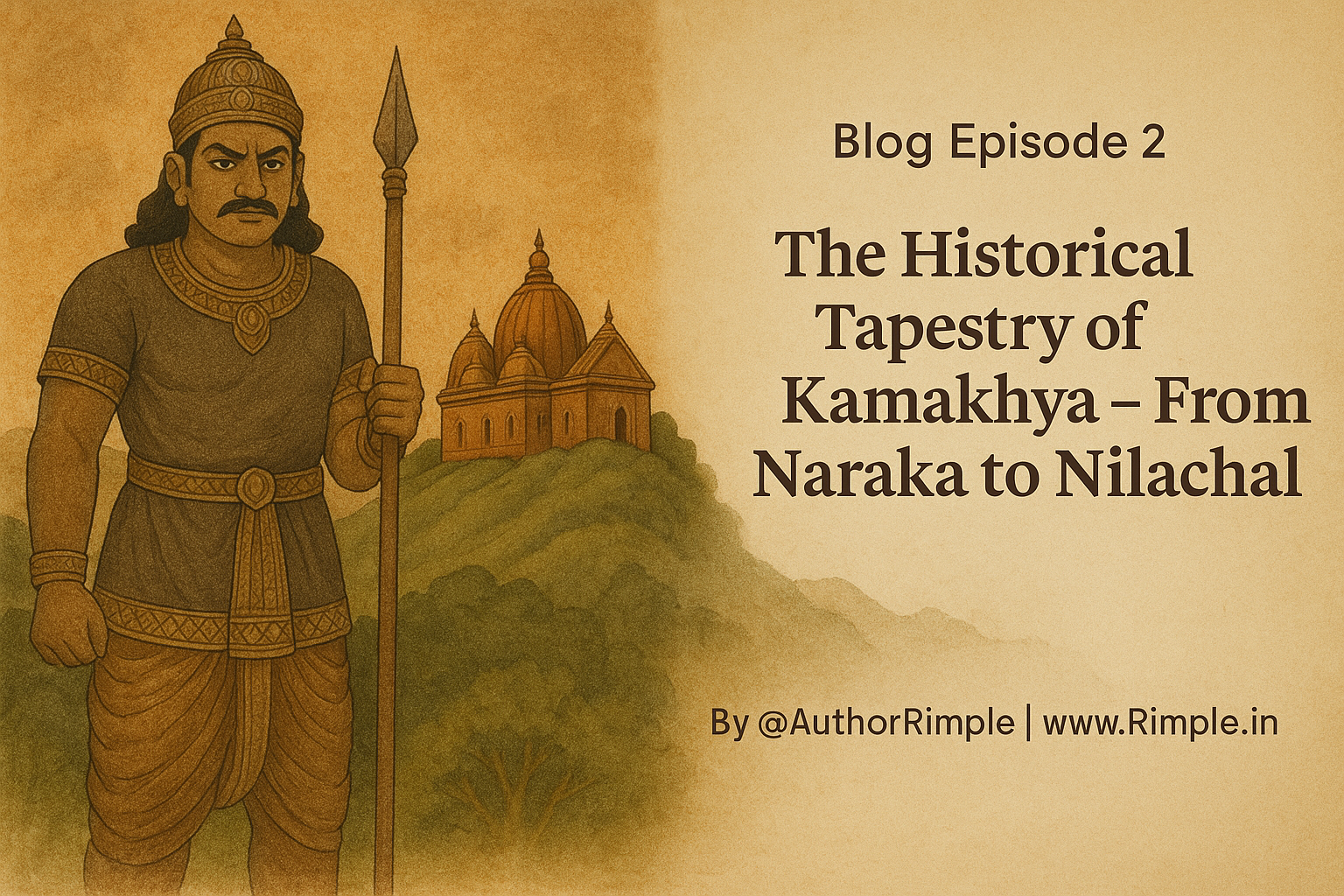
Long before temples rose, Nilachal Hill pulsed with Devi’s shakti. In the ancient mists, around 2200 BCE, King Naraka, blessed by Bhagwan Krishna, ruled the land of Kamarupa. The Mahabharata tells of Naraka guarding Devi Kamakhya’s sacred yoni, his bhakti as steadfast as the hill itself. Imagine him standing at dawn, his hands folded, offering flowers to the Devi, the scent of jasmine blending with the cool river breeze. The Pandavas, too, are said to have bathed in the Brahmaputra’s sacred waters, their hearts turned to Kamakhya for strength before their epic war. Feel the weight of their footsteps on the hill, the air alive with their silent prayers. Naraka’s reign marked Kamakhya as a beacon of shakti, a place where the feminine was revered as the source of life.
The First Temples: Stones of Bhakti
By the 8th century, Nilachal Hill bore a grand stone temple, its ruins still whispering of forgotten artisans. The Mlechchha dynasty, early rulers of Assam, carved their bhakti into the rocks, their inscriptions naming Kamakhya as the heart of Kamarupa. Picture the clink of chisels against stone, the sweat of craftsmen under a blazing sun, their hands shaping sanctuaries for Devi’s yoni (womb). The temple’s early form, simple yet sacred, drew bhakts from afar, their footsteps echoing on paths lined with wildflowers. Smell the damp earth after monsoon rains, hear the soft chants rising from the hill. These early structures were a testament to the divine feminine, honoring every woman’s creative power in the yoni’s sacred form.
A Dark Hour: Destruction by Kala Pahar
In the 16th century, a shadow fell over Nilachal. The invader Kala Pahar, driven by conquest, razed the Kamakhya Temple, its stones crumbling like a wounded heart. Imagine the silence after the destruction, the air heavy with dust and sorrow, the Brahmaputra flowing quietly as if mourning. Yet, Devi Kamakhya’s shakti could not be silenced. Her yoni, hidden in the garbhagriha’s cave, pulsed with life, a reminder of womanhood’s resilience. Bhakts gathered in secret, their whispers of bhakti like sparks in the dark, keeping her spirit alive. This moment mirrors a woman’s strength—shattered yet unbroken, ready to rise again.
Rebirth Under the Koch Kings
In 1565, King Chilarai of the Koch dynasty, with his brother Naranarayana, breathed new life into Kamakhya. They rebuilt the temple, blending Assam’s unique Nilachal style with their boundless bhakti. Picture artisans carving the beehive-shaped dome, its curves echoing the yoni’s sacred form. The scent of fresh mortar mingled with sandalwood smoke, and the rhythmic chants of priests filled the air as the temple rose anew. The garbhagriha, with its yoni-shaped stone kissed by an eternal spring, became the heart of worship once more. Women bhakts, standing before it, felt their own shakti awaken, their bodies celebrated as vessels of creation. Chilarai’s work was a love letter to Devi, a testament to the feminine’s enduring power.
The Ahom Era: Guardians of Shakti
As centuries turned, the Ahom kings of Assam embraced Kamakhya, enriching her rituals with Tantric traditions. They built additional shrines on Nilachal Hill, honoring the Dasa Mahavidyas—ten forms of Devi’s shakti. Imagine the hill alive with festivals, the air thick with the fragrance of marigolds and the sound of drums. Bhakts, men and women alike, climbed the stone steps, their hearts swelling with bhakti. The Ahoms saw Devi Kamakhya as the mother of Kamarupa, her yoni the source of the land’s fertility. Women felt especially drawn, their own creative power mirrored in the temple’s sacred stone, a reminder that Hinduism celebrates womanhood as divine.
A Sanskrit Shloka: Kamakhya’s Eternal Glory
Let’s pause to chant a verse from the Yogini Tantra, which sings of Devi Kamakhya’s timeless presence:
नीलाचले कामाख्या योनिपीठं महत् स्मृतम् ।
सर्वं शक्तिमयं विश्वं तस्याः कृपया स्थिरम् ॥
Poetic Translation:
On Nilachal, Kamakhya’s throne does shine,
Her yoni peeth, sacred, pure, divine,
The world, with shakti filled, stands firm and free,
By her compassion, all exists to be.
Meaning: This shloka glorifies Devi Kamakhya’s yoni peeth on Nilachal Hill as the supreme seat of shakti, stabilizing the universe through her grace. It reflects the temple’s historical significance as a center of feminine power, its stones alive with Devi’s energy across centuries.
Womanhood’s Resilience in Kamakhya’s History
The history of Kamakhya is a mirror of a woman’s spirit—enduring, resilient, and divine. From Naraka’s ancient bhakti to the temple’s rebirth under Chilarai, each chapter celebrates the yoni as the source of creation. Women visiting Kamakhya feel this truth in their bones, their own shakti echoing Devi’s eternal power. Imagine a mother standing at the temple’s gates, her heart full, knowing her body is sacred, her life a reflection of Devi’s creative force. Hinduism, through Kamakhya, honors every woman as a bearer of shakti, her womb a divine spark.
As we leave the echoes of history, the temple stands before us, its dome glowing against a crimson dawn. The scent of incense lingers, the Brahmaputra hums softly, and Devi Kamakhya’s shakti calls us forward. In our next article, we’ll step into the temple’s architectural marvels, where stone sings of the divine feminine, inviting us deeper into her embrace.
This is Blog Episode 2 of Kamakhya Temple Series. You can read all episodes this blog series in this website. In the Menu Go to Blog Series >>>> Kamakhya Series
If you like this article, then also read “Pandharpur Series” and “Jagannath Series”. Here are the links:
https://rimple.in/category/blog-episode-series/pandharpur-series
https://rimple.in/category/blog-episode-series/jagannath-puri-series
Also Read: