From the majestic Jagannath Temple in Puri, where the golden Neelachakra shines and Hanumanji guards the sacred shores, we step into the heart of its daily life, where rituals called Nitis weave a divine melody of bhakti. Like a river of love flowing through the temple’s stone halls, these rituals wrap Bhagwan Jagannath, Balabhadraji, and Subhadraji in vibrant colors—crimson silks, emerald garlands, and golden lamps—making their presence a living song of Shri Krishna’s mercy. The air hums with chants, the scent of sandalwood swirls, and the daily Nitis, enriched with the Gita Govinda and the sacred Mahaprasad, paint a tapestry of Hinduism that kindles bhakti in every heart, guiding bhakts through Kali Yuga’s darkness.
The Dawn of Bhakti: Daily Nitis
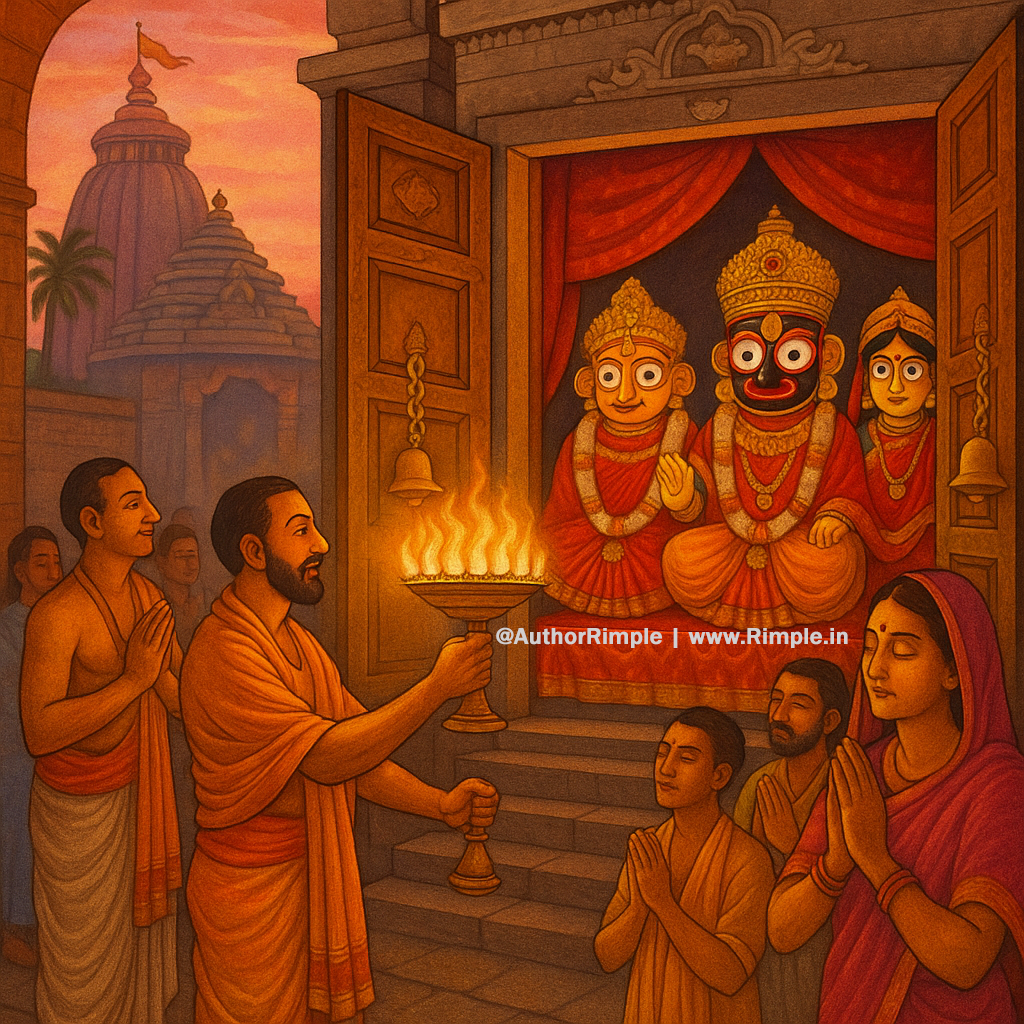
As dawn’s first rays paint Puri’s sky in soft pink and gold, the temple awakens with the Dwaraphita ritual at 4:30 AM. Priests, their faces glowing with bhakti, open the heavy wooden doors of the Singhadwara, the Lion Gate. The creak of the doors echoes like a divine call, and the air fills with the sweet fragrance of camphor and the clang of brass bells. Bhakts gather outside, their bare feet touching the cool stone floor, their hearts racing as they await Jagannathji’s darshan.
The Mangal Arati follows, a sacred offering of light. Priests wave flickering oil lamps before Jagannathji, Balabhadraji, and Subhadraji, their lotus-like eyes sparkling in the golden glow. The sanctum, draped in crimson and saffron silks, pulses with divine energy, as if Shri Krishna Himself smiles through Jagannathji’s radiant form. A Pauranic story tells of Shri Krishna blessing this ritual: once, in Dwarka, He accepted a lamp offered by a poor bhakt, its light shining brighter than a thousand suns, teaching that bhakti makes every offering divine.
In the Mailam ritual, priests gently remove the previous day’s garlands, the scent of wilted jasmine lingering in the air. The Abakasha ritual bathes the deities with sacred water, their wooden forms adorned with fresh silks in emerald and gold, as if dressing Shri Krishna for a Vrindavan dance. A unique ritual, the Gita Govinda Seva, fills the sanctum with love. Priests recite verses from Jayadeva’s Gita Govinda, its poetic songs of Shri Krishna and Shri Radha’s divine love echoing through the halls. The air vibrates with the melody of flutes and the rhythm of mridangams, as bhakts feel Shri Radha’s bhakti in Jagannathji’s gaze. A Pauranic tale says Jayadeva, inspired by Jagannathji, wrote Gita Govinda in Puri, and when he paused at a verse, Jagannathji Himself completed it, his divine hand leaving ink on the palm leaves, a miracle still cherished by bhakts.
The Surya Puja and Dwarapala Puja honor the sun and gatekeepers, with bhakts offering lotus flowers, their petals soft and pink, under the temple’s glowing arches. A Pauranic story of Puri tells of Surya Bhagwan’s bhakti: when the temple was built, Surya’s rays refused to scorch its stones, bowing to Jagannathji’s divine presence, a blessing that keeps the temple cool even in summer’s heat.
The Miracle of Mahaprasad
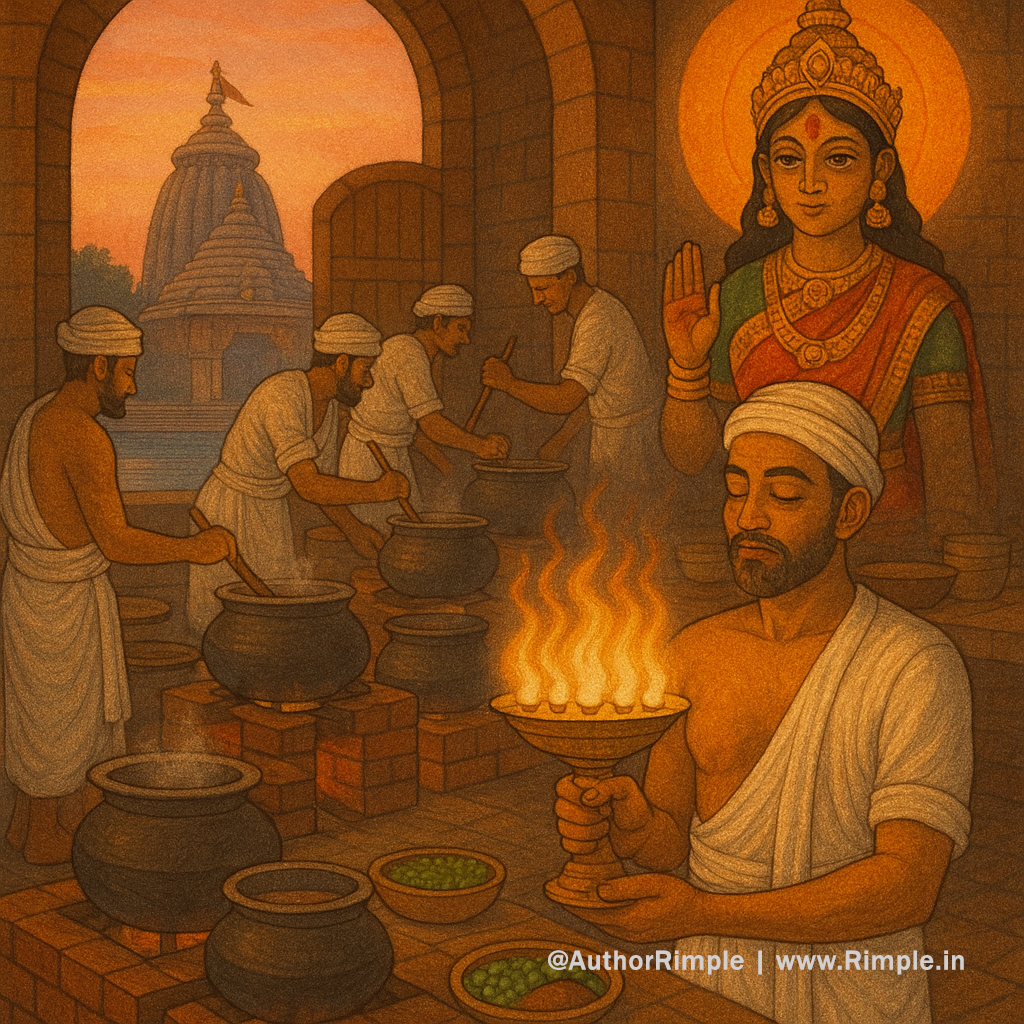
The heart of the Nitis is the Mahaprasad, the sacred food offered to Bhagwan Jagannath and Devi Bimala, a form of Devi Parvati. This divine offering, cooked in the world’s largest kitchen, is a miracle of bhakti, uniting all in Shri Krishna’s love.
- Pre-Preparation: The process begins at dawn, when Suaras, the temple cooks, purify themselves with a bath in the sacred Indradyumna Tank, their white dhotis gleaming in the early light. They gather pure ingredients—rice, dal, vegetables, and spices—blessed by Vedic chants. The Rosha Sala, the kitchen, is swept clean, its clay ovens glowing with the scent of burning wood. Bhakts believe Devi Lakshmi oversees the preparation, her divine touch ensuring purity. A Pauranic story tells of Devi Lakshmi’s bhakti: once, when prasad was cooked without love, Jagannathji refused it, and Lakshmi vowed to guide every grain, her presence felt in the kitchen’s warmth and the aroma of cardamom.
- Preparation: In the Rosha Sala, 500 Suaras work in harmony, their hands stirring massive clay pots stacked in seven layers over a wood fire. A divine miracle unfolds: the topmost pot cooks first, defying earthly logic, as if Jagannathji’s love kindles the flame from above. The air fills with the steam of simmering rice, the earthy scent of dal spiced with cumin, and the sweet fragrance of kheer laced with saffron. Fifty-six types of prasad—anna, bhoga, and sweets—are prepared, each a vibrant offering of love. A Pauranic tale tells of Naradji and Mahaprasad: once, Naradji, curious about its divine taste, disguised himself as a bhakt and tasted the prasad before it was offered. Jagannathji, smiling, blessed Naradji’s act, declaring that Mahaprasad’s sanctity remains even if tasted with bhakti, a miracle that fills bhakts with joy.
- Post-Preparation and Offering to Devi Bimala: The cooked Mahaprasad is carried to the sanctum in clay pots, their warmth radiating love. Priests offer it to Jagannathji, Balabhadraji, and Subhadraji, chanting mantras as the deities’ lotus eyes seem to smile. The prasad is then taken to Devi Bimala’s shrine, glowing with red and gold silks. Here, it is re-offered, sanctified by her divine energy, becoming Mahaprasad. In the Ananda Bazaar, bhakts share this prasad, its taste—sweet, earthy, divine—melting on their tongues, erasing all divisions. A Pauranic story of Puri says that once, a leper bhakt’s touch did not spoil the prasad, as Jagannathji declared it pure, teaching that bhakti transcends all impurity.
Pauranic History of Mahaprasad and Devi Bimala: The Skanda Purana tells of Devi Bimala’s sacred role. When Jagannathji’s temple was built, Devi Parvati, as Bimala, requested to share in His worship. Jagannathji, embodying Shri Krishna’s love, decreed that all prasad offered to Him must be sanctified by Bimala, uniting their divine energies. This harmony of Vaishnavism and Shaktism blesses every bhakt with Shri Krishna’s mercy and Parvati’s strength. Another tale speaks of Sudama, whose humble rice offering was transformed into Mahaprasad by Jagannathji’s touch, its aroma filling Puri, a miracle that feeds thousands daily. A third story tells of Vidura, a poor bhakt, whose simple spinach leaf was accepted by Jagannathji, its taste divine, teaching that bhakti makes every offering sacred.
More Pauranic Stories of Puri
The daily Nitis are steeped in Puri’s Pauranic history, each ritual a thread in Jagannathji’s divine tapestry:
- The Sacred Tank: A Pauranic tale tells of Indradyumna Tank’s origin. When King Indradyumna built the temple, Bhagwan Vishnu blessed a nearby lake with His presence, making its waters sacred. Bhakts bathing there feel Jagannathji’s touch, the water cool and fragrant with lotus blooms.
- Chaitanya Mahaprabhu’s Bhakti: The Chaitanya Charitamrita recounts how Chaitanya Mahaprabhu, overwhelmed by bhakti, danced before Jagannathji during the Gita Govinda recitation, his tears soaking the temple floor. Jagannathji’s gaze blessed him, filling Puri with the vibrant colors of Gaudiya Vaishnavism.
- The Divine Flag: A Pauranic story says the temple’s flag, fluttering against the wind, was blessed by Bhagwan Brahma, who tied it atop the spire, declaring it a symbol of Jagannathji’s eternal love. Bhakts see its red and yellow hues as a call to bhakti.
The Evening’s Embrace
As dusk falls, the Sandhya Arati bathes the sanctum in light, lamps flickering like stars. The deities, draped in fresh silks, shine in the golden glow, their forms radiant with Shri Krishna’s love. The Badasinghara Besha dresses them in royal attire, with emerald jewels and saffron cloth, as if ready for a divine festival. Priests recite Gita Govinda verses, their voices soft, the air tingling with Shri Radha’s love. The Pahuda ritual closes the day, the deities “resting” as priests chant, the air heavy with rosewater’s scent and the hum of bhajans. Bhakts linger, their hearts full, feeling the divine triad’s love.
A Beacon in Kali Yuga
In Kali Yuga, when hearts often stray, the daily Nitis make Jagannathji a living presence, his lotus eyes calling bhakts to bhakti. The Gita Govinda fills the temple with Shri Radha’s love, and the Mahaprasad, blessed by Devi Bimala, carries Shri Krishna’s mercy, uniting all in vibrant colors—saffron, emerald, and gold. Puri’s Pauranic stories weave a divine legacy, where every ritual is a miracle of bhakti.
To capture this divine rhythm, let us turn to an Odia verse from traditional Jagannath bhakti poetry, sung in Puri’s sacred halls:
Odia Verse (Devanagari):
जगन्नाथ भक्तिसङ्गीते, महाप्रसाद प्रेम भरे।
विमला शक्त्या संनादति, विश्वं शान्त्या प्रकाशति॥
Poetic English Translation:
Jagannath’s bhakti songs resound, with Mahaprasad’s love,
Bimala’s strength joins hand in hand, lighting peace above.
Meaning of the Verse:
This verse celebrates the daily Nitis, where Jagannathji’s bhakti fills the temple with love through Mahaprasad and Gita Govinda. Devi Bimala’s divine strength sanctifies the offerings, uniting the world in a harmonious glow of peace, guiding bhakts in Kali Yuga.
As the temple’s lamps glow under Puri’s starry sky, bhakts share Mahaprasad, its divine taste lingering, their voices rising in bhajans. The grandeur of Jagannathji, Balabhadraji, and Subhadraji, enriched by Puri’s Pauranic tales, fills every heart. But who are the sacred hands that weave these rituals? The answer lies with the sevakas, whose bhakti keeps the temple’s divine flame burning, waiting to unfold in their sacred service.
This is Blog Episode 6 of Jagannath Series. If you missed earlier articles then visit the website and from the menu select “Blog Series >>>> Jagannath Series” to read all articles. Or click the link below:
https://rimple.in/category/blog-episode-series/jagannath-puri-series
If you like this series, then also read “Pandharpur Series”. Here’s the link:
https://rimple.in/category/blog-episode-series/pandharpur-series
Also Read: